AP®︎ World History: Unit 8 Practice Test
Prepare for your quiz, test, or the AP exam with focused practice questions on Unit 8 of AP World History – Cold War and Decolonization.
Questions List
Unit 8 (All Topics)
Question 1 Topic 8.1Easy
Military Personnel in 1947
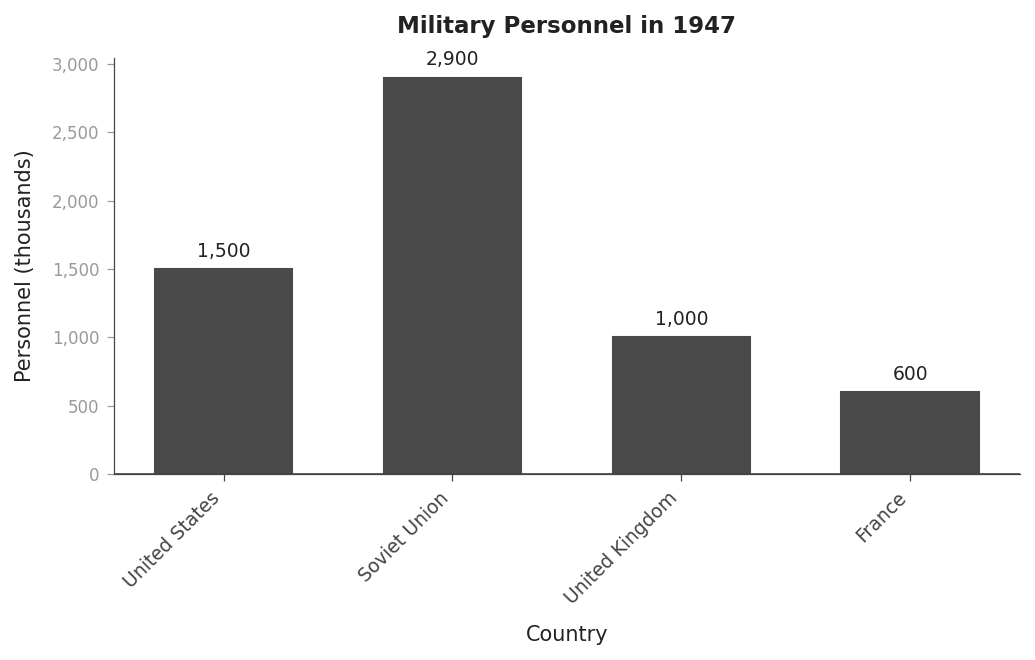
Source: Correlates of War Project
The large military forces shown for the United States and the Soviet Union were primarily made possible by which development during World War II?
What You’re Being Tested On:
Explore the learning objectives taken directly from the College Board’s AP® World History: Modern Curriculum. Ensure you’re prepared for the exact topics covered on the AP® exam, in-class tests, and quizzes, and gain confidence in your mastery of the material.
Unit 8: Cold War and Decolonization
This unit explores the geopolitical rivalry between the U.S. and Soviet Union during the Cold War and the global wave of decolonization after World War II. It highlights ideological conflicts, independence movements, and the emergence of new nations.

Topic 8.1: Setting the Stage for the Cold War and Decolonization
Thematic Focus: GovernanceGOV
A variety of internal and external factors contribute to state formation, expansion, and decline. Governments maintain order through a variety of administrative institutions, policies, and procedures, and governments obtain, retain, and exercise power in different ways and for different purposes.
Learning Objective: Unit 8: Learning Objective A
Explain the historical context of the Cold War after 1945.
Historical Developments: KC-6.2.II
Hopes for greater self-government were largely unfulfilled following World War I; however, in the years following World War II, increasing anti-imperialist sentiment contributed to the dissolution of empires and the restructuring of states.
Historical Developments: KC-6.2.IV.C.i
Technological and economic gains experienced during World War II by the victorious nations shifted the global balance of power.
Topic 8.2: The Cold War
Thematic Focus: Cultural Developments and InteractionsCDI
The development of ideas, beliefs, and religions illustrates how groups in society view themselves, and the interactions of societies and their beliefs often have political, social, and cultural implications.
Learning Objective: Unit 8: Learning Objective B
Explain the causes and effects of the ideological struggle of the Cold War.
Historical Developments: KC-6.2.IV.C.ii
The global balance of economic and political power shifted during and after World War II and rapidly evolved into the Cold War. The democracy of the United States and the authoritarian communist Soviet Union emerged as superpowers, which led to ideological conflict and a power struggle between capitalism and communism across the globe.
Historical Developments: KC-6.2.V.B
Groups and individuals, including the Non-Aligned Movement, opposed and promoted alternatives to the existing economic, political, and social orders.
Illustrative Examples specific knowledge students should know & demonstrate
- Sukarno in Indonesia
- Kwame Nkrumah in Ghana
Topic 8.3: Effects of the Cold War
Thematic Focus: GovernanceGOV
A variety of internal and external factors contribute to state formation, expansion, and decline. Governments maintain order through a variety of administrative institutions, policies, and procedures, and governments obtain, retain, and exercise power in different ways and for different purposes.
Learning Objective: Unit 8: Learning Objective C
Compare the ways in which the United States and the Soviet Union sought to maintain influence over the course of the Cold War.
Historical Developments: KC-6.2.IV.D
The Cold War produced new military alliances, including NATO and the Warsaw Pact, and led to nuclear proliferation and proxy wars between and within postcolonial states in Latin America, Africa, and Asia.
Illustrative Examples specific knowledge students should know & demonstrate
- Korean War
- Angolan Civil War
- Sandinista-Contras conflict in Nicaragua
Topic 8.4: Spread of Communism
Thematic Focus: Economic SystemsECN
As societies develop, they affect and are affected by the ways that they produce, exchange, and consume goods and services.
Learning Objective: Unit 8: Learning Objective D
Explain the causes and consequences of China's adoption of communism.
Historical Developments: KC-6.2.I.i
As a result of internal tension and Japanese aggression, Chinese communists seized power. These changes in China eventually led to communist revolution.
Historical Developments: KC-6.3.I.A.ii
In communist China, the government controlled the national economy through the Great Leap Forward, often implementing repressive policies, with negative repercussions for the population.
Thematic Focus: Social Interactions and OrganizationSIO
The process by which societies group their members and the norms that govern the interactions between these groups and between individuals influence political, economic, and cultural institutions and organization.
Learning Objective: Unit 8: Learning Objective E
Explain the causes and effects of movements to redistribute economic resources.
Historical Developments: KC-6.2.II.D.i
Movements to redistribute land and resources developed within states in Africa, Asia, and Latin America, sometimes advocating communism or socialism.
Illustrative Examples specific knowledge students should know & demonstrate
- Communist Revolution for Vietnamese independence
- Mengistu Haile Mariam in Ethiopia
- Land reform in Kerala and other states within India
- White Revolution in Iran
Topic 8.5: Decolonization
Thematic Focus: GovernanceGOV
A variety of internal and external factors contribute to state formation, expansion, and decline. Governments maintain order through a variety of administrative institutions, policies, and procedures, and governments obtain, retain, and exercise power in different ways and for different purposes.
Learning Objective: Unit 8: Learning Objective F
Compare the processes by which various peoples pursued independence after 1900.
Historical Developments: KC-6.2.II.A
Nationalist leaders and parties in Asia and Africa sought varying degrees of autonomy within or independence from imperial rule.
Historical Developments: KC-6.2.I.C
After the end of World War II, some colonies negotiated their independence, while others achieved independence through armed struggle.
Historical Developments: KC-6.2.II.B
Regional, religious, and ethnic movements challenged colonial rule and inherited imperial boundaries. Some of these movements advocated for autonomy.
Illustrative Examples specific knowledge students should know & demonstrate
- Indian National Congress
- Ho Chi Minh in French Indochina (Vietnam)
- Kwame Nkrumah in British Gold Coast (Ghana)
- Gamal Abdel Nasser in Egypt
- India from the British Empire
- The Gold Coast from the British Empire
- French West Africa
- Algeria from the French Empire
- Angola from the Portuguese Empire
- Vietnam from the French Empire
- Muslim League in British India
- Québécois separatist movement in Canada
- Biafra secessionist movement in Nigeria
Topic 8.6: Newly Independent States
Thematic Focus: GovernanceGOV
A variety of internal and external factors contribute to state formation, expansion, and decline. Governments maintain order through a variety of administrative institutions, policies, and procedures, and governments obtain, retain, and exercise power in different ways and for different purposes.
Learning Objective: Unit 8: Learning Objective G
Explain how political changes in the period from c. 1900 to the present led to territorial, demographic, and nationalist developments.
Historical Developments: KC-6.2.III.A.i
The redrawing of political boundaries after the withdrawal of former colonial authorities led to the creation of new states.
Historical Developments: KC-6.2.III.A.ii
The redrawing of political boundaries in some cases led to conflict as well as population displacement and/or resettlements, including those related to the Partition of India and the creation of the state of Israel.
Thematic Focus: Economic SystemsECN
As societies develop, they affect and are affected by the ways that they produce, exchange, and consume goods and services.
Learning Objective: Unit 8: Learning Objective H
Explain the economic changes and continuities resulting from the process of decolonization.
Historical Developments: KC-6.3.I.C
In newly independent states after World War II, governments often took on a strong role in guiding economic life to promote development.
Historical Developments: KC-6.2.III.B
The migration of former colonial subjects to imperial metropoles (the former colonizing country), usually in the major cities, maintained cultural and economic ties between the colony and the metropole even after the dissolution of empires.
Illustrative Examples specific knowledge students should know & demonstrate
- Israel
- Cambodia
- Pakistan
- Gamal Abdel Nasser’s promotion of economic development in Egypt
- Indira Gandhi’s economic policies in India
- Julius Nyerere’s modernization in Tanzania
- Sirimavo Bandaranaike’s economic policies in Sri Lanka
- South Asians to Britain
- Algerians to France
- Filipinos to the United States
Topic 8.7: Global Resistance to Established Power Structures After 1900
Thematic Focus: Cultural Developments and InteractionsCDI
The development of ideas, beliefs, and religions illustrates how groups in society view themselves, and the interactions of societies and their beliefs often have political, social, and cultural implications.
Learning Objective: Unit 8: Learning Objective I
Explain various reactions to existing power structures in the period after 1900.
Historical Developments: KC-6.2.V
Although conflict dominated much of the 20th century, many individuals and groups—including states—opposed this trend. Some individuals and groups, however, intensified the conflicts.
Historical Developments: KC-6.2.V.A
Groups and individuals challenged the many wars of the century, and some, such as Mohandas Gandhi, Martin Luther King Jr., and Nelson Mandela, promoted the practice of nonviolence as a way to bring about political change.
Historical Developments: KC-6.2.V.C
Militaries and militarized states often responded to the proliferation of conflicts in ways that further intensified conflict.
Historical Developments: KC-6.2.V.D
Some movements used violence against civilians in an effort to achieve political aims.
Illustrative Examples specific knowledge students should know & demonstrate
- Chile under Augusto Pinochet
- Spain under Francisco Franco
- Uganda under Idi Amin
- The buildup of the military–industrial complex and weapons trading
- Shining Path
- Al-Qaeda
Topic 8.8: End of the Cold War
Thematic Focus: GovernanceGOV
A variety of internal and external factors contribute to state formation, expansion, and decline. Governments maintain order through a variety of administrative institutions, policies, and procedures, and governments obtain, retain, and exercise power in different ways and for different purposes.
Learning Objective: Unit 8: Learning Objective J
Explain the causes of the end of the Cold War.
Historical Developments: KC-6.2.IV.E
Advances in U.S. military and technological development, the Soviet Union’s costly and ultimately failed invasion of Afghanistan, and public discontent and economic weakness in communist countries led to the end of the Cold War and the collapse of the Soviet Union.
Topic 8.9: Causation in the Age of the Cold War and Decolonization
Learning Objective: Unit 8: Learning Objective K
Explain the extent to which the effects of the Cold War were similar in the Eastern and Western Hemispheres.
Review: KC-6.2
Peoples and states around the world challenged the existing political and social order in varying ways, leading to unprecedented worldwide conflicts.
Review: KC-6.2.II
Hopes for greater self-government were largely unfulfilled following the World War I; however, in the years following the World War II, increasing anti- imperialist sentiment contributed to the dissolution of empires and the restructuring of states.
Review: KC-6.2.IV.C
The Cold War conflict extended beyond its basic ideological origins to have profound effects on economic, political, social, and cultural aspects of global events.
Review: KC-6.3
The role of the state in the domestic economy varied, and new institutions of global association emerged and continued to develop throughout the century.
Review: KC-6.3.I
States responded in a variety of ways to the economic challenges of the 20th century.
