AP®︎ World History: Topic 4.3 Practice Test
Prepare for your quiz, test, or the AP exam with focused practice questions on Topic 4.3 of AP World History – Columbian Exchange.
Questions List
Topic 4.3
Question 1 Easy
Cattle Recorded in Colonial Inventories, Hispaniola
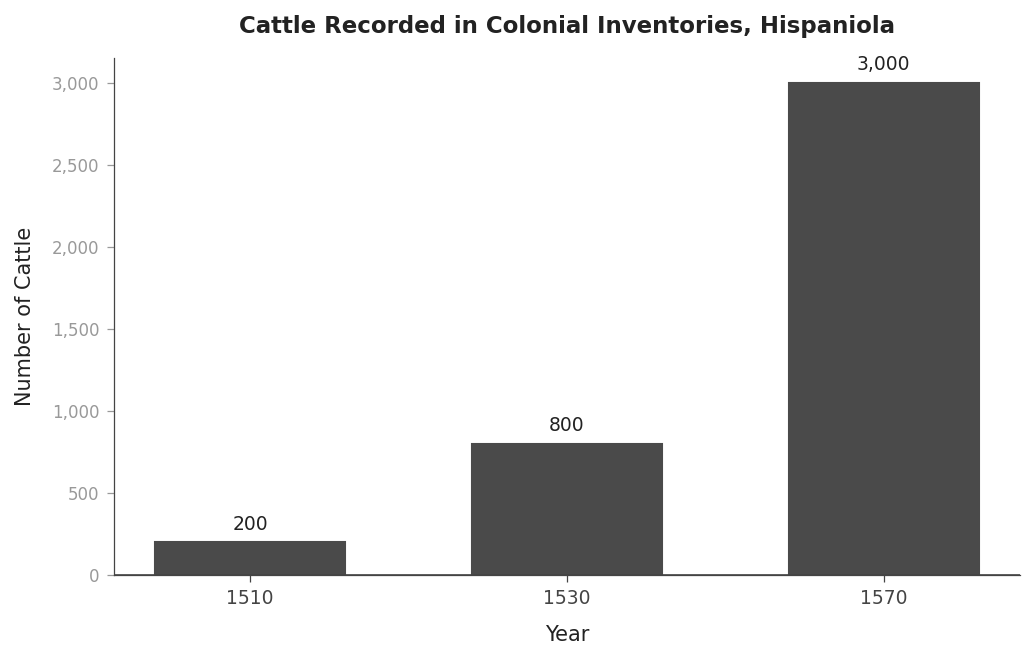
Adapted from historical estimates
The trend shown in the chart is best understood in the context of which development?
What You’re Being Tested On:
Explore the learning objectives taken directly from the College Board’s AP® World History: Modern Curriculum. Ensure you’re prepared for the exact topics covered on the AP® exam, in-class tests, and quizzes, and gain confidence in your mastery of the material.

Topic 4.3: Columbian Exchange
Thematic Focus: Humans and the EnvironmentsENV
The environment shapes human societies, and as populations grow and change, these populations in turn shape their environments.
Learning Objective: Unit 4: Learning Objective D
Explain the causes of the Columbian Exchange and its effects on the Eastern and Western Hemispheres.
Historical Developments: KC-4.1.V
The new connections between the Eastern and Western Hemispheres resulted in the exchange of new plants, animals, and diseases, known as the Columbian Exchange.
Historical Developments: KC-4.1.V.A
European colonization of the Americas led to the unintentional transfer of disease vectors, including mosquitoes and rats, and the spread of diseases that were endemic in the Eastern Hemisphere, including smallpox, measles, and malaria. Some of these diseases substantially reduced the indigenous populations, with catastrophic effects in many areas.
Historical Developments: KC-4.1.V.B
American foods became staple crops in various parts of Europe, Asia, and Africa. Cash crops were grown primarily on plantations with coerced labor and were exported mostly to Europe and the Middle East.
Historical Developments: KC-4.1.V.C
Afro-Eurasian fruit trees, grains, sugar, and domesticated animals were brought by Europeans to the Americas, while other foods were brought by African enslaved persons.
Historical Developments: KC-4.1.V.D
Populations in Afro-Eurasia benefitted nutritionally from the increased diversity of American food crops.
Illustrative Examples specific knowledge students should know & demonstrate
- Horses
- Pigs
- Cattle
- Okra
- Rice
