Topic 4.3 Notes – Columbian Exchange
What the Columbian Exchange Was and Why It Happened
The Columbian Exchange was the transfer of plants, animals, diseases, disease vectors, and people between the Americas and Afro-Eurasia after Columbus’s Spanish-sponsored voyage in 1492. One voyage started contact, but colonization made that contact continuous, and that is what turned a meeting into a long-term exchange.
Regular ocean crossings became possible because Europeans had better ships, stronger state support, and better knowledge of winds and currents. Once colonies were established, ships kept moving back and forth, carrying living things on purpose and by accident.
- Intentional transfers included crops, livestock, settlers, and enslaved Africans.
- Unintentional transfers included pathogens, rats, mosquitoes, insects, and weeds.
- The exam loves this point. The exchange was two-way, but its effects were not equal.
The causal chain
- Transoceanic contact
- Sustained colonization
- Biological transfer
- Epidemics and environmental change
- Plantation expansion
- Increased coerced labor
- Afro-Eurasian population growth from new crops
What Moved in Each Direction
A good way to hold this in your head is simple. Afro-Eurasia sent diseases and animals to the Americas. The Americas sent staple crops to Afro-Eurasia.
Afro-Eurasia to the Americas
- Diseases included smallpox, measles, and malaria. Indigenous peoples had little prior exposure, so epidemics spread fast.
- Disease vectors included mosquitoes and rats, which carried pathogens unintentionally.
- Crops and food plants included wheat and other grains, sugarcane, citrus, grapes, bananas, and plantains.
- Domesticated animals included horses, pigs, and cattle.
- Through forced migration, Africans also brought okra, rice, and rice-growing knowledge, especially valuable in rice cultivation.
Americas to Afro-Eurasia
- Staple crops included maize, potatoes, sweet potatoes, and cassava. These mattered most because they added major calories.
- Other important products included tomatoes, chili peppers, peanuts, cacao, and tobacco.
- Chili peppers are a great cultural diffusion example. They became common in African and Asian cuisines.
Effects on the Americas
The biggest effect was catastrophic Indigenous population decline. Disease was the main cause, especially because these populations had little previous exposure to Eurasian pathogens.
A standard example is smallpox in central Mexico in 1520, during the Spanish conquest of the Mexica. It weakened Tenochtitlan by killing people and disrupting food and leadership. Disease was not the only cause of depopulation. Warfare, famine, forced labor, and displacement also mattered. Broad epidemic spread was mostly unintentional, so don’t overstate deliberate germ warfare.
Depopulation disrupted:
- families and farming
- religion and leadership
- resistance to conquest
- labor supply in colonial economies
European plants and animals reshaped the land:
- Forests were cleared for wheat fields, ranches, and plantations.
- Horses changed transport, warfare, and hunting.
- Cattle created ranching economies and needed large grazing lands.
- Pigs reproduced quickly and damaged Indigenous fields.
- Invasive grasses and weeds altered ecosystems.
Sugar in the Caribbean and Brazil is the clearest plantation example. These cash crops were grown mainly for export. Monoculture and plantation agriculture depended on coerced labor, and Indigenous decline helped drive the importation of enslaved Africans. The map highlights how heavily the Caribbean and coastal Brazil became major disembarkation zones in the Atlantic slave trade.
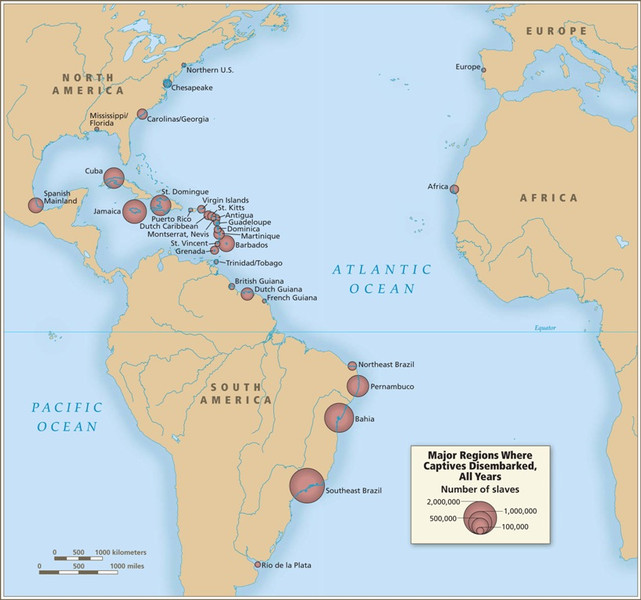
Major Atlantic slave disembarkation regions
Effects on Afro-Eurasia
Afro-Eurasia did not face demographic collapse. The main result was better nutrition and population growth.
American crops mattered because they often had:
- high yields
- ability to grow in poor soils or marginal lands
- power to reduce dependence on one staple harvest
Regional examples you should know:
- Potatoes in Europe
- Maize and cassava in Africa
- Sweet potatoes and maize in China, especially in upland areas
Not all crops did the same job. Maize, potatoes, cassava, and sweet potatoes were staple foods. Tobacco and cacao were commercial goods. Cuisine also changed over time as tomatoes and chili peppers entered many regional diets.
The Big Comparison and How to Read It on a Test
Here’s the core comparison. The East sent diseases and animals that devastated and transformed the Americas. The West sent crops that improved diets and supported growth in Afro-Eurasia. That asymmetry matters more than memorizing random lists.
Agriculture still stayed the base of most economies. What changed was the crops available, how land was used, and how labor was organized.
The Florentine Codex, compiled by Bernardino de Sahagún with Nahua informants, gives evidence for smallpox’s social disruption in Mexico. On maps, arrows show two-way transfer, but the outcomes were not equally important on both sides.
Key Takeaways
Columbian Exchange
Post-1492 transfer of plants, animals, diseases, vectors, and people between the Americas and Afro-Eurasia, causing Indigenous depopulation, ecological change, and expanded Afro-Eurasian food supplies
Christopher Columbus
Navigator whose Spanish-sponsored 1492 voyage began sustained contact between the Americas and Afro-Eurasia, initiating the Columbian Exchange
Endemic Disease
A disease regularly present in a population or region; long exposure gave Afro-Eurasian populations more resistance than Indigenous Americans had
Disease Vector
An organism that carries and transmits pathogens, such as mosquitoes spreading malaria or rats and their parasites transporting disease
Indigenous American Depopulation
Catastrophic post-contact population decline caused primarily by smallpox, measles, malaria, and other diseases, with warfare, forced labor, famine, and displacement worsening mortality
Staple Crop
A crop supplying a major share of ordinary calories; American maize, potatoes, sweet potatoes, and cassava diversified Afro-Eurasian diets and supported population growth
Cash Crop
A crop grown mainly for sale rather than subsistence; sugar and tobacco were produced on American plantations for export to Europe and the Middle East
Plantation Agriculture
Large-scale, export-oriented farming that commonly used monoculture and coerced labor, especially for labor-intensive sugar production
Coerced Labor
Work compelled by force; Indigenous population decline and expanding cash-crop plantations intensified colonial demand for forced workers, including enslaved Africans
Smallpox Epidemic of 1520
Outbreak in central Mexico that killed or incapacitated many Mexica, causing hunger and disruption and weakening them during the Spanish conquest
Notes
Columbian Exchange
Post-1492 transfer of plants, animals, diseases, vectors, and people between the Americas and Afro-Eurasia, causing Indigenous depopulation, ecological change, and expanded Afro-Eurasian food supplies
Christopher Columbus
Navigator whose Spanish-sponsored 1492 voyage began sustained contact between the Americas and Afro-Eurasia, initiating the Columbian Exchange
Endemic Disease
A disease regularly present in a population or region; long exposure gave Afro-Eurasian populations more resistance than Indigenous Americans had
Disease Vector
An organism that carries and transmits pathogens, such as mosquitoes spreading malaria or rats and their parasites transporting disease
Indigenous American Depopulation
Catastrophic post-contact population decline caused primarily by smallpox, measles, malaria, and other diseases, with warfare, forced labor, famine, and displacement worsening mortality
Staple Crop
A crop supplying a major share of ordinary calories; American maize, potatoes, sweet potatoes, and cassava diversified Afro-Eurasian diets and supported population growth
Cash Crop
A crop grown mainly for sale rather than subsistence; sugar and tobacco were produced on American plantations for export to Europe and the Middle East
Plantation Agriculture
Large-scale, export-oriented farming that commonly used monoculture and coerced labor, especially for labor-intensive sugar production
Coerced Labor
Work compelled by force; Indigenous population decline and expanding cash-crop plantations intensified colonial demand for forced workers, including enslaved Africans
Smallpox Epidemic of 1520
Outbreak in central Mexico that killed or incapacitated many Mexica, causing hunger and disruption and weakening them during the Spanish conquest
