Topic 9.5 Notes – Calls for Reform and Responses After 1900
How Rights-Based Reform Challenged Social Hierarchies After 1900
Rights-based discourse means people framed inequality as something unjust and changeable. That shift mattered because after the world wars, decolonization, mass media, rising literacy, and globalization, reformers could reach bigger audiences and organize across borders.
The main hierarchies under attack were:
- Race through civil-rights and anti-apartheid struggles
- Class through movements demanding protection for workers and the poor
- Gender through feminism and suffrage campaigns
- Caste through antidiscrimination and reservation policies in India
- Religion when people demanded equal treatment and freedom of belief
Common claims kept repeating across regions:
- equality before the law
- voting rights and public office
- access to schools and professions
- freedom from discrimination
- protections for women, children, refugees, and displaced people
A key distinction shows up a lot on tests. Formal equality means the law says everyone is equal. Substantive equality means governments take extra steps to fix the results of past exclusion. India’s reservation system is the clearest example.
Major Rights-Based Movements and Ideas
The U.N. Universal Declaration of Human Rights
The UDHR was adopted in 1948 after World War II and the Holocaust. Eleanor Roosevelt helped lead the UN commission that drafted it.
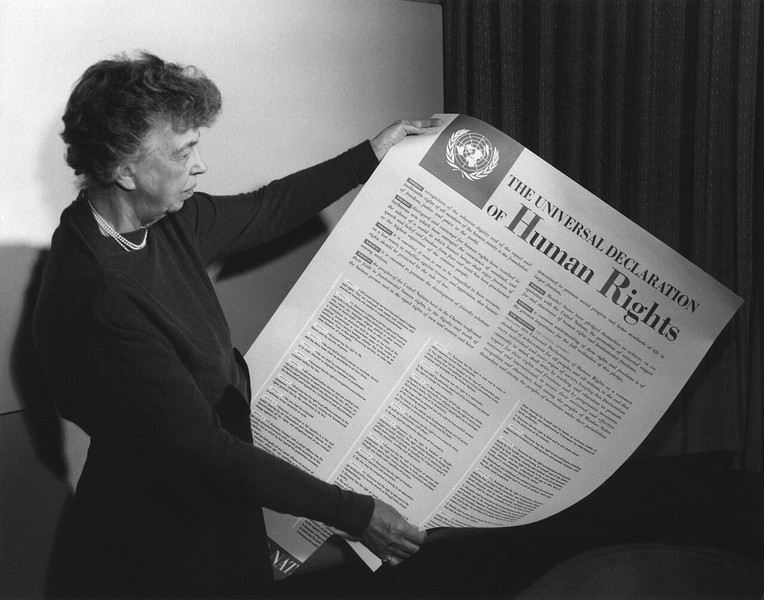
Eleanor Roosevelt with the Universal Declaration of Human Rights
It declared universal rights such as legal equality, freedom of religion and expression, education, work, and political participation. It was especially important for women, children, refugees, and displaced persons. Its weakness was enforcement. It set a global standard, but the UN could not simply force states to obey.
Global feminism movements
Feminism challenged women’s exclusion from politics, education, professions, and family law, and pushed for protection from violence.
Suffrage examples you need to know:
- United States 1920
- Brazil 1932
- Turkey 1934
- Japan 1945
- India 1947
- Morocco 1963
Female literacy rose in much of the world, and more women entered higher education. Still, legal rights did not erase underrepresentation or unequal expectations at home and work.
Negritude movement
Aimé Césaire, Léopold Sédar Senghor, and Léon-Gontran Damas challenged French colonial racism and the idea that Black people should assimilate into French culture. Negritude celebrated Black identity and African culture. That made culture itself a form of political resistance.
Liberation theology in Latin America
Gustavo Gutiérrez, A Theology of Liberation, and the Medellín conference connected Christianity to social justice. The phrase “preferential option for the poor” meant the church should side with the poor against exploitation, not just offer charity. This challenged class inequality and the church’s traditional closeness to elites.
How States Expanded Inclusion in Politics, Education, and Public Life
Governments responded through suffrage, antidiscrimination laws, expanded schooling, access to professions, and affirmative action.
- U.S. civil-rights movement fought Jim Crow through boycotts, sit-ins, marches, voter-registration drives, and nonviolent protest. Know Martin Luther King Jr., Brown v. Board of Education, and the Montgomery Bus Boycott. Also keep the laws straight. Civil Rights Act of 1964 attacked discrimination. Voting Rights Act of 1965 protected voting.
- South Africa ended apartheid, the post-1948 system of legal racial segregation and white-minority rule. Resistance included the African National Congress, international sanctions, and Nelson Mandela. F. W. de Klerk negotiated the transition, Mandela was released, and universal suffrage came in 1994. Huge inequalities remained.
- India abolished untouchability in its constitution and banned caste discrimination. It also created reservations for Scheduled Castes, Scheduled Tribes, and later Other Backward Classes in legislatures, schools, and government jobs. That is substantive equality in action.
Environmental and Economic Justice Movements
These movements argued that globalization spread benefits unevenly and pushed environmental damage and labor abuse onto poorer communities.
- Greenpeace began in 1971 protesting U.S. nuclear testing at Amchitka. It used direct action and media attention to fight whaling, toxic waste, deforestation, climate threats, and ocean damage.
- Wangari Maathai’s Green Belt Movement in Kenya, founded in 1977, organized tree planting and rural women’s leadership to fight deforestation, erosion, and fuel and water insecurity. It also linked environmental protection to democracy under Daniel arap Moi.
- World Fair Trade tried to reform trade, not end it. Through networks like the World Fair Trade Organization, it pushed fairer prices, safer labor conditions, less child and forced labor, and sustainable production for goods like coffee, cocoa, tea, bananas, textiles, and handicrafts.
Responses, Limits, and Big Patterns
States and institutions responded with reform, delay, repression, or partial enforcement. That is the core pattern.
The biggest continuity is simple. Rights on paper did not always become rights in practice. Prejudice, unequal wealth, violence, weak enforcement, underrepresentation, and institutional discrimination kept old hierarchies alive.
Key Takeaways
Rights-Based Discourse
Language presenting equality, protection, or opportunity as an enforceable right rather than charity granted by those in power
Formal Equality vs. Substantive Equality
Formal equality applies the same rules to everyone; substantive equality uses targeted remedies to overcome the continuing effects of past exclusion
Universal Declaration of Human Rights (UDHR)
Nonbinding UN declaration adopted in 1948 that proclaimed universal civil, political, social, and economic rights and supplied reformers with a global rights vocabulary
Eleanor Roosevelt
Chaired the United Nations commission responsible for preparing the Universal Declaration of Human Rights
Global Feminism
Diverse movements challenging gender inequality in voting, education, employment, property, family law, health, and protection from violence
Negritude
1930s Francophone Black literary and political movement affirming African culture and Black identity while rejecting colonial racism and assimilation
Aimé Césaire
Martinican writer and major Negritude figure who affirmed Black identity and criticized colonialism and cultural assimilation
Léopold Sédar Senghor
Senegalese Negritude leader who promoted Black cultural affirmation and later became independent Senegal’s first president in 1960
Léon-Gontran Damas
Writer from French Guiana and major Negritude figure who condemned colonial racism, assimilation, and the alienation they produced
Liberation Theology
Latin American Christian movement that treated poverty as structural injustice and called for active social reform and a preferential option for the poor
Gustavo Gutiérrez
Peruvian theologian who helped define liberation theology, especially through his 1971 work A Theology of Liberation
United States Civil Rights Movement
Movement using litigation, boycotts, sit-ins, freedom rides, marches, and nonviolent protest to challenge Jim Crow segregation and racial discrimination
Jim Crow
System of laws and customs enforcing racial segregation and Black political exclusion, especially in the southern United States
Civil Rights Act of 1964
US law banning discrimination in public accommodations and employment and strengthening federal action against school segregation
Voting Rights Act of 1965
US law attacking racial discrimination in voting, including literacy tests and other devices used to disfranchise Black citizens
Apartheid
South Africa’s post-1948 system of legal racial classification, segregation, movement restrictions, and white-minority political rule, dismantled before the 1994 democratic election
African National Congress (ANC)
Major South African organization in the resistance to apartheid that won the country’s first universal-suffrage election in 1994
Nelson Mandela
Imprisoned from 1962 to 1990, he became the best-known symbol of the anti-apartheid struggle and South Africa’s president in 1994
F. W. de Klerk
South African president who began negotiations in 1990 by unbanning opposition organizations, releasing Mandela, and dismantling apartheid laws
India’s Reservation Policies
Affirmative-action policies reserving places in legislatures, public employment, and education for Scheduled Castes, Scheduled Tribes, and other disadvantaged groups
Greenpeace
Transnational environmental organization founded in 1971 that uses direct action, media campaigns, and advocacy against nuclear testing, pollution, deforestation, and other harms
Wangari Maathai
Kenyan activist who founded the Green Belt Movement in 1977, linked environmental restoration to women’s empowerment and democracy, and won the 2004 Nobel Peace Prize
Green Belt Movement
Kenyan movement founded in 1977 that organized rural women to plant trees, restore resources, strengthen livelihoods, and oppose government abuses
Fair Trade Movement
Movement seeking fairer international exchange through better producer prices, acceptable labor conditions, sustainable production, cooperatives, and consumer certification
Women’s Suffrage
Women gained the right to vote and/or hold office at different times, including in the United States (1920), Brazil (1932), Turkey (1934), Japan (1945), India (1947), and Morocco (1963)
Affirmative Action
Policies directing opportunities toward historically excluded groups to address the continuing effects of past discrimination
Untouchability
Exclusionary caste practices directed against communities historically placed outside or at the bottom of India’s caste hierarchy, constitutionally abolished in 1950
Notes
Rights-Based Discourse
Language presenting equality, protection, or opportunity as an enforceable right rather than charity granted by those in power
Formal Equality vs. Substantive Equality
Formal equality applies the same rules to everyone; substantive equality uses targeted remedies to overcome the continuing effects of past exclusion
Universal Declaration of Human Rights (UDHR)
Nonbinding UN declaration adopted in 1948 that proclaimed universal civil, political, social, and economic rights and supplied reformers with a global rights vocabulary
Eleanor Roosevelt
Chaired the United Nations commission responsible for preparing the Universal Declaration of Human Rights
Global Feminism
Diverse movements challenging gender inequality in voting, education, employment, property, family law, health, and protection from violence
Negritude
1930s Francophone Black literary and political movement affirming African culture and Black identity while rejecting colonial racism and assimilation
Aimé Césaire
Martinican writer and major Negritude figure who affirmed Black identity and criticized colonialism and cultural assimilation
Léopold Sédar Senghor
Senegalese Negritude leader who promoted Black cultural affirmation and later became independent Senegal’s first president in 1960
Léon-Gontran Damas
Writer from French Guiana and major Negritude figure who condemned colonial racism, assimilation, and the alienation they produced
Liberation Theology
Latin American Christian movement that treated poverty as structural injustice and called for active social reform and a preferential option for the poor
Gustavo Gutiérrez
Peruvian theologian who helped define liberation theology, especially through his 1971 work A Theology of Liberation
United States Civil Rights Movement
Movement using litigation, boycotts, sit-ins, freedom rides, marches, and nonviolent protest to challenge Jim Crow segregation and racial discrimination
Jim Crow
System of laws and customs enforcing racial segregation and Black political exclusion, especially in the southern United States
Civil Rights Act of 1964
US law banning discrimination in public accommodations and employment and strengthening federal action against school segregation
Voting Rights Act of 1965
US law attacking racial discrimination in voting, including literacy tests and other devices used to disfranchise Black citizens
Apartheid
South Africa’s post-1948 system of legal racial classification, segregation, movement restrictions, and white-minority political rule, dismantled before the 1994 democratic election
African National Congress (ANC)
Major South African organization in the resistance to apartheid that won the country’s first universal-suffrage election in 1994
Nelson Mandela
Imprisoned from 1962 to 1990, he became the best-known symbol of the anti-apartheid struggle and South Africa’s president in 1994
F. W. de Klerk
South African president who began negotiations in 1990 by unbanning opposition organizations, releasing Mandela, and dismantling apartheid laws
India’s Reservation Policies
Affirmative-action policies reserving places in legislatures, public employment, and education for Scheduled Castes, Scheduled Tribes, and other disadvantaged groups
Greenpeace
Transnational environmental organization founded in 1971 that uses direct action, media campaigns, and advocacy against nuclear testing, pollution, deforestation, and other harms
Wangari Maathai
Kenyan activist who founded the Green Belt Movement in 1977, linked environmental restoration to women’s empowerment and democracy, and won the 2004 Nobel Peace Prize
Green Belt Movement
Kenyan movement founded in 1977 that organized rural women to plant trees, restore resources, strengthen livelihoods, and oppose government abuses
Fair Trade Movement
Movement seeking fairer international exchange through better producer prices, acceptable labor conditions, sustainable production, cooperatives, and consumer certification
Women’s Suffrage
Women gained the right to vote and/or hold office at different times, including in the United States (1920), Brazil (1932), Turkey (1934), Japan (1945), India (1947), and Morocco (1963)
Affirmative Action
Policies directing opportunities toward historically excluded groups to address the continuing effects of past discrimination
Untouchability
Exclusionary caste practices directed against communities historically placed outside or at the bottom of India’s caste hierarchy, constitutionally abolished in 1950
