Topic 1.6 Notes – Developments in Europe from c. 1200 to c. 1450
How Europe Was Organized from 1200 to 1450
Europe looked very different from big centralized empires like Song China. Most rulers did not have strong bureaucracies, standing armies, or one uniform legal system. Power was scattered.
- Europe was divided among kingdoms, duchies, bishoprics, city-states, and local lordships.
- Authority overlapped. A king, a noble, a bishop, a monastery, a town council, and a guild might all claim power in the same region.
- The broad pattern was Christian, decentralized, agricultural.
- The key connection is this: religion, landholding, and political power reinforced each other. The people who controlled land often held political power, and the Church was one of the biggest landholders of all.
How Religion Shaped European Society
Christianity gave Europe a shared culture, even though it was split between Roman Catholicism in western Europe and Eastern Orthodoxy in the Byzantine world and eastern Europe.
The Catholic Church
The Church reached into daily life more than any government did.
- Pope, bishops, priests, monasteries, convents, friars formed a hierarchy that connected villages to Rome.
- Sacraments like baptism, marriage, confession, and the Eucharist shaped major moments in life.
- The liturgical calendar organized time through Sundays, Lent, Easter, Christmas, and saints’ days.
- In a low-literacy society, the Church also ran charity, hospitals, education, and recordkeeping.
- Universities such as Paris, Oxford, and Bologna grew from religious institutions.
- Thomas Aquinas used scholasticism to reconcile Christian teaching with Aristotle.
- Franciscans stressed poverty and preaching. Dominicans stressed preaching and education.
- Gothic cathedrals showed Church wealth and taught the faith visually through stained glass, sculpture, and architectural features like flying buttresses.
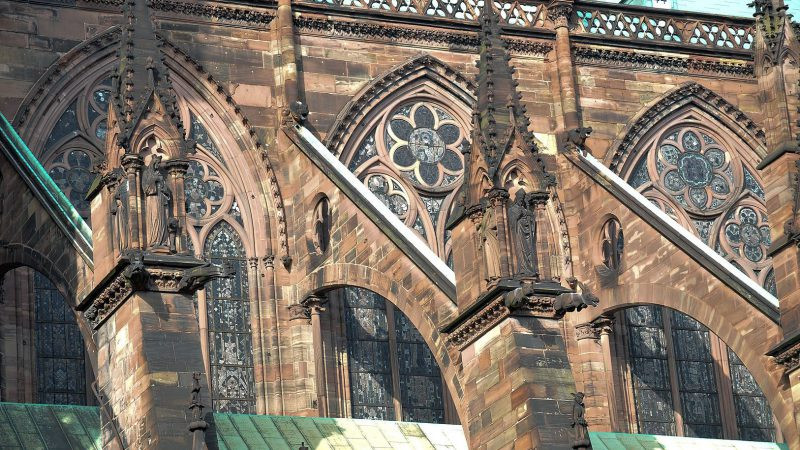
Gothic cathedral architecture
The Church as a political power
The Church did not just advise rulers. It could pressure them.
- It owned land, collected the tithe, and ran canon law courts.
- Clergy often served as royal advisers because they were literate.
- Excommunication could cut off a ruler from the sacraments. An interdict could suspend religious services in a whole region.
- The Crusades showed the pope could mobilize warfare across borders.
- On the test, remember this phrasing: the Church supported rulers but also limited them.
Judaism and Islam in Europe
Europe was mostly Christian, but it was not religiously uniform.
- Jewish communities kept a distinct identity and contributed to trade, medicine, scholarship, and finance. They also faced persecution, including expulsion from England in 1290 and scapegoating during the Black Death.
- Islam remained important in Iberia, especially al-Andalus and later Granada.
- The Christian victory at Las Navas de Tolosa in 1212 sped up the Reconquista.
- Toledo became a major translation center for Greek and Islamic learning.
- The Alhambra in Granada is a key example of Islamic culture in Europe.
How Political Decentralization Worked
Political fragmentation came from weak post-Roman institutions, slow communication, land-based wealth, and kings depending on nobles for soldiers and administration.
Feudalism
Feudalism means elite political and military ties.
- A lord granted a fief to a vassal in exchange for loyalty, military service, and counsel.
- These were personal ties, and nobles often had overlapping loyalties, which made politics unstable.
- Easy exam trap: feudalism = elite obligations. Manorialism = rural economy.
Decentralized monarchies
| Region | Example | What it shows |
|---|---|---|
| England | Magna Carta (1215), Parliament | kings had to negotiate, especially over taxes |
| France | Capetians, Hundred Years’ War | monarchy slowly grew stronger through war and taxation |
| Holy Roman Empire | Golden Bull (1356) | princes and electors kept major autonomy |
| Italy | Venice, Genoa, Florence, Milan | city-states added to fragmentation |
Decentralization meant frequent local warfare and different laws from place to place. It also helped create parliaments, town councils, and local privileges.
How Agriculture Organized Society
Most people lived on the land, so agriculture shaped the whole social order.
Manorialism
A manor was the basic rural unit.
- It included the lord’s demesne, peasant strips, commons, village, church, and mill.
- The manor court enforced local customs and obligations.
- Lords had both economic and judicial authority.
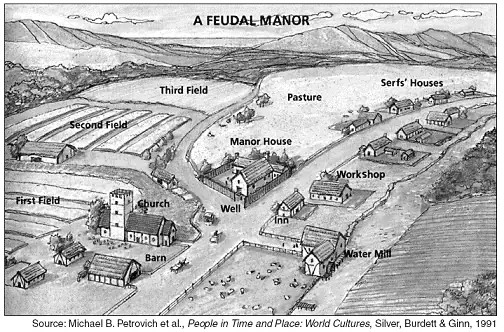
Medieval manor
Social structure and labor
- The three estates were those who pray, those who fight, and those who work.
- Europe used both free and coerced labor, especially serfdom.
- Serfs were bound to the land and owed labor, rent, and fees, but they were not slaves.
- Peasant households were the core of production, and women’s labor was essential.
Agricultural methods and growth
- The heavy plow, horse collar, watermills, and windmills improved production.
- The image also shows the three-field system, with land divided into first, second, and third fields to help increase output in some regions.
- More food supported population growth, towns, and markets.
- Guilds organized urban crafts, and “town air makes free” reflects weakening manorial control in some places.
Crisis and Change in the 1300s
The whole system was vulnerable to disaster.
- The Great Famine (1315 to 1317) exposed how fragile an agricultural society could be.
- The Black Death (1347 to 1351) killed about one-third to one-half of the population in many places.
- Labor shortages let peasants demand higher wages and lower obligations.
- Landlords often shifted from labor dues to cash rents or turned land into pasture.
- England’s Statute of Labourers (1351) tried to freeze wages.
- The Peasants’ Revolt (1381) showed the tension this created.
- In western Europe, serfdom often weakened, but this was uneven, not universal.
By 1450, some monarchs had grown stronger, but Europe was still mostly Christian, fragmented, and agricultural.
Key Takeaways
Latin Catholic Church
Pope-led western Christian institution that shaped worship, education, law, social life, landholding, and politics across European kingdoms
Sacraments
Christian rites associated with salvation, including baptism, marriage, confession, and the Eucharist
Tithe
A required contribution collected by the Church to support its religious, economic, and social functions
Canon Law
The Catholic Church’s legal system, administered through Church courts alongside secular jurisdictions
Crusades
Church-sanctioned military campaigns that joined religious aims to warfare in the eastern Mediterranean, Iberia, and the Baltic
Medieval Universities
Institutions such as Paris, Oxford, and Bologna that developed from religious schools and studied theology, law, medicine, and philosophy
Scholasticism
A method using reasoned argument, especially Aristotelian philosophy, to explain and reconcile Christian doctrine and philosophical learning
Thomas Aquinas
Thirteenth-century Dominican theologian who argued in the Summa Theologica that reason and Christian revelation could support one another
Gothic Cathedrals
Large churches using pointed arches, ribbed vaults, flying buttresses, tall interiors, and stained glass to express Christian teachings and institutional wealth
Franciscans
Religious order emphasizing poverty, preaching, and service among growing urban populations
Dominicans
Religious order emphasizing preaching and education, including efforts to oppose teachings considered heretical
Eastern Orthodox Christianity
Christian tradition influential in Byzantium and eastern Europe, associated with icons, local liturgies, the patriarch of Constantinople, and imperial involvement in religion
Judaism in Medieval Europe
Distinct monotheistic communities centered on the Torah, Talmud, Sabbath, and synagogues that contributed to trade and scholarship but faced restrictions, expulsions, and violence
Islam in Medieval Europe
Qur’an-based monotheistic religion present in Iberia, Sicily, and later the Balkans that influenced European rule, commerce, scholarship, agriculture, and architecture
Five Pillars of Islam
Profession of faith, prayer, charity, fasting during Ramadan, and pilgrimage to Mecca
Al-Andalus
Muslim-ruled Iberian territory that transmitted Islamic and Greek learning into Latin Europe while gradually losing land to Christian kingdoms
Political Decentralization
Distribution of authority among kings, nobles, clergy, towns, and local institutions rather than concentration in one sovereign government
Holy Roman Empire
Loosely organized central European realm whose princes, bishops, and free cities acknowledged an emperor while retaining substantial autonomy
Feudalism
Political and military system in which a lord granted a vassal a fief in return for homage, loyalty, counsel, and usually military service
Decentralized Monarchy
Monarchy in which a king claimed legitimate rule but depended on nobles, clergy, towns, and assemblies to govern, tax, and raise armies
Magna Carta
1215 charter forced on King John by English barons, affirming that the king was subject to law and certain obligations required consultation
English Parliament
Representative institution that developed from royal meetings with nobles and clergy to include county and town representatives, especially for taxation
Capetian Monarchy
French dynasty that gradually expanded direct royal territory, courts, and appointed administration while negotiating with local elites
Hundred Years’ War
Intermittent English-French war from 1337 to 1453 that exposed weaknesses in feudal levies and encouraged taxation, paid armies, and stronger administration
Golden Bull of 1356
Imperial decree formally giving seven leading electors the chief role in choosing the Holy Roman emperor
Italian City-States
Independent urban states such as Venice, Genoa, Florence, and Milan governed through competing merchants, guilds, aristocrats, councils, and rulers
Town Charters
Grants giving towns privileges such as self-government, markets, toll collection, or freedom from some manorial obligations
Manorial System (Manorialism)
Local economic and social system organizing an estate’s land, agricultural production, peasant obligations, and the lord’s judicial authority
Three Estates
Idealized social order of those who prayed, those who fought, and those who worked: clergy, nobles, and commoners
Serfdom
Legally restricted agricultural labor binding peasants to a lord’s estate and requiring labor, rent, crops, or fees; obligations could be inherited, but serfs retained customary household and land rights
Heavy Moldboard Plow
Heavy plow that made the dense soils of northern Europe easier to cultivate
Horse Collar
Improved harness that allowed horses to pull plows efficiently without choking, making them useful alternatives to slower oxen
Three-Field System
Crop rotation dividing land among autumn grain, a spring crop, and fallow, with each field changing use annually
Guilds
Urban associations that regulated crafts or commerce; craft training normally progressed from apprentice to journeyman to master
Great Famine of 1315–1317
Severe northern European food crisis caused by unusually wet and cold conditions, resulting in widespread hunger and mortality
Black Death
Plague reaching Europe in 1347 that killed a large share of the population, caused labor shortages, and weakened some rents and labor obligations
Statute of Labourers
English law of 1351 attempting to restrict wages and worker mobility after Black Death labor shortages
English Peasants’ Revolt
1381 uprising fueled by conflict over taxes, labor dues, and attempts to restrict workers after the Black Death
Excommunication
Church sanction excluding an individual from participation in the sacraments, potentially weakening the person’s legitimacy and political authority
Interdict
Church sanction suspending certain religious services within a ruler’s territory to pressure the ruler and subjects
Watermill
Machine using water power to grind grain and assist some manufacturing processes
Windmill
Machine using wind power to grind grain and assist some manufacturing processes
Notes
Latin Catholic Church
Pope-led western Christian institution that shaped worship, education, law, social life, landholding, and politics across European kingdoms
Sacraments
Christian rites associated with salvation, including baptism, marriage, confession, and the Eucharist
Tithe
A required contribution collected by the Church to support its religious, economic, and social functions
Canon Law
The Catholic Church’s legal system, administered through Church courts alongside secular jurisdictions
Crusades
Church-sanctioned military campaigns that joined religious aims to warfare in the eastern Mediterranean, Iberia, and the Baltic
Medieval Universities
Institutions such as Paris, Oxford, and Bologna that developed from religious schools and studied theology, law, medicine, and philosophy
Scholasticism
A method using reasoned argument, especially Aristotelian philosophy, to explain and reconcile Christian doctrine and philosophical learning
Thomas Aquinas
Thirteenth-century Dominican theologian who argued in the Summa Theologica that reason and Christian revelation could support one another
Gothic Cathedrals
Large churches using pointed arches, ribbed vaults, flying buttresses, tall interiors, and stained glass to express Christian teachings and institutional wealth
Franciscans
Religious order emphasizing poverty, preaching, and service among growing urban populations
Dominicans
Religious order emphasizing preaching and education, including efforts to oppose teachings considered heretical
Eastern Orthodox Christianity
Christian tradition influential in Byzantium and eastern Europe, associated with icons, local liturgies, the patriarch of Constantinople, and imperial involvement in religion
Judaism in Medieval Europe
Distinct monotheistic communities centered on the Torah, Talmud, Sabbath, and synagogues that contributed to trade and scholarship but faced restrictions, expulsions, and violence
Islam in Medieval Europe
Qur’an-based monotheistic religion present in Iberia, Sicily, and later the Balkans that influenced European rule, commerce, scholarship, agriculture, and architecture
Five Pillars of Islam
Profession of faith, prayer, charity, fasting during Ramadan, and pilgrimage to Mecca
Al-Andalus
Muslim-ruled Iberian territory that transmitted Islamic and Greek learning into Latin Europe while gradually losing land to Christian kingdoms
Political Decentralization
Distribution of authority among kings, nobles, clergy, towns, and local institutions rather than concentration in one sovereign government
Holy Roman Empire
Loosely organized central European realm whose princes, bishops, and free cities acknowledged an emperor while retaining substantial autonomy
Feudalism
Political and military system in which a lord granted a vassal a fief in return for homage, loyalty, counsel, and usually military service
Decentralized Monarchy
Monarchy in which a king claimed legitimate rule but depended on nobles, clergy, towns, and assemblies to govern, tax, and raise armies
Magna Carta
1215 charter forced on King John by English barons, affirming that the king was subject to law and certain obligations required consultation
English Parliament
Representative institution that developed from royal meetings with nobles and clergy to include county and town representatives, especially for taxation
Capetian Monarchy
French dynasty that gradually expanded direct royal territory, courts, and appointed administration while negotiating with local elites
Hundred Years’ War
Intermittent English-French war from 1337 to 1453 that exposed weaknesses in feudal levies and encouraged taxation, paid armies, and stronger administration
Golden Bull of 1356
Imperial decree formally giving seven leading electors the chief role in choosing the Holy Roman emperor
Italian City-States
Independent urban states such as Venice, Genoa, Florence, and Milan governed through competing merchants, guilds, aristocrats, councils, and rulers
Town Charters
Grants giving towns privileges such as self-government, markets, toll collection, or freedom from some manorial obligations
Manorial System (Manorialism)
Local economic and social system organizing an estate’s land, agricultural production, peasant obligations, and the lord’s judicial authority
Three Estates
Idealized social order of those who prayed, those who fought, and those who worked: clergy, nobles, and commoners
Serfdom
Legally restricted agricultural labor binding peasants to a lord’s estate and requiring labor, rent, crops, or fees; obligations could be inherited, but serfs retained customary household and land rights
Heavy Moldboard Plow
Heavy plow that made the dense soils of northern Europe easier to cultivate
Horse Collar
Improved harness that allowed horses to pull plows efficiently without choking, making them useful alternatives to slower oxen
Three-Field System
Crop rotation dividing land among autumn grain, a spring crop, and fallow, with each field changing use annually
Guilds
Urban associations that regulated crafts or commerce; craft training normally progressed from apprentice to journeyman to master
Great Famine of 1315–1317
Severe northern European food crisis caused by unusually wet and cold conditions, resulting in widespread hunger and mortality
Black Death
Plague reaching Europe in 1347 that killed a large share of the population, caused labor shortages, and weakened some rents and labor obligations
Statute of Labourers
English law of 1351 attempting to restrict wages and worker mobility after Black Death labor shortages
English Peasants’ Revolt
1381 uprising fueled by conflict over taxes, labor dues, and attempts to restrict workers after the Black Death
Excommunication
Church sanction excluding an individual from participation in the sacraments, potentially weakening the person’s legitimacy and political authority
Interdict
Church sanction suspending certain religious services within a ruler’s territory to pressure the ruler and subjects
Watermill
Machine using water power to grind grain and assist some manufacturing processes
Windmill
Machine using wind power to grind grain and assist some manufacturing processes
