Topic 6.4 Notes – Global Economic Development from 1750 to 1900
How Export Economies Fit into the Industrial Global Economy
An export economy produced a large share of goods for sale abroad instead of mainly for local use. This had existed before 1750, but now the system grew much faster and tighter because factories needed huge, steady supplies.
The chain you want in your head is:
- Industrialization increased demand for raw materials.
- Urbanization increased demand for food.
- Different environments could supply useful crops, animals, minerals, or fertilizer.
- Producers expanded extraction or commercial farming.
- Railroads, steamships, telegraphs, canals, and refrigeration linked those regions to global markets.
- Export earnings bought finished goods such as textiles, machinery, and metal products.
A few terms students mix up a lot:
- Commercial production means producing for sale.
- Natural resources are materials from the environment, like diamonds, rubber, or guano.
- Industrial crops are grown mainly to feed manufacturing, like cotton.
- Cash crops are grown for sale. Some are industrial crops, but food crops can be cash crops too.
- Finished goods are manufactured products ready to use or sell.
A common exam pattern is this. Many regions specialized in primary commodities while industrial states specialized in manufacturing. The profits also spread unevenly. Elites, merchants, states, and foreign investors often gained more than workers.
Why Particular Places Specialized in Particular Commodities
The environment shaped what a region could export. It did not automatically create an export economy.
Environmental factors
- Climate and growing season determined which crops could thrive.
- Soil fertility and water supply mattered for crops like cotton.
- Vegetation and animal ecology mattered for rubber trees, oil palms, and cattle.
- Grasslands supported ranching in places like the Pampas.
- Geological deposits made mining possible, as with diamonds.
- Ocean currents and coastal conditions created guano deposits.
- Rivers and ports made extraction and shipping easier.
Environment plus demand plus transport
A place only became a major exporter when the resource was profitable. That took global demand, labor, capital, and transportation.
- Railroads moved goods from inland areas to ports.
- Steamships made ocean shipping faster and more regular.
- The Suez Canal shortened routes after 1869.
- Telegraphs sped up price and shipping information.
- Refrigerated shipping made long-distance meat exports possible.
The map below helps you picture the bigger idea. Commodity exports depended on long-distance trade networks linking resource-producing regions to major markets and ports across the world.
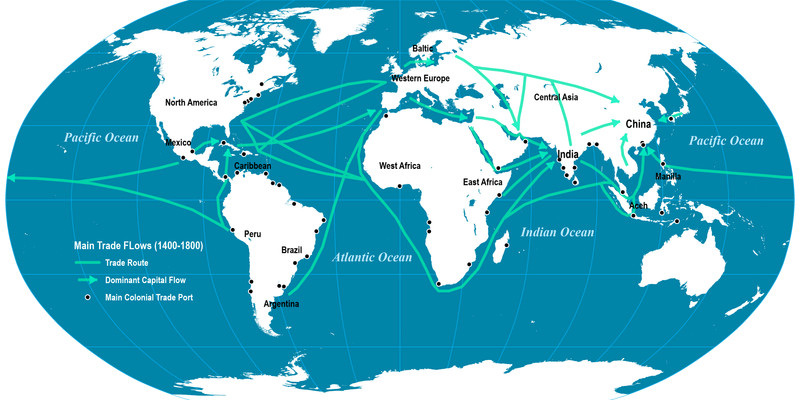
Global trade routes and ports
Major Commodity Export Examples
These examples all fit the same pattern, but each one shows a different environmental advantage.
- Egyptian cotton grew well in the fertile, irrigated Nile Valley. British and European textile mills created demand, and the American Civil War disrupted U.S. cotton, causing a boom in Egypt.
- Rubber in the Amazon and Congo came from humid tropical forests. It was used in waterproof goods, belts, hoses, insulation, and later tires. In the Congo Free State, King Leopold II enforced collection through extreme violence. This was often wild extraction, not plantation farming.
- West African palm oil came from oil palms in humid tropical regions. It had long been used locally, then industrial demand raised exports for soap, candles, and machine lubricant. This became part of so-called “legitimate commerce” after limits on the Atlantic slave trade.
- Guano from Peru and Chile came from seabird droppings used as fertilizer. The Humboldt Current, rich fish supply, huge seabird populations, and dry coast created dense deposits. Chinese contract laborers often worked under harsh conditions.
- Meat from Argentina and Uruguay depended on the grasslands of the Pampas and Uruguay. Railroads and refrigerated ships turned cattle raising into a major export feeding European cities.
- Diamonds in southern Africa came from geological deposits around Kimberley. Mining became capital-intensive and tightly controlled, and diamonds served luxury markets and industrial cutting.
What These Export Economies Changed
This system strengthened an international division of labor. Commodity-exporting regions sent out raw materials and food, then imported manufactured goods.
It also reshaped environments:
- irrigation expanded
- monoculture spread
- pastureland grew
- mines dug deeper
- forests were penetrated for rubber
- finite resources like guano were depleted
The system created serious vulnerabilities too:
- dependence on foreign demand
- price swings
- crop failure or exhaustion
- boom-and-bust cycles, like Egyptian cotton after the Civil War
One nuance AP likes in SAQs and essays is that these were not all colonies. Argentina, Uruguay, Peru, and Chile were independent states but still fit the same export pattern. This topic is mainly about environmental factors and global demand, though imperialism often overlapped with it.
Key Takeaways
Export Economy
An economy that directs a substantial share of production toward commodities sold outside the producing region
Economic Specialization
Concentration on producing one commodity or a limited group of commodities, increasing trade earnings but creating vulnerability to price and demand changes
Global Division of Labor
A system in which many regions exported raw materials and food while industrial centers manufactured and exported finished goods
Egyptian Cotton
Long-staple cotton grown with Nile soils and irrigation; exports boomed when the American Civil War disrupted U.S. supplies to European textile mills
Rubber in the Amazon and Congo Basins
Latex collected from wild plants in humid tropical forests for industrial goods; river access aided export while coercive labor was common
West African Palm Oil
A tropical plant product exported through existing African networks for European soap, candles, and machine lubrication
Guano in Peru and Chile
Nutrient-rich seabird deposits created by ecosystems supported by the Humboldt Current, preserved by coastal aridity, and exported as fertilizer
Meat Exports from Argentina and Uruguay
Cattle raised on the Pampas and Uruguayan grasslands and shipped to European cities after railroads and refrigeration enabled long-distance export
Southern African Diamonds
Diamonds mined around Kimberley after late-1860s discoveries, using concentrated capital and labor for luxury and industrial markets
Commercial Production
Production principally for sale rather than direct use by the producers
Subsistence Production
Production mainly for consumption by the households or communities producing it
Industrial Crop
A crop grown primarily as an input for manufacturing, such as cotton, palm oil, or rubber
Cash Crop
A crop produced for sale rather than primarily for the cultivator’s own consumption
Raw Materials
Natural materials supplied as inputs for industrial production
Finished Goods
Manufactured products that have completed industrial processing and are ready for use or sale
American Civil War
The 1861–1865 conflict that disrupted southern U.S. cotton exports and caused European textile mills to seek more Egyptian cotton
Humboldt Current
A cold, nutrient-rich Pacific current that supported the fish and seabird populations responsible for guano deposits along Peru and Chile
Notes
Export Economy
An economy that directs a substantial share of production toward commodities sold outside the producing region
Economic Specialization
Concentration on producing one commodity or a limited group of commodities, increasing trade earnings but creating vulnerability to price and demand changes
Global Division of Labor
A system in which many regions exported raw materials and food while industrial centers manufactured and exported finished goods
Egyptian Cotton
Long-staple cotton grown with Nile soils and irrigation; exports boomed when the American Civil War disrupted U.S. supplies to European textile mills
Rubber in the Amazon and Congo Basins
Latex collected from wild plants in humid tropical forests for industrial goods; river access aided export while coercive labor was common
West African Palm Oil
A tropical plant product exported through existing African networks for European soap, candles, and machine lubrication
Guano in Peru and Chile
Nutrient-rich seabird deposits created by ecosystems supported by the Humboldt Current, preserved by coastal aridity, and exported as fertilizer
Meat Exports from Argentina and Uruguay
Cattle raised on the Pampas and Uruguayan grasslands and shipped to European cities after railroads and refrigeration enabled long-distance export
Southern African Diamonds
Diamonds mined around Kimberley after late-1860s discoveries, using concentrated capital and labor for luxury and industrial markets
Commercial Production
Production principally for sale rather than direct use by the producers
Subsistence Production
Production mainly for consumption by the households or communities producing it
Industrial Crop
A crop grown primarily as an input for manufacturing, such as cotton, palm oil, or rubber
Cash Crop
A crop produced for sale rather than primarily for the cultivator’s own consumption
Raw Materials
Natural materials supplied as inputs for industrial production
Finished Goods
Manufactured products that have completed industrial processing and are ready for use or sale
American Civil War
The 1861–1865 conflict that disrupted southern U.S. cotton exports and caused European textile mills to seek more Egyptian cotton
Humboldt Current
A cold, nutrient-rich Pacific current that supported the fish and seabird populations responsible for guano deposits along Peru and Chile
