Topic 4.8 Notes – Continuity and Change from 1450 to 1750
What Changed and What Stayed the Same from 1450 to 1750
The biggest continuity was that agriculture still sat at the center of the economy. Most people were peasants, and most goods were still made by artisans, not factories.
Older trade networks also kept going:
- Indian Ocean trade still linked East Africa, the Middle East, South Asia, and Southeast Asia.
- Silk Roads still moved luxury goods over land across Asia.
- Trans-Saharan routes still connected West Africa to North Africa.
- The Mediterranean still mattered for exchange among Europe, North Africa, and the Middle East.
The huge change was sustained transoceanic contact between the Eastern and Western Hemispheres. Europe, Africa, Asia, and the Americas became tied into one circulation of goods, people, and diseases. This map captures that shift from older regional networks to an increasingly connected global system.
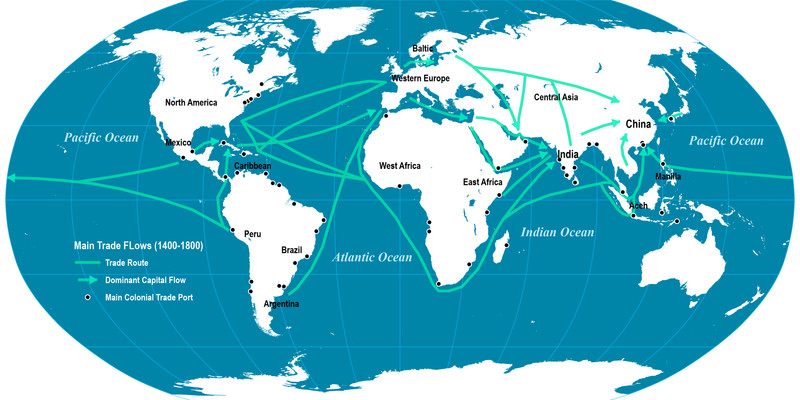
Main trade flows, 1400-1800
That happened because of cross-cultural diffusion of maritime knowledge:
- Compass helped navigation.
- Lateen sail let ships tack against the wind.
- Astronomical charts improved open-ocean travel.
- Caravel and carrack carried cargo farther and more safely.
- Better knowledge of winds and currents made routes repeatable.
The best overall claim is this: old systems stayed in place, but global trade intensified and reorganized them.
How Global Trade Reshaped Production and Exchange
The Atlantic and Pacific pulled the Americas into global commerce. The best example is silver.
American silver
- Potosí in present-day Bolivia, discovered in 1545, became one of the world’s richest silver mines.
- Manila, founded in 1571, linked Spanish America to Asian markets across the Pacific.
- Silver flowed to Europe, but a huge amount went to China, where demand was high because silver was needed for taxes and trade.
The map below traces those connections from Potosí across both the Atlantic and the Pacific.
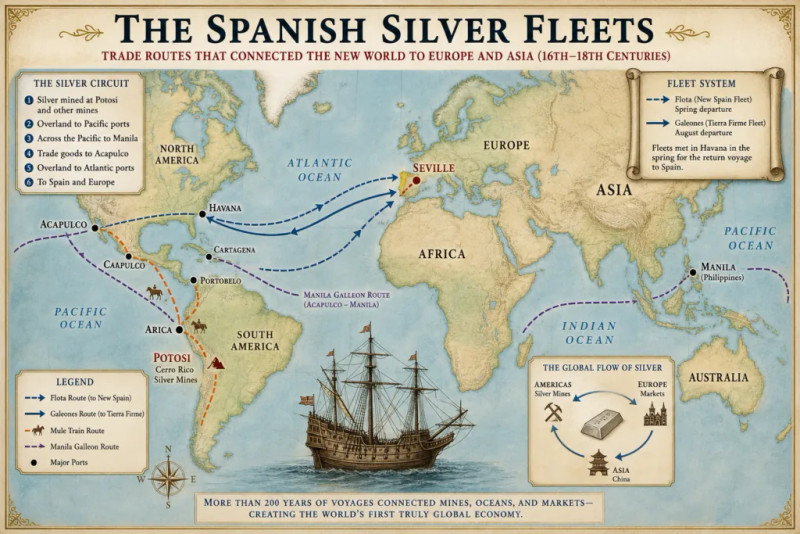
Spanish silver fleet routes
This is an AP favorite because one commodity connects labor in the Americas to markets in Europe and Asia.
Cash crops, mercantilism, and companies
Plantations expanded export agriculture:
- Sugar in Brazil and the Caribbean became the classic plantation crop.
- Tobacco also became important in Atlantic trade.
Mercantilism said colonies should enrich the mother country.
- Colonies supplied raw materials
- Colonies served as markets
- States tried to keep wealth inside the empire through regulation
Joint-stock companies helped make this work:
| Company | Why it mattered |
|---|---|
| Dutch East India Company | Investors pooled money, shared risk, had state backing, and built a trading empire |
| English East India Company | Could trade, fortify ports, and sometimes govern territory |
Europeans entered old trade systems, but they did not erase them. Gujarati, Arab, Swahili, Javanese, and Omani merchants stayed active, and intra-Asian trade remained strong.
Labor Systems That Expanded or Changed
Global demand increased labor needs in mining, plantations, and production. Some labor systems stayed old. Others grew harsher.
Peasants still farmed food and raw materials. Artisans still made valuable goods like Indian cotton textiles and Chinese silk.
In the Americas, coerced labor expanded:
- Mit’a was adapted by Spain from an Inca labor draft and used heavily in mining.
- Encomienda gave colonists rights to Indigenous labor or tribute.
- Hacienda used dependent labor on large estates.
- Indentured servitude brought workers, often Europeans, for a fixed term.
Slavery
Slavery already existed before 1450 in Africa and elsewhere. The major change was Atlantic chattel slavery.
- It grew on a much larger scale
- It focused on plantation labor
- It became racialized
- It became hereditary and permanent
- Millions of Africans were transported across the Atlantic
A map of Atlantic trade helps connect slavery to the wider exchange system.
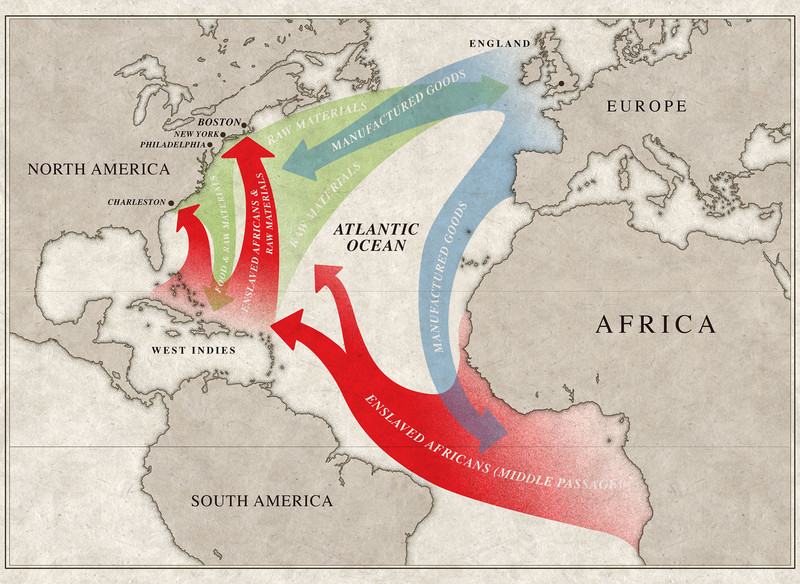
Atlantic triangular trade and the Middle Passage
Strong cause chain to remember: plantation demand → slave trade expansion → demographic and social change.
How Economic Change Altered Social Structures
Economic change reshaped populations and hierarchy.
- In the Americas, smallpox, measles, and malaria caused catastrophic Indigenous population decline. That weakened Indigenous societies and pushed colonizers to seek other labor sources.
- In Africa, the slave trade removed many young adults, disrupting households, farming, and age and sex ratios. In some places, women took on larger agricultural and household roles.
- In the Atlantic world, Africans, Indigenous peoples, and Europeans created blended cultures through syncretic religion, language, food, and music. African crops and knowledge, including rice and okra, shaped American societies.
New elites rose, but old elites did not disappear:
- In Europe, merchants and investors grew richer, but nobles still mattered.
- In Africa, some rulers and merchants profited, including Asante.
- In China, the Qing created a new Manchu ruling elite but kept the scholar-gentry bureaucracy.
Racialized hierarchy in the Americas
The Casta system ranked people by ancestry and birthplace. Paintings like the one below tried to sort colonial society into named racial categories.
- Peninsulares were born in Spain and ranked highest.
- Creoles were of European ancestry but born in the Americas.
- Mixed-race groups were ranked below them.
- Indigenous and African-descended peoples were usually at the bottom.
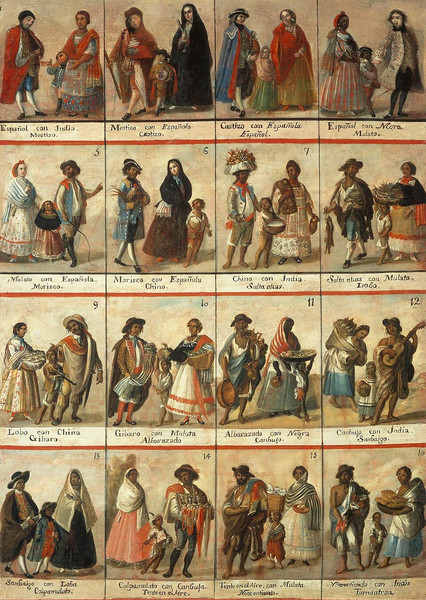
Spanish colonial casta painting
Hierarchy itself was old. The change was that race became much more central.
Why Trade Led to Rivalry and Conflict
Trade created wealth, and states fought over it. They competed for colonies, ports, shipping routes, and monopolies.
- In the seventeenth century, the Dutch attacked Portuguese trade positions in Africa and Asia.
- The Dutch gained major influence in the spice trade.
- Joint-stock companies were tied to state power and could build forts and wage war.
- Morocco’s invasion of Songhai in 1591 was tied to control of trans-Saharan trade and West African wealth.
Expanding trade connected the world more tightly, but it also sharpened imperial rivalry and interstate conflict.
