Topic 9.2 Notes – Technological Advances and Limitations After 1900: Disease
How Disease Patterns Changed After 1900
Disease did not disappear once modern medicine improved. What changed was the pattern of disease. Many people died less often from infections, lived longer, and then faced chronic illnesses that become more common with age.
A few terms have to stay clear in your head:
- Infectious disease means a disease caused by a transmissible pathogen.
- Chronic disease means a long-lasting disease, usually not spread person to person.
- Endemic means constantly present in a region.
- Epidemic means an outbreak above normal levels.
- Pandemic means an epidemic spread across many countries or continents.
- Incidence means new cases. Mortality means deaths.
The environment here means both nature and human-built conditions:
- Climate, standing water, and insect vectors like mosquitoes shape exposure.
- Crowding, weak ventilation, bad housing, and poor nutrition make people more vulnerable.
- Clean water, sewage systems, hospitals, transportation, and medicine access lower death rates.
Medical advances changed survival:
- Vaccines prevented many infections.
- Antibiotics treated bacterial disease.
- Sanitation and water treatment cut waterborne illness.
- Diagnostic testing and surveillance helped detect outbreaks faster.
- Insect control, oral rehydration therapy, and antiviral drugs saved lives too.
The catch is the main AP point. Technology existed, but poverty, war, weak states, unequal access, and pathogen resistance limited what it could do.
This broad shift is the epidemiological transition. Many societies moved from high infectious-disease mortality to longer life expectancy and more chronic disease, but richer regions usually made that transition earlier than poorer ones.
Diseases Associated with Poverty
These diseases lasted because prevention and treatment were unevenly available, not because people did not know what caused them.
Malaria
Malaria is caused by a parasite spread by infected Anopheles mosquitoes. It hit tropical sub-Saharan Africa especially hard, and also parts of South Asia.
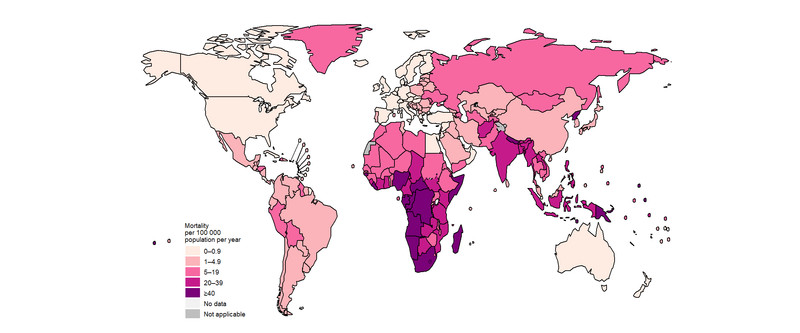
Global malaria mortality map
- Warm climates and standing water help mosquitoes breed.
- The map makes the pattern clear. The highest mortality is concentrated in tropical Africa, with smaller hotspots in South and Southeast Asia.
- Human choices matter too. Drainage, screened housing, bed nets, and mosquito control can reduce cases.
- Prevention and treatment included insecticide-treated nets, preventive drugs, antimalarial medicines, and later vaccines.
- It persisted because of cost, weak administration, and resistance in both parasites and mosquitoes.
Tuberculosis
Tuberculosis is a bacterial disease, usually in the lungs, spread through the air.
- It thrives in crowded, poorly ventilated places.
- Malnutrition and weak immune systems make infection worse.
- Antibiotics can cure TB, but treatment takes months and uses multiple drugs.
- Incomplete treatment helped create drug-resistant TB.
- It remained common in parts of Africa and Asia and was often linked with HIV.
Cholera
Cholera is a bacterial disease spread through contaminated water or food.
- It causes severe diarrhea and dehydration and can kill fast.
- It appears where sewage and drinking water mix, especially in refugee camps, disasters, or state breakdown.
- Treatment includes oral rehydration solution, IV fluids, some antibiotics, and vaccines.
- Cholera is the clearest proof that infrastructure matters.
Emergent Epidemic Diseases
Older diseases persisted, and new epidemic threats spread under modern conditions like war, travel, urbanization, and shifting social behavior.
The 1918 influenza pandemic
The 1918 flu spread globally at the end of World War I.
- Troop movement, ships, camps, crowded cities, and wartime malnutrition sped transmission.
- It was called Spanish flu because Spain reported openly during wartime censorship.
- It killed tens of millions, often estimated around 50 million.
- There was no vaccine, no antivirals, and no antibiotics for secondary infections.
- Responses included quarantine, masks, school closures, and bans on gatherings.
Its significance is huge. Global war and transportation could turn outbreak into pandemic very quickly.
HIV/AIDS
HIV attacks the immune system. Untreated HIV can develop into AIDS.
- It spreads through sexual contact, blood, shared needles, and mother-to-child transmission.
- Recognized in the early 1980s, it devastated sub-Saharan Africa especially.
- It lowered life expectancy, created orphan crises, reduced labor forces, and overwhelmed hospitals.
- Stigma and discrimination, especially against gay men and other groups, made the crisis worse.
- Responses included blood screening, testing, safer-sex education, sterile needles, and antiretroviral therapy.
- AIDS activism pushed governments and drug companies to speed research and expand access.
Ebola
Ebola spread by direct contact with bodily fluids, not through the air like influenza.
- First identified in 1976.
- The biggest outbreak came in 2014-2016 in Guinea, Liberia, and Sierra Leone.
- It exposed weak health systems, poor lab capacity, lack of PPE, and weak contact tracing.
- Control depended on isolation, safe burials, protective gear, contact tracing, and community trust.
- It helped speed vaccine and diagnostic development.
Diseases Associated with Increased Longevity
When more people survive childhood and infection, more people live long enough to develop age-related disease.
Heart disease
Heart disease became a leading cause of death in many wealthy societies, and later in many middle-income ones.
- Risk rises with age.
- Smoking, high blood pressure, diet, obesity, diabetes, and inactivity also matter.
- Survival improved with blood-pressure drugs, cholesterol drugs, surgery, and emergency care.
Alzheimer’s disease
Alzheimer’s disease causes progressive memory and reasoning loss and is strongly tied to old age.
- Rising cases reflect longer life expectancy more than simple medical failure.
- It created major needs for elder care, long-term caregiving, and family support.
- There is no cure comparable to antibiotics for bacterial disease.
Why This Topic Matters
This topic ties continuity and change together. Malaria, TB, and cholera persisted because inequality and weak infrastructure persisted. New epidemics spread faster in an interconnected world. Longer life expectancy then increased chronic and age-related disease.
Key Takeaways
Infectious Disease vs. Chronic Disease
Infectious diseases are caused by transmissible pathogens; chronic diseases persist over time and are generally nontransmissible
Epidemic vs. Pandemic vs. Endemic Disease
An epidemic exceeds expected disease levels in a population, a pandemic spreads across countries or continents, and an endemic disease remains consistently present in a region
Public Health
Population-level disease prevention through measures such as vaccination, sanitation, surveillance, mosquito control, isolation, contact tracing, and health education
Vaccines
Preventive technologies that train the immune system against particular diseases, reducing illness and mortality when widely accessible
Antibiotics
Medicines that treat bacterial infections and reduce mortality, although drug-resistant bacteria can limit their effectiveness
Sanitation
Safe-water treatment and the separation and disposal of sewage, which sharply reduce exposure to waterborne diseases such as cholera
Diseases Associated with Poverty
Diseases such as malaria, tuberculosis, and cholera that persist where crowding, malnutrition, unsafe water, weak infrastructure, and limited health-care access increase exposure and vulnerability
Malaria
A parasitic disease spread by infected Anopheles mosquitoes that persists especially in tropical, poorer regions lacking sustained mosquito control, prevention, and treatment
Tuberculosis (TB)
An airborne bacterial disease, usually of the lungs, encouraged by crowding and weakened immunity; long antibiotic treatment can cure it, but incomplete treatment promotes drug resistance
Cholera
A bacterial disease spread through food or water contaminated by human waste, causing deadly dehydration but preventable through sanitation and treatable with rapid fluid-and-salt replacement
Emergent Disease
A disease that is newly identified, newly introduced, or newly able to spread widely because of changes such as transportation, urbanization, warfare, or human-animal contact
1918 Influenza Pandemic (Spanish Flu)
A 1918–1919 global influenza pandemic spread by wartime movement and crowding that killed tens of millions and prompted quarantines, closures, surveillance, and further medical research
HIV/AIDS
HIV attacks the immune system and can progress to AIDS; its global pandemic caused severe mortality, stigma, and social disruption, especially in sub-Saharan Africa
Antiretroviral Therapy (ART)
Combination drug treatment that suppresses HIV and can make infection a manageable chronic condition, although unequal access produces unequal outcomes
Ebola Virus Disease
A severe disease spread through direct contact with infected bodily fluids; West African outbreaks caused social disruption and spurred improved diagnosis, protective practices, treatment, and vaccination
Diseases Associated with Increased Longevity
Chronic and degenerative diseases that become more common as medical and public-health advances allow more people to survive into old age
Heart Disease
Age-associated disorders of the heart and blood vessels that became leading causes of death as populations aged, with risk also shaped by smoking, diet, inactivity, obesity, and hypertension
Alzheimer’s Disease
A progressive disorder of memory, reasoning, behavior, and daily functioning whose prevalence rises sharply as more people survive into old age
Epidemiological Transition
The uneven shift from mortality dominated by infectious disease toward greater prevalence of chronic and age-related disease as sanitation, nutrition, medicine, and life expectancy improve
Double Burden of Disease
The simultaneous persistence of infectious diseases and rise of chronic diseases, especially in poorer societies undergoing an incomplete epidemiological transition
Drug Resistance
The survival and spread of pathogens resistant to medicines, limiting treatments for diseases such as tuberculosis and malaria
Notes
Infectious Disease vs. Chronic Disease
Infectious diseases are caused by transmissible pathogens; chronic diseases persist over time and are generally nontransmissible
Epidemic vs. Pandemic vs. Endemic Disease
An epidemic exceeds expected disease levels in a population, a pandemic spreads across countries or continents, and an endemic disease remains consistently present in a region
Public Health
Population-level disease prevention through measures such as vaccination, sanitation, surveillance, mosquito control, isolation, contact tracing, and health education
Vaccines
Preventive technologies that train the immune system against particular diseases, reducing illness and mortality when widely accessible
Antibiotics
Medicines that treat bacterial infections and reduce mortality, although drug-resistant bacteria can limit their effectiveness
Sanitation
Safe-water treatment and the separation and disposal of sewage, which sharply reduce exposure to waterborne diseases such as cholera
Diseases Associated with Poverty
Diseases such as malaria, tuberculosis, and cholera that persist where crowding, malnutrition, unsafe water, weak infrastructure, and limited health-care access increase exposure and vulnerability
Malaria
A parasitic disease spread by infected Anopheles mosquitoes that persists especially in tropical, poorer regions lacking sustained mosquito control, prevention, and treatment
Tuberculosis (TB)
An airborne bacterial disease, usually of the lungs, encouraged by crowding and weakened immunity; long antibiotic treatment can cure it, but incomplete treatment promotes drug resistance
Cholera
A bacterial disease spread through food or water contaminated by human waste, causing deadly dehydration but preventable through sanitation and treatable with rapid fluid-and-salt replacement
Emergent Disease
A disease that is newly identified, newly introduced, or newly able to spread widely because of changes such as transportation, urbanization, warfare, or human-animal contact
1918 Influenza Pandemic (Spanish Flu)
A 1918–1919 global influenza pandemic spread by wartime movement and crowding that killed tens of millions and prompted quarantines, closures, surveillance, and further medical research
HIV/AIDS
HIV attacks the immune system and can progress to AIDS; its global pandemic caused severe mortality, stigma, and social disruption, especially in sub-Saharan Africa
Antiretroviral Therapy (ART)
Combination drug treatment that suppresses HIV and can make infection a manageable chronic condition, although unequal access produces unequal outcomes
Ebola Virus Disease
A severe disease spread through direct contact with infected bodily fluids; West African outbreaks caused social disruption and spurred improved diagnosis, protective practices, treatment, and vaccination
Diseases Associated with Increased Longevity
Chronic and degenerative diseases that become more common as medical and public-health advances allow more people to survive into old age
Heart Disease
Age-associated disorders of the heart and blood vessels that became leading causes of death as populations aged, with risk also shaped by smoking, diet, inactivity, obesity, and hypertension
Alzheimer’s Disease
A progressive disorder of memory, reasoning, behavior, and daily functioning whose prevalence rises sharply as more people survive into old age
Epidemiological Transition
The uneven shift from mortality dominated by infectious disease toward greater prevalence of chronic and age-related disease as sanitation, nutrition, medicine, and life expectancy improve
Double Burden of Disease
The simultaneous persistence of infectious diseases and rise of chronic diseases, especially in poorer societies undergoing an incomplete epidemiological transition
Drug Resistance
The survival and spread of pathogens resistant to medicines, limiting treatments for diseases such as tuberculosis and malaria
