Topic 8.3 Notes – Effects of the Cold War
How the United States and the Soviet Union Maintained Influence
After World War II, Europe split into rival camps divided by the Iron Curtain, but the struggle quickly spread worldwide. The Cold War meant no direct full-scale U.S.-USSR war, yet both superpowers used pressure, money, weapons, and allies to expand their reach.
- The United States pushed containment. It wanted to stop communism from spreading, defend capitalism and liberal democracy, and protect strategic regions and trade.
- The Soviet Union defended socialism/communism, claimed to support anti-imperialist movements, and protected its security buffer in Eastern Europe after the devastation of WWII.
They often used the same tools:
- military alliances that tied other states to them
- troops and overseas bases that projected power far from home
- economic aid such as reconstruction money or development support
- weapons, training, and intelligence for allies or rebels
- propaganda that sold their system as the better way to live
- covert operations and intervention through client states
One of the most tested comparisons is this. Both sides talked ideology, but both often supported governments or movements for strategic reasons even when those clients did not fully match their values.
Rival Blocs and Military Alliances
A bloc was a group of states aligned politically, economically, and militarily with one superpower. These blocs made the Cold War feel permanent because local conflicts could pull in much larger powers.
The map below makes that division easy to see, with NATO countries in blue and the Soviet sphere in red.
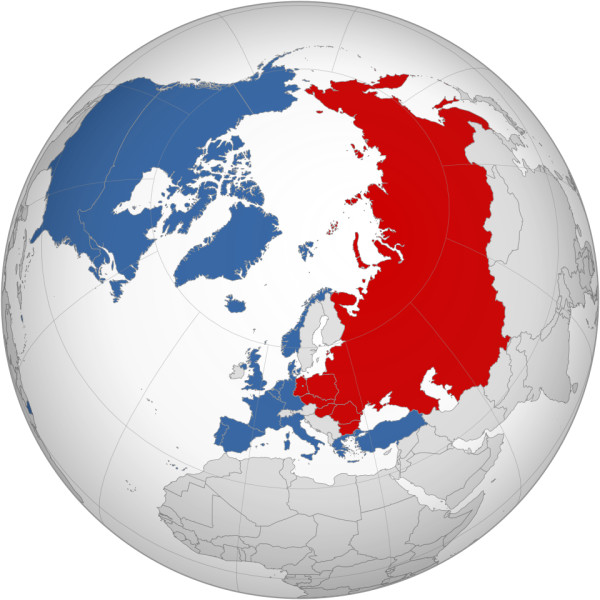
NATO and Warsaw Pact blocs in Europe
NATO
Founded in 1949, NATO joined the U.S., Canada, and Western European states.
- Its core idea was collective defense. An attack on one member counted as an attack on all.
- It helped the U.S. carry out containment and station troops, bases, and nuclear weapons in Europe.
- It worked alongside the Marshall Plan, which rebuilt Western Europe and tied it economically to the U.S.
- It was a multilateral alliance of sovereign states, though the U.S. clearly dominated.
Warsaw Pact
Founded in 1955, the Warsaw Pact linked the USSR with communist Eastern European states after West Germany joined NATO.
- It also used collective defense, but under much tighter Soviet control.
- It preserved Eastern Europe as a Soviet security buffer.
- Soviet troops stayed in the region, showing this was not an alliance of equals.
- Soviet control had limits on member independence:
- Hungary, 1956
- Czechoslovakia, 1968 Prague Spring
- Comecon tied Eastern bloc economies to the USSR.
NATO and Warsaw Pact compared
- Both organized military cooperation, troop deployments, and ideological blocs.
- NATO was looser and tied together capitalist democracies.
- The Warsaw Pact was tighter and Soviet-dominated.
- Germany is the clearest example on the map. West Germany joined NATO; East Germany joined the Warsaw Pact.
Nuclear Proliferation and the Arms Race
Cold War rivalry became terrifying because it involved weapons that could destroy humanity, not just armies.
Nuclear spread
- U.S. atomic bomb in 1945
- USSR atomic bomb in 1949
- Britain in 1952
- France in 1960
- China in 1964
The arms race meant more weapons and better delivery systems:
- hydrogen bombs
- long-range bombers
- ICBMs
- submarine-launched ballistic missiles
MAD
Mutually assured destruction meant both sides had second-strike capability. Even after being hit first, they could still destroy the attacker. That made direct war less likely, but it also raised fear, spending, and the danger of mistakes.
Cuban Missile Crisis
In 1962, the USSR placed missiles in Cuba. The U.S. responded with a naval quarantine. The crisis ended when the Soviets withdrew the missiles, the U.S. promised not to invade Cuba, and the U.S. secretly removed missiles from Turkey. This is the classic example of the Cold War coming closest to nuclear war.
Détente
In the 1970s, SALT agreements limited some strategic weapons. Competition continued, but both sides recognized that unlimited buildup was dangerous.
Proxy Wars in Asia, Africa, and Latin America
A proxy war happened when outside powers backed local governments or rebels instead of fighting each other directly. These often erupted in postcolonial states already dealing with instability, weak institutions, and internal conflict.
Korean War
- North Korea under Kim Il Sung had Soviet backing.
- South Korea under Syngman Rhee had U.S. backing.
- North invaded South in 1950.
- A U.S.-led UN force intervened, and China entered for the North.
- The 1953 armistice created the DMZ, and Korea stayed divided.
This set the pattern for later Cold War conflicts. A local struggle became part of a global rivalry.
Angolan Civil War
- Angola became independent from Portugal in 1975.
- The MPLA got Soviet aid and Cuban troops.
- UNITA, led by Jonas Savimbi, got U.S. and apartheid South African support.
- This war mixed decolonization, civil war, and Cold War rivalry.
- It lasted beyond the Cold War, which reminds you that local causes mattered too.
Nicaragua
- The Sandinistas overthrew the Somoza dictatorship in 1979.
- They carried out socialist reforms and built ties to Cuba and the Soviet bloc.
- The U.S. backed the Contras under Reagan.
- The Iran-Contra affair exposed illegal covert funding.
- This is a major example of the U.S. supporting anti-communist forces despite human-rights concerns.
Effects of Cold War Competition
These methods reshaped the world far beyond Europe.
- Alliances and spheres of influence created a militarized global division.
- Nuclear stockpiles made the whole world vulnerable to catastrophe.
- Proxy wars prolonged violence, increased casualties, and caused displacement and economic damage.
- Many postcolonial states lost real sovereignty because they depended on superpower aid, weapons, or intervention.
The strongest ending comparison is simple. Both superpowers used very similar tools, but the U.S. relied on containment and a capitalist alliance network, while the USSR relied on tighter control in Eastern Europe and support for socialist movements abroad.
Key Takeaways
Cold War
1945–1991 global rivalry in which the United States and Soviet Union competed through opposing blocs, arms buildups, and proxy conflicts while avoiding general war with each other
Bloc
A group of states aligned politically, economically, and militarily with one Cold War superpower
North Atlantic Treaty Organization (NATO)
U.S.-led military alliance formed in 1949 whose collective-defense principle treated an attack on one member as an attack on all
Containment
U.S. strategy of preventing communism and Soviet influence from expanding into additional states
Warsaw Pact
Soviet-led military alliance formed in 1955 that coordinated the Eastern bloc’s forces and helped preserve Soviet control in Eastern Europe
Comecon (Council for Mutual Economic Assistance)
Soviet-led organization that linked the economies of Eastern bloc states to the Soviet Union
Nuclear Proliferation
The spread of nuclear weapons to additional states and the expansion of existing nuclear arsenals
Nuclear Arms Race
American-Soviet competition to accumulate more nuclear warheads and develop more powerful weapons and effective delivery systems
Deterrence
Preventing an attack by threatening the attacker with unacceptable retaliation
Mutually Assured Destruction (MAD)
Condition in which each side retained enough second-strike capacity to destroy the other after absorbing a nuclear first strike
Cuban Missile Crisis
1962 confrontation over Soviet nuclear missiles in Cuba that ended with their withdrawal, a U.S. pledge not to invade Cuba, and secret removal of U.S. missiles from Turkey
Strategic Arms Limitation Talks (SALT)
U.S.-Soviet negotiations that limited some categories of strategic weapons without eliminating nuclear arsenals or ending the arms race
Proxy War
Conflict in which outside powers support opposing local governments or movements instead of fighting each other openly and directly
Korean War
1950–1953 proxy war in which a U.S.-led UN force defended South Korea while the Soviet Union and China supported North Korea; the armistice left Korea divided near the 38th parallel
Kim Il Sung
Leader of Soviet-supported communist North Korea during the Korean War
Syngman Rhee
Leader of American-supported anti-communist South Korea during the Korean War
Angolan Civil War
Post-independence proxy war in which the Soviet Union and Cuba supported the Marxist MPLA while the United States and apartheid South Africa supported UNITA; foreign intervention helped prolong the conflict until 2002
Popular Movement for the Liberation of Angola (MPLA)
Marxist movement that established Angola’s government and received Soviet weapons and extensive Cuban military assistance
National Union for the Total Independence of Angola (UNITA)
Jonas Savimbi’s Angolan movement, supported during the civil war by the United States and apartheid South Africa
Jonas Savimbi
Leader of UNITA, the U.S.- and South African-supported movement that fought the MPLA in Angola
Sandinista National Liberation Front (Sandinistas)
Nicaraguan revolutionary movement that overthrew the Somoza government in 1979, pursued socialist reforms, and aligned with Cuba and the Soviet bloc
Contras
Counterrevolutionary forces funded, armed, and trained by the United States to fight Nicaragua’s Sandinista government
Ronald Reagan
U.S. president whose administration armed and funded the Contras to oppose the Sandinista government and Soviet-Cuban influence in Nicaragua
Iran-Contra Affair
Scandal exposing Reagan administration officials’ illegal effort to channel proceeds from secret arms sales to the Nicaraguan Contras
Sandinista-Contra Conflict
Nicaraguan proxy conflict in which U.S.-backed Contras fought the socialist, Soviet- and Cuban-aligned Sandinista government; the Sandinistas lost a 1990 election and transferred power
Notes
Cold War
1945–1991 global rivalry in which the United States and Soviet Union competed through opposing blocs, arms buildups, and proxy conflicts while avoiding general war with each other
Bloc
A group of states aligned politically, economically, and militarily with one Cold War superpower
North Atlantic Treaty Organization (NATO)
U.S.-led military alliance formed in 1949 whose collective-defense principle treated an attack on one member as an attack on all
Containment
U.S. strategy of preventing communism and Soviet influence from expanding into additional states
Warsaw Pact
Soviet-led military alliance formed in 1955 that coordinated the Eastern bloc’s forces and helped preserve Soviet control in Eastern Europe
Comecon (Council for Mutual Economic Assistance)
Soviet-led organization that linked the economies of Eastern bloc states to the Soviet Union
Nuclear Proliferation
The spread of nuclear weapons to additional states and the expansion of existing nuclear arsenals
Nuclear Arms Race
American-Soviet competition to accumulate more nuclear warheads and develop more powerful weapons and effective delivery systems
Deterrence
Preventing an attack by threatening the attacker with unacceptable retaliation
Mutually Assured Destruction (MAD)
Condition in which each side retained enough second-strike capacity to destroy the other after absorbing a nuclear first strike
Cuban Missile Crisis
1962 confrontation over Soviet nuclear missiles in Cuba that ended with their withdrawal, a U.S. pledge not to invade Cuba, and secret removal of U.S. missiles from Turkey
Strategic Arms Limitation Talks (SALT)
U.S.-Soviet negotiations that limited some categories of strategic weapons without eliminating nuclear arsenals or ending the arms race
Proxy War
Conflict in which outside powers support opposing local governments or movements instead of fighting each other openly and directly
Korean War
1950–1953 proxy war in which a U.S.-led UN force defended South Korea while the Soviet Union and China supported North Korea; the armistice left Korea divided near the 38th parallel
Kim Il Sung
Leader of Soviet-supported communist North Korea during the Korean War
Syngman Rhee
Leader of American-supported anti-communist South Korea during the Korean War
Angolan Civil War
Post-independence proxy war in which the Soviet Union and Cuba supported the Marxist MPLA while the United States and apartheid South Africa supported UNITA; foreign intervention helped prolong the conflict until 2002
Popular Movement for the Liberation of Angola (MPLA)
Marxist movement that established Angola’s government and received Soviet weapons and extensive Cuban military assistance
National Union for the Total Independence of Angola (UNITA)
Jonas Savimbi’s Angolan movement, supported during the civil war by the United States and apartheid South Africa
Jonas Savimbi
Leader of UNITA, the U.S.- and South African-supported movement that fought the MPLA in Angola
Sandinista National Liberation Front (Sandinistas)
Nicaraguan revolutionary movement that overthrew the Somoza government in 1979, pursued socialist reforms, and aligned with Cuba and the Soviet bloc
Contras
Counterrevolutionary forces funded, armed, and trained by the United States to fight Nicaragua’s Sandinista government
Ronald Reagan
U.S. president whose administration armed and funded the Contras to oppose the Sandinista government and Soviet-Cuban influence in Nicaragua
Iran-Contra Affair
Scandal exposing Reagan administration officials’ illegal effort to channel proceeds from secret arms sales to the Nicaraguan Contras
Sandinista-Contra Conflict
Nicaraguan proxy conflict in which U.S.-backed Contras fought the socialist, Soviet- and Cuban-aligned Sandinista government; the Sandinistas lost a 1990 election and transferred power
