Topic 5.7 Notes – Economic Developments and Innovations in the Industrial Age
What Industrial Capitalism Was
You already know the machines part of industrialization. Here the key question is who paid for it and how it was organized. Industrial capitalism meant private people or companies owned productive property, hired workers for wages, used machines in factories, sold to markets, and reinvested profits to grow.
Its main features worked together:
- Private property let individuals and firms own factories, mines, and railroads.
- Capital investment meant wealth was put into machinery, buildings, and transport to make more wealth.
- Wage labor meant workers sold labor for pay instead of owning the tools or final product.
- Division of labor split jobs into specialized tasks, which boosted speed and output.
- Competition pushed firms to cut costs and improve goods.
- Market production reached local, national, and global buyers.
- Reinvestment turned profits into more factories, more track, more machines.
The system had a cycle:
- Investors provide capital.
- Businesses build factories, railroads, and mines.
- Machines raise output.
- Lower cost per item helps goods reach bigger markets.
- Profits come in.
- Profits get reinvested, so firms grow even larger.
The image below helps connect those pieces to real industrial workplaces, from factory labor on the left to large mechanized production on the right.
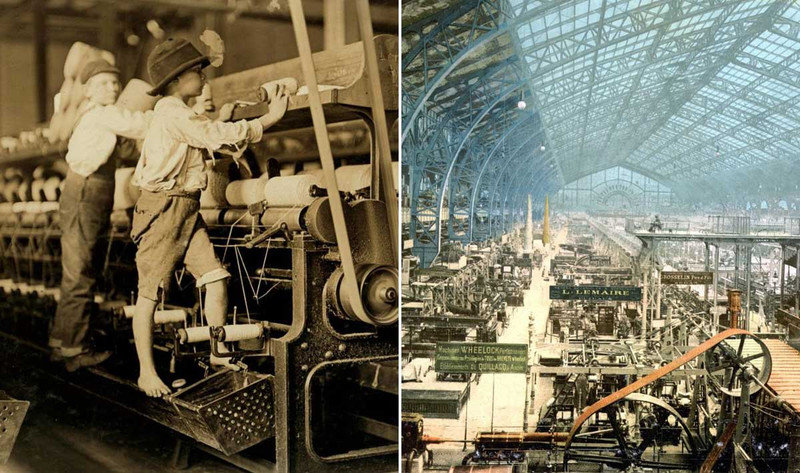
Industrial factory labor and mechanized production
This did not wipe out older economies overnight. Agriculture, small workshops, empire, and state involvement all still mattered.
From Mercantilism to Free Trade
Before this shift, many European states followed mercantilism, which treated trade as a way to strengthen the state.
- Favorable balance of trade meant exporting more than importing.
- Gold and silver were seen as signs of national wealth.
- Tariffs protected local producers from foreign competition.
- Governments gave monopolies to favored companies.
- Colonies were expected to buy from and sell to the mother country.
- Navigation Acts regulated which ships could carry trade.
Then came Adam Smith and economic liberalism. In Wealth of Nations (1776), he argued that wealth came from productive labor and exchange, not just piles of bullion.
Adam Smith
- Division of labor increased productivity. His famous example was the pin factory, where splitting pin-making into separate tasks made output soar.
- Competition lowered prices and improved quality.
- Supply and demand shaped market prices.
- Laissez-faire meant limited government interference in the economy.
- Free trade meant fewer tariffs and restrictions between countries.
Britain shows the policy shift best:
- Corn Laws repealed in 1846. Cheaper grain could enter Britain, helping consumers and industrial employers.
- Most Navigation Acts repealed in 1849.
- Cobden-Chevalier Treaty (1860) lowered tariffs between Britain and France.
The exam likes this nuance. Free trade increased, but governments did not step aside completely. States still enforced contracts, protected property, and often used imperial power to open markets.
How Industrial Capital Was Raised and Organized
Industrial projects were expensive in a way earlier trade often was not. A railroad or steel mill usually cost too much for one family to fund alone.
| Institution | What it did |
|---|---|
| Joint-stock companies | Sold shares to many investors, pooling money and spreading risk |
| Corporations | Legal entities separate from owners, able to own property and sign contracts |
| Limited liability | Investors could lose only what they invested; Britain’s 1855 law is a key example |
| Stock markets | Let people buy and sell shares more easily |
| Bonds | Loans to a business or government; bondholders were creditors, not owners |
| Banks | Handled deposits, loans, transfers, and exchange |
| Credit and insurance | Made long-distance trade and risky ventures more manageable |
A railroad shows how these fit together:
- A railroad corporation sells stock and bonds.
- Banks and investors supply capital.
- Track and equipment get built.
- Freight and passenger revenue comes in.
- Debts are paid, profits are distributed or reinvested.
Transnational Business and the Global Industrial Economy
Industrial capitalism became global because firms worked across borders and empires. A common pattern looked like this:
- raw materials extracted in one region
- capital raised in financial centers
- manufacturing in industrial centers
- goods sold in world markets
HSBC
Founded in Hong Kong in 1865, HSBC financed trade across China, India, Britain, and other Asian markets. It shows that even banking became transnational.
Lever Brothers
Founded in 1885, Lever Brothers made soap in Britain using palm oil from West Africa. It later merged with a Dutch firm to form Unilever, based in England and the Netherlands, which ran plantations and processing in British West Africa and the Belgian Congo. That is the pattern you want to see. Industrial firms connected European factories to colonial raw materials.
Railroads, steamships, and telegraphs made this possible. Free trade and imperialism often worked together, not separately.
Consumer Goods, Living Standards, and the Big Picture
Mass production made many goods cheaper and easier to get:
- cotton textiles
- soap
- metal goods
- processed foods
- sewing machines and bicycles
Consumption also changed through branding, packaging, advertising, and department stores.
Some groups benefited a lot:
- factory owners
- merchants
- investors
- the middle class
- later, parts of the working class
But the gains were uneven. Early factory workers often had low wages and terrible city conditions, and colonial raw-material regions did not benefit equally.
Key Takeaways
Mercantilism
Collection of state policies seeking national wealth and power through regulated trade, tariffs, monopolies, bullion accumulation, and controlled colonial markets
Economic Liberalism
Ideology favoring private property, competitive markets, freer trade, and limited government direction of economic activity
Adam Smith
Scottish Enlightenment thinker whose 1776 Wealth of Nations defended private enterprise, competition, division of labor, and freer markets and trade
Division of Labor
Dividing production into specialized tasks so workers become more efficient and total output rises, illustrated by Smith’s pin factory
Laissez-Faire Capitalism
Principle that private economic activity should generally operate without extensive government interference, though government still protects property, contracts, and public order
Free Market
Market in which buyers and sellers, rather than direct government commands, mainly determine production, prices, investment, and consumption
Free Trade
International exchange with reduced tariffs, monopolies, and restrictions on imports and exports
Corn Laws
British tariffs protecting landowners from cheaper imported grain; repealed in 1846 as industrial and urban interests gained influence
Industrial Capitalism
System of private ownership, capital investment, wage labor, mechanized market production, and reinvestment of profits in expanding industrial enterprises
Economies of Scale
Reduction in cost per unit when firms produce and distribute goods in larger quantities
Joint-Stock Company
Enterprise that pools capital by selling ownership shares to multiple investors, dividing both ownership and risk
Corporation
Business legally separate from its owners that can own property, make contracts, borrow, and continue despite changes in shareholders
Limited Liability
Legal principle restricting a shareholder’s potential loss to the amount invested rather than making personal property responsible for corporate debts
Stock Exchange / Stock Market
Organized market for buying and selling company shares, making ownership easier to transfer and helping firms attract investment
Banks
Institutions that collected deposits, made loans, transferred funds, exchanged currencies, and directed savings and credit into commerce and industry
Insurance
Arrangement in which a premium purchases compensation for specified losses, spreading risks such as shipwreck, fire, or property damage
Transnational Business
Firm with major operations across countries or imperial territories, linking international sources of capital, raw materials, production, and markets
Hongkong and Shanghai Banking Corporation (HSBC)
Bank founded in Hong Kong in 1865 that financed trade, exchanged currencies, and handled payments across China, India, Europe, and British possessions
Capital
Wealth invested in productive assets or enterprises to generate additional wealth
The Wealth of Nations
Adam Smith’s 1776 work arguing for greater productivity, competitive markets, and freer trade instead of mercantilist restrictions
Stock
A share of ownership in a company that gives an investor a claim on its potential profits while exposing the investment to risk
Bond
A debt obligation through which an investor lends money in return for promised interest and repayment of principal
Unilever
Transnational consumer-goods company formed in 1929 from predecessor firms including Lever Brothers, whose nineteenth-century soap production linked European factories to African palm-oil networks
Notes
Mercantilism
Collection of state policies seeking national wealth and power through regulated trade, tariffs, monopolies, bullion accumulation, and controlled colonial markets
Economic Liberalism
Ideology favoring private property, competitive markets, freer trade, and limited government direction of economic activity
Adam Smith
Scottish Enlightenment thinker whose 1776 Wealth of Nations defended private enterprise, competition, division of labor, and freer markets and trade
Division of Labor
Dividing production into specialized tasks so workers become more efficient and total output rises, illustrated by Smith’s pin factory
Laissez-Faire Capitalism
Principle that private economic activity should generally operate without extensive government interference, though government still protects property, contracts, and public order
Free Market
Market in which buyers and sellers, rather than direct government commands, mainly determine production, prices, investment, and consumption
Free Trade
International exchange with reduced tariffs, monopolies, and restrictions on imports and exports
Corn Laws
British tariffs protecting landowners from cheaper imported grain; repealed in 1846 as industrial and urban interests gained influence
Industrial Capitalism
System of private ownership, capital investment, wage labor, mechanized market production, and reinvestment of profits in expanding industrial enterprises
Economies of Scale
Reduction in cost per unit when firms produce and distribute goods in larger quantities
Joint-Stock Company
Enterprise that pools capital by selling ownership shares to multiple investors, dividing both ownership and risk
Corporation
Business legally separate from its owners that can own property, make contracts, borrow, and continue despite changes in shareholders
Limited Liability
Legal principle restricting a shareholder’s potential loss to the amount invested rather than making personal property responsible for corporate debts
Stock Exchange / Stock Market
Organized market for buying and selling company shares, making ownership easier to transfer and helping firms attract investment
Banks
Institutions that collected deposits, made loans, transferred funds, exchanged currencies, and directed savings and credit into commerce and industry
Insurance
Arrangement in which a premium purchases compensation for specified losses, spreading risks such as shipwreck, fire, or property damage
Transnational Business
Firm with major operations across countries or imperial territories, linking international sources of capital, raw materials, production, and markets
Hongkong and Shanghai Banking Corporation (HSBC)
Bank founded in Hong Kong in 1865 that financed trade, exchanged currencies, and handled payments across China, India, Europe, and British possessions
Capital
Wealth invested in productive assets or enterprises to generate additional wealth
The Wealth of Nations
Adam Smith’s 1776 work arguing for greater productivity, competitive markets, and freer trade instead of mercantilist restrictions
Stock
A share of ownership in a company that gives an investor a claim on its potential profits while exposing the investment to risk
Bond
A debt obligation through which an investor lends money in return for promised interest and repayment of principal
Unilever
Transnational consumer-goods company formed in 1929 from predecessor firms including Lever Brothers, whose nineteenth-century soap production linked European factories to African palm-oil networks
