Topic 9.8 Notes – Institutions Developing in a Globalized World
How Globalization Changed Relations Among States
As the world became more connected, problems stopped staying inside one country. A war could pull in many states, a financial crisis could spread quickly, and refugees or disease could cross borders fast.
- Globalization increased interdependence, meaning states affected each other more directly through trade, migration, transportation, communication, and information flows.
- States still stayed sovereign. They kept their own governments and national interests.
- The change was that they increasingly used permanent international organizations instead of relying only on temporary conferences or one-time diplomacy.
- This was a move toward multilateralism, which means cooperation among three or more states through shared rules and institutions.
- These organizations were part of global governance, meaning states coordinated behavior through rules and institutions without creating a single world government.
- Most were intergovernmental, so they depended on member states. A supranational body has more independent authority over members. The UN is mostly intergovernmental. The EU is a stronger supranational example.
- Old patterns did not disappear. States still formed alliances, competed for power, and pursued national interests.
From the League of Nations to the United Nations
After World War I, leaders tried to prevent another catastrophe through the League of Nations. It was built around collective security, the idea that aggression against one state should concern all.
Why the League failed
- The United States never joined, even though Woodrow Wilson supported it. That weakened the League from the start.
- It had no independent military force.
- It depended on members to enforce decisions.
- Decision-making was often slow.
- Major powers ignored it, withdrew, or acted anyway.
Failure examples
- Japan in Manchuria in 1931
- Italy in Ethiopia in 1935
- Nazi German expansion in the 1930s
Those failures taught states that international organization was still necessary, but major powers had to stay involved. This League meeting captures the kind of international cooperation leaders hoped could preserve peace.
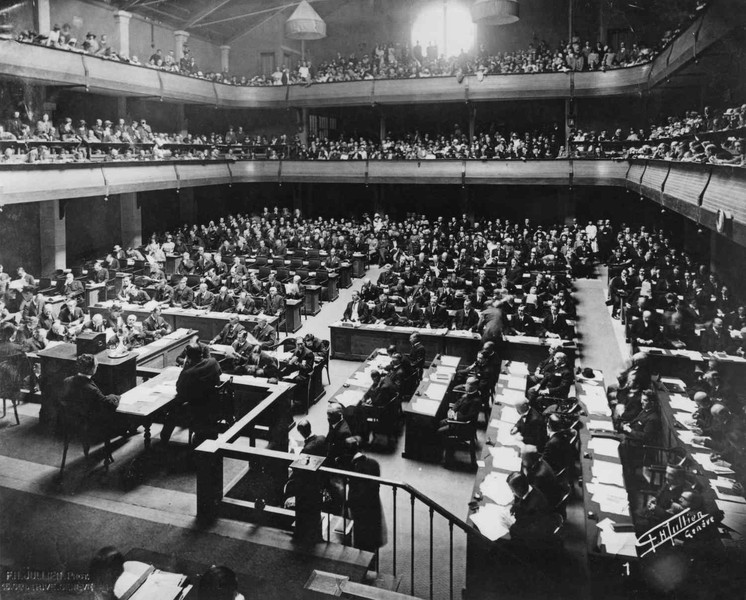
League of Nations assembly
The United Nations
The United Nations was founded in 1945 at San Francisco. The UN Charter took effect on October 24, 1945.
Its stated purposes were to:
- maintain peace and security
- promote friendly relations among nations
- encourage economic, social, cultural, and humanitarian cooperation
- promote human rights
- provide a forum for coordinating state action
How the United Nations Works
The UN mixes equality and unequal power. Every state gets a voice, but the biggest powers got extra influence in 1945.
| Organ | What it does |
|---|---|
| General Assembly | All member states have one vote. It debates issues, approves the budget, and passes mostly nonbinding resolutions. Newly independent states used it heavily during decolonization. |
| Security Council | 15 members total. The 5 permanent members are the U.S., U.K., France, Russia, and China. It can impose sanctions, authorize peacekeeping, and sometimes military force. |
| Secretariat | Administrative branch led by the secretary-general. |
| International Court of Justice | Located in The Hague. Hears disputes between states, but enforcement is weak. |
| Economic and Social Council | Coordinates economic, social, and humanitarian work. |
| Trusteeship Council | Oversaw trust territories and faded after decolonization. |
The key tension is easy to test. The General Assembly shows sovereign equality. The Security Council shows unequal power, especially through the veto.
What International Institutions Actually Did
The UN was supposed to do more than talk. Its record shows both real cooperation and serious limits.
- The UN has no permanent army. It relies on member states for troops and money.
- Peacekeeping missions monitored cease-fires, elections, disarmament, and rebuilding.
- Relative successes included Cambodia and Mozambique.
- A major failure was the Rwanda genocide in 1994, when weak mandates and lack of political will blocked action.
- During the Cold War, U.S.-Soviet rivalry often froze the UN through vetoes.
Cooperation also expanded beyond war:
- WHO worked on global health.
- UNESCO supported education, science, and culture.
- UNICEF focused on children.
- UNHCR helped refugees.
- The Universal Declaration of Human Rights in 1948 set global norms, even though it was not itself enforceable world law.
A wider pattern appeared too:
- IMF and World Bank came from Bretton Woods
- WTO succeeded GATT
- European Union shows a more supranational model
- ASEAN shows regional cooperation that protects sovereignty and noninterference
Effects and Limits of International Organizations
These institutions changed daily international politics. Diplomacy became more continuous, more rule-based, and more public.
- Smaller states gained forums to build coalitions and shape debate.
- States could use international law, human rights, development, and collective security to justify policies.
- Procedures for sanctions, mediation, dispute resolution, and trade negotiation became normal.
- Decolonization expanded UN membership and made it more globally representative.
- The Bandung Conference in 1955 linked cooperation to sovereignty, anti-colonialism, racial equality, and noninterference.
Limits stayed just as real:
- State consent still mattered most.
- The veto could block action.
- Powerful states dominated many institutions.
- Organizations could be slow, selective, or weak.
Key Takeaways
International Organizations
Permanent institutions through which states manage conflict, negotiate rules, coordinate policies, and address cross-border problems
Multilateralism
Cooperation among three or more states through shared rules, negotiations, or institutions
Intergovernmental vs. Supranational Institutions
Intergovernmental bodies act through agreements among sovereign states; supranational bodies can make some decisions binding on members without unanimous consent
Nongovernmental Organization (NGO)
A cross-border organization not composed of sovereign states, unlike an intergovernmental organization
Global Governance
Coordination through international rules, negotiations, and institutions without a single worldwide sovereign government
Collective Security
The principle that aggression against one member should be treated as a concern of the entire international community
United Nations (UN)
Intergovernmental organization founded in 1945 to maintain international peace and facilitate cooperation on global problems
United Nations Charter
The UN’s 1945 founding agreement, establishing its purposes, structure, and principles of peace, cooperation, human rights, and sovereign equality
United Nations General Assembly
UN body in which every member state has one vote and debates issues, approves the budget, and adopts mostly nonbinding resolutions
United Nations Security Council
Fifteen-member UN body responsible for peace and security; China, France, Russia, the UK, and the US are permanent members with vetoes
International Court of Justice (ICJ)
UN court in The Hague that hears disputes submitted by states and issues advisory opinions but lacks independent enforcement power
Economic and Social Council (ECOSOC)
UN body coordinating international economic, social, humanitarian, and development work with specialized agencies
United Nations Trusteeship Council
UN body that supervised trust territories moving toward self-government and suspended regular operations in 1994 after decolonization
United Nations Peacekeeping
Deployment of multinational personnel to monitor cease-fires, separate combatants, protect aid, and support peace agreements, usually with the parties’ consent
United Nations Specialized Agencies and Related Bodies
Organizations such as WHO, UNESCO, UNICEF, and UNHCR that coordinate cooperation in health, education, children’s welfare, and refugee relief
Universal Declaration of Human Rights (UDHR)
Nonbinding 1948 UN declaration establishing international standards for civil, political, economic, and social rights
International Monetary Fund (IMF)
Institution created from the 1944 Bretton Woods Conference to address international monetary and balance-of-payments problems
World Bank
Bretton Woods institution that increasingly financed long-term economic development
World Trade Organization (WTO)
Organization created in 1995 to establish international trade rules and procedures for resolving trade disputes
European Union (EU)
Regional organization with a single market and institutions that exercise some supranational authority shared by member states
Association of Southeast Asian Nations (ASEAN)
Regional organization founded in 1967 to promote Southeast Asian stability and economic cooperation while emphasizing sovereignty and noninterference
United Nations Secretariat
UN organ responsible for the organization’s daily administrative work
United Nations Secretary-General
Head of the UN Secretariat who also uses diplomacy to draw attention to conflicts and encourage negotiation
State Sovereignty
A state’s authority over its own affairs; international institutions coordinate states without generally replacing that authority
Notes
International Organizations
Permanent institutions through which states manage conflict, negotiate rules, coordinate policies, and address cross-border problems
Multilateralism
Cooperation among three or more states through shared rules, negotiations, or institutions
Intergovernmental vs. Supranational Institutions
Intergovernmental bodies act through agreements among sovereign states; supranational bodies can make some decisions binding on members without unanimous consent
Nongovernmental Organization (NGO)
A cross-border organization not composed of sovereign states, unlike an intergovernmental organization
Global Governance
Coordination through international rules, negotiations, and institutions without a single worldwide sovereign government
Collective Security
The principle that aggression against one member should be treated as a concern of the entire international community
United Nations (UN)
Intergovernmental organization founded in 1945 to maintain international peace and facilitate cooperation on global problems
United Nations Charter
The UN’s 1945 founding agreement, establishing its purposes, structure, and principles of peace, cooperation, human rights, and sovereign equality
United Nations General Assembly
UN body in which every member state has one vote and debates issues, approves the budget, and adopts mostly nonbinding resolutions
United Nations Security Council
Fifteen-member UN body responsible for peace and security; China, France, Russia, the UK, and the US are permanent members with vetoes
International Court of Justice (ICJ)
UN court in The Hague that hears disputes submitted by states and issues advisory opinions but lacks independent enforcement power
Economic and Social Council (ECOSOC)
UN body coordinating international economic, social, humanitarian, and development work with specialized agencies
United Nations Trusteeship Council
UN body that supervised trust territories moving toward self-government and suspended regular operations in 1994 after decolonization
United Nations Peacekeeping
Deployment of multinational personnel to monitor cease-fires, separate combatants, protect aid, and support peace agreements, usually with the parties’ consent
United Nations Specialized Agencies and Related Bodies
Organizations such as WHO, UNESCO, UNICEF, and UNHCR that coordinate cooperation in health, education, children’s welfare, and refugee relief
Universal Declaration of Human Rights (UDHR)
Nonbinding 1948 UN declaration establishing international standards for civil, political, economic, and social rights
International Monetary Fund (IMF)
Institution created from the 1944 Bretton Woods Conference to address international monetary and balance-of-payments problems
World Bank
Bretton Woods institution that increasingly financed long-term economic development
World Trade Organization (WTO)
Organization created in 1995 to establish international trade rules and procedures for resolving trade disputes
European Union (EU)
Regional organization with a single market and institutions that exercise some supranational authority shared by member states
Association of Southeast Asian Nations (ASEAN)
Regional organization founded in 1967 to promote Southeast Asian stability and economic cooperation while emphasizing sovereignty and noninterference
United Nations Secretariat
UN organ responsible for the organization’s daily administrative work
United Nations Secretary-General
Head of the UN Secretariat who also uses diplomacy to draw attention to conflicts and encourage negotiation
State Sovereignty
A state’s authority over its own affairs; international institutions coordinate states without generally replacing that authority
