Topic 6.7 Notes – Effects of Migration
How Migration Reshaped Societies from 1750 to 1900
This topic is about effects, not mainly causes. Migration now connected home and destination at the same time, so you have to think in both directions.
Three social effects show up over and over:
- Male-dominated migration changed households back home because many migrants were men recruited for railroads, mines, plantations, docks, and wage labor.
- Ethnic enclaves formed in receiving societies because migrants settled near jobs and near people who shared language, religion, and family ties.
- Prejudice and restriction grew because receiving societies often wanted migrants’ labor without wanting migrants as full members of the nation.
That gives you the core paradox of the whole topic. Economies needed migrant workers, but societies often treated them as outsiders.
This map helps you picture just how global those labor flows became, especially from India and China to Southeast Asia, the Pacific, Africa, and the Americas.
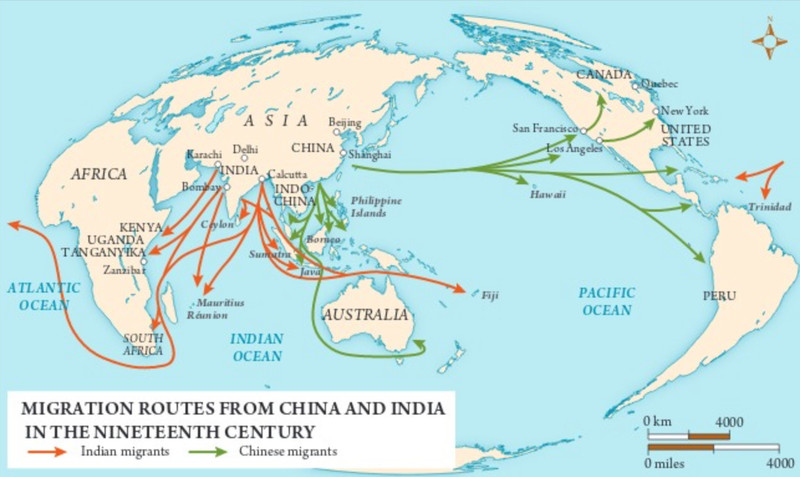
Nineteenth-century migration routes from China and India
How Migration Changed Sending Societies
A lot of long-distance labor migration involved men leaving for years, sometimes intending to return after earning wages. That reshaped family life in the communities they left behind.
Women often took over work men had done before:
- managing farms and agricultural labor
- running shops or family businesses
- handling land, debts, and household money
- dealing with merchants, landlords, and officials
- keeping households going during long separations
The key point is practical authority. Women often made more decisions because someone had to. But this did not mean full equality. Patriarchal laws and expectations usually stayed in place.
Migration also changed local economies through remittances, which were wages sent home. Families used them to pay debts, buy land, survive hard times, or send another relative abroad. Men who returned could also bring back new habits, political ideas, or expectations.
Ethnic Enclaves and Diasporas
Once migrants arrived, they rarely scattered randomly. They followed kinship and labor networks, then clustered near ports, railroads, mines, plantations, and cities.
What they were
- An ethnic enclave is a concentrated migrant community inside a receiving society.
- A diaspora is a people spread across multiple regions who still keep a shared identity.
Enclaves helped migrants survive and belong at the same time:
- found jobs and housing for newcomers
- provided mutual aid during illness or unemployment
- supported temples, churches, mosques, schools, newspapers, and businesses
- preserved food, language, religion, and customs
- encouraged chain migration and kept homeland ties
- spread culture into the larger society
Enclaves were never sealed off. They preserved culture and adapted to local life. Historic Chinatowns in U.S. cities are a good example of that mix of cultural continuity and urban adaptation.
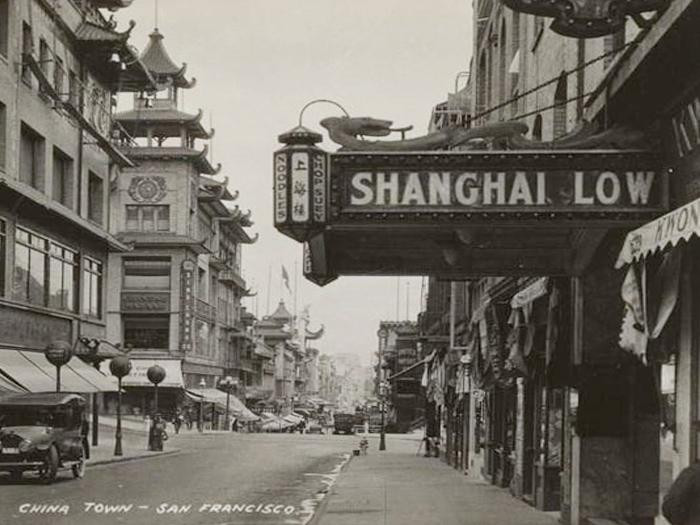
San Francisco Chinatown
Key examples
| Group | Main destinations | What to remember |
|---|---|---|
| Chinese | Southeast Asia, Cuba, Peru, U.S. | Railroad labor in the U.S.; Chinatowns preserved culture and mutual aid |
| Indian | Caribbean, East Africa, Southern Africa, Southeast Asia | Indentured workers in Trinidad and British Guiana; merchants and railroad workers in East Africa |
| Irish | U.S. and Canada | Catholic parishes, labor networks, strong city political influence |
| Italian | North and South America | Little Italies; huge impact in Argentina, especially Buenos Aires |
Prejudice, Nativism, and Immigration Restriction
Visible migrant communities often triggered fear. People saw migrants as job competition, religious outsiders, racially inferior, or threats to national identity.
Hostility could include:
- workplace exclusion
- segregation
- mob violence
- denial of citizenship
- immigration restriction laws
Chinese Exclusion Act
The Chinese Exclusion Act in the United States in 1882 suspended immigration of Chinese laborers and made Chinese laborers ineligible for naturalization. This happened after Chinese workers had helped build railroads and develop the West. The Geary Act renewed exclusion in 1892.
White Australia policy
Australia built restriction into nation-making. Anti-Chinese and anti-Asian feeling in the late 1800s fed the Immigration Restriction Act of 1901, which used a dictation test to exclude unwanted immigrants.
Irish and Italians also faced strong nativism, especially in Protestant North America. The difference is that they were more often later absorbed into whiteness than Chinese or Indian migrants.
Patterns and Significance to Remember
You can think of the whole topic as one chain:
- mostly male workers migrate
- women take on new roles at home
- migrants cluster near jobs and form enclaves
- enclaves preserve culture and help adaptation
- their visibility helps fuel prejudice and restriction
Migration created more multicultural societies, but it also sharpened racial and national boundaries.
Key Takeaways
Male-Dominated Labor Migration
The predominance of men in many labor migrations left women managing farms, businesses, property, finances, and households, expanding practical authority without necessarily ending patriarchy
Ethnic Enclave
A concentrated community of migrants and their descendants that offered mutual support and helped preserve and transplant their culture
Diaspora
A population dispersed from its homeland into multiple regions while maintaining a shared identity or connection to that homeland
Chinese Migrant Communities
Communities across Southeast Asia and the Americas whose members worked in trade, mining, plantations, railroads, and cities while establishing businesses, temples, associations, and mutual aid
Indian Migrant Communities
Communities established across Africa, the Caribbean, and Southeast Asia by indentured workers and merchants who founded temples, mosques, shops, schools, and family networks
Irish Migrant Communities
Catholic immigrant communities in North American cities that supplied urban labor, formed parishes and mutual-aid networks, faced nativism, and gained political influence
Italian Migrant Communities
Enclaves in North and South America, including Little Italies, that preserved Italian customs and influenced wider society through both permanent and return migration
Nativism
Political and social hostility by established residents toward immigrants, often based on economic competition, religion, nationality, race, or alleged failure to assimilate
Chinese Exclusion Act
The 1882 U.S. law that suspended Chinese labor immigration for ten years and denied Chinese laborers naturalization, establishing racialized federal immigration exclusion
White Australia Policy
Measures designed to preserve a white Australia by restricting non-European immigration, formalized through the Immigration Restriction Act of 1901 and its discriminatory dictation test
Notes
Male-Dominated Labor Migration
The predominance of men in many labor migrations left women managing farms, businesses, property, finances, and households, expanding practical authority without necessarily ending patriarchy
Ethnic Enclave
A concentrated community of migrants and their descendants that offered mutual support and helped preserve and transplant their culture
Diaspora
A population dispersed from its homeland into multiple regions while maintaining a shared identity or connection to that homeland
Chinese Migrant Communities
Communities across Southeast Asia and the Americas whose members worked in trade, mining, plantations, railroads, and cities while establishing businesses, temples, associations, and mutual aid
Indian Migrant Communities
Communities established across Africa, the Caribbean, and Southeast Asia by indentured workers and merchants who founded temples, mosques, shops, schools, and family networks
Irish Migrant Communities
Catholic immigrant communities in North American cities that supplied urban labor, formed parishes and mutual-aid networks, faced nativism, and gained political influence
Italian Migrant Communities
Enclaves in North and South America, including Little Italies, that preserved Italian customs and influenced wider society through both permanent and return migration
Nativism
Political and social hostility by established residents toward immigrants, often based on economic competition, religion, nationality, race, or alleged failure to assimilate
Chinese Exclusion Act
The 1882 U.S. law that suspended Chinese labor immigration for ten years and denied Chinese laborers naturalization, establishing racialized federal immigration exclusion
White Australia Policy
Measures designed to preserve a white Australia by restricting non-European immigration, formalized through the Immigration Restriction Act of 1901 and its discriminatory dictation test
