Topic 7.4 Notes – Economy in the Interwar Period
Why Governments Took a Bigger Role in the Economy
World War I had already shown that governments could control production, labor, prices, and trade when survival was on the line. After the war, they were dealing with debts, reparations, inflation, and damaged infrastructure, so pulling back to old-school laissez-faire was hard.
Europe’s recovery was shaky because the whole system depended on a chain of payments:
- Germany paid reparations to Britain and France.
- Britain and France paid war debts to the United States.
- U.S. banks loaned money to Europe, especially Germany.
That meant Europe looked stable only as long as American loans kept coming.
Germany’s crisis
Germany showed how fragile this was. In 1923, after France occupied the Ruhr over unpaid reparations, Germany printed money to support resistance. That caused hyperinflation, which wiped out savings and made the mark nearly worthless.
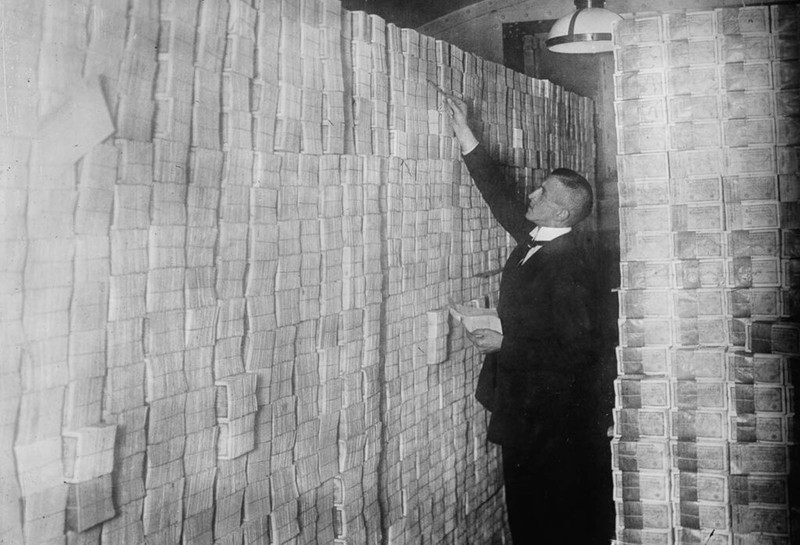
German hyperinflation, 1923
The Dawes Plan in 1924 helped for a while by reorganizing payments and bringing in more U.S. loans, but it solved the emergency, not the dependence.
The Great Depression goes global
The 1929 crash exposed deeper weaknesses:
- speculation in stocks
- overproduction in industry and agriculture
- weak banks
- unequal purchasing power so people could not buy what factories produced
- too much credit and debt
The crisis spread fast when U.S. lenders recalled loans, trade fell, commodity prices crashed, tariffs rose, and the gold standard made governments hesitate to spend freely. The map traces that spread outward from the United States and highlights just how widely economies contracted.
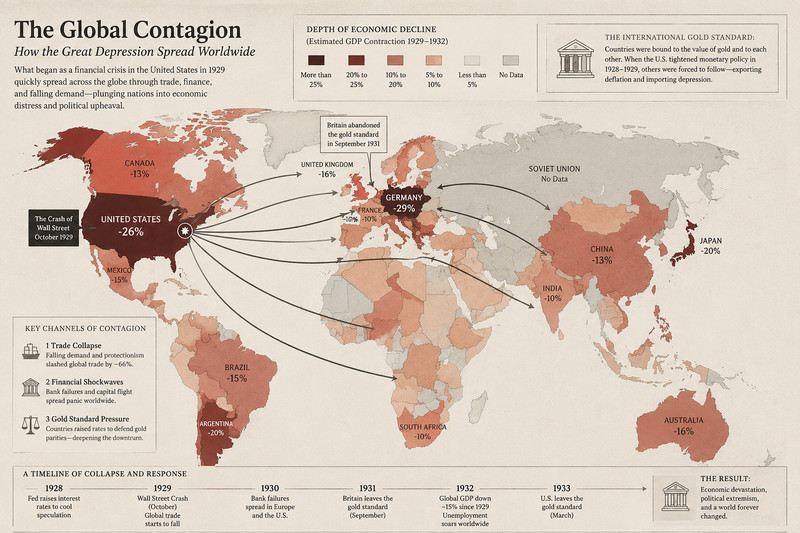
Global spread of the Great Depression
The result was a major shift away from laissez-faire toward intervention.
The Main Types of Interwar Economic Responses
Different governments intervened for different reasons. The common pattern was more state power. The differences were about ownership, freedom, and purpose.
| Response | What stayed | What changed | Main goal |
|---|---|---|---|
| Democratic mixed economies | Private property and markets | Bank regulation, jobs programs, welfare | Save capitalism through reform |
| Soviet command economy | State ownership | State set production, prices, investment, distribution | Rapid industrialization and socialism |
| Fascist corporatism | Private property | Workers and businesses subordinated to state | National strength, autarky, war prep |
| Latin American nationalist reform | Mixed economy | More state control over labor, resources, industry | Reduce dependence on foreign markets |
The Soviet Five-Year Plans
The Soviet Union took intervention furthest. In 1928, Stalin ended the New Economic Policy and launched the first Five-Year Plan.
State planners set quotas and directed labor and raw materials into heavy industry such as steel, coal, electricity, machinery, railroads, and armaments. This built new industrial centers fast, but consumer goods and living standards were pushed aside.
Collectivization
In 1929, the state forced peasants onto collective farms and state farms. The goal was to collect more grain, mechanize farming, and use agriculture to fund industry.
Peasants resisted by withholding grain, slaughtering livestock, and fighting officials. The state answered with arrests, deportations, executions, and attacks on so-called kulaks.
That coercion helped produce the famine of 1932-1933, especially in Ukraine and Kazakhstan. The Ukrainian case is the Holodomor.
Soviet propaganda presented the Five-Year Plans very differently, as a shared national effort pulling industry forward.
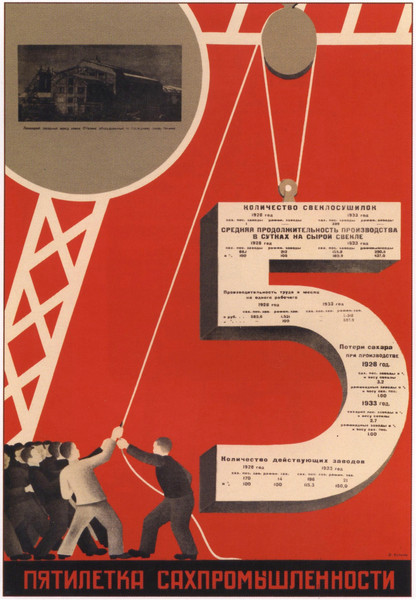
Soviet Five-Year Plan propaganda poster
The key AP point is this: Soviet industrialization did succeed in some ways, but it came with massive suffering. The USSR was less exposed to the capitalist crash, but that did not mean prosperity or freedom.
Democratic and Fascist Responses in the United States and Europe
The United States expanded government power without ending democracy. FDR’s New Deal used relief, recovery, and reform.
- Banking reforms restored confidence through the bank holiday, FDIC, SEC, and Glass-Steagall.
- Jobs programs like the CCC, WPA, and TVA put people to work and built infrastructure.
- AAA paid farmers to reduce production and raise prices.
- Social Security Act and Wagner Act expanded welfare and labor rights.
- Keynes defended government spending to boost demand.
Mussolini’s Italy and Hitler’s Germany also intervened, but under dictatorship.
- In Italy, corporatism claimed to organize workers and employers by sector under state supervision. Independent unions were crushed. Policies included the Battle for Grain, public works, and bank intervention.
- In Nazi Germany, unemployment and Weimar instability helped Hitler rise. Unions were abolished and replaced by the German Labor Front. The regime used autobahns, deficit spending, rearmament, conscription, and the Four Year Plan to push autarky and war preparation.
Brazil, Mexico, and the Big Picture
Latin American governments also moved toward intervention because export economies got hammered by the Depression.
- In Brazil, Getúlio Vargas responded to the collapse of coffee exports by managing coffee prices, promoting import substitution industrialization, expanding infrastructure, and supervising unions under an increasingly authoritarian Estado Novo.
- In Mexico, Lázaro Cárdenas pushed land reform through ejidos, tied labor and peasant groups to the state, and nationalized oil in 1938 by creating PEMEX.
Key Takeaways
Great Depression
Global economic collapse beginning in 1929 that caused bank failures, falling trade and production, mass unemployment, and expanded government intervention
Wall Street Crash of 1929
October 1929 collapse in U.S. stock prices that helped trigger, but did not solely cause, the Great Depression
German Hyperinflation of 1923
Collapse of the German mark after the government printed money during the Ruhr crisis, destroying purchasing power and many middle-class savings
Dawes Plan
1924 arrangement that restructured German reparations and facilitated American loans, temporarily stabilizing Germany while preserving dependence on U.S. credit
Gold Standard
System tying currencies to fixed amounts of gold, limiting monetary flexibility and encouraging deflationary policies during the depression
Protectionism
Use of tariffs and other trade barriers to protect domestic producers, provoking retaliation and further reducing global trade during the depression
Laissez-Faire Economics
Belief that markets should operate with limited government interference, an approach weakened by interwar economic crises
Mixed Economy
Economy based mainly on private property and markets but supplemented by government regulation, public enterprises, and welfare programs
Command Economy
Economy in which the state controls investment, production, prices, and distribution rather than relying primarily on markets
Joseph Stalin
Soviet leader who ended the New Economic Policy and imposed Five-Year Plans, rapid industrialization, and forced collectivization
Five-Year Plans
Soviet central plans beginning in 1928 that set production targets and concentrated resources on rapid heavy industrialization
Collectivization
Stalin’s forced consolidation of peasant farms into collective or state farms to control grain and support industrialization
Kulaks
People labeled prosperous peasant class enemies during collectivization and subjected to confiscation, deportation, imprisonment, or execution
Holodomor
Name commonly given to the catastrophic 1932–1933 famine in Soviet Ukraine, to which forced collectivization, grain seizures, production disruption, and punitive policies contributed
Herbert Hoover
U.S. president whose early depression response emphasized limited public works, loans to institutions, and voluntary cooperation
Franklin D. Roosevelt
U.S. president elected in 1932 who launched the New Deal and expanded federal responsibility for economic recovery and security
New Deal
Roosevelt’s program of relief, recovery, and reform that expanded federal action while preserving democracy, private property, and capitalism
Relief, Recovery, and Reform
New Deal goals: immediate aid, renewed employment and production, and lasting changes intended to stabilize capitalism
Federal Deposit Insurance Corporation (FDIC)
New Deal agency that insured qualifying bank deposits to protect savings and restore confidence in banks
Securities and Exchange Commission (SEC)
New Deal agency created to regulate securities markets and curb abuses associated with financial speculation
Civilian Conservation Corps (CCC)
New Deal relief program that employed young men on conservation and natural-resource projects
Works Progress Administration (WPA)
New Deal agency that employed people on roads, public buildings, parks, arts, and other public projects
Tennessee Valley Authority (TVA)
New Deal agency that built dams, generated electricity, controlled floods, and promoted regional development
Agricultural Adjustment Administration (AAA)
New Deal agency that paid participating farmers to reduce production and raise prices, sometimes displacing tenants and sharecroppers
National Labor Relations Act (Wagner Act)
1935 New Deal law protecting labor unions, collective bargaining, and workers’ right to organize
Social Security Act of 1935
New Deal law establishing old-age pensions and unemployment insurance, initially excluding many agricultural and domestic workers
John Maynard Keynes
British economist who argued that weak private demand could prolong unemployment and that government spending could stimulate recovery
Keynesian Economics
Theory that governments can combat recessions through deficit spending and other policies that increase aggregate demand
Fascist Corporatism
Authoritarian system retaining private ownership while placing employers and workers under state-supervised bodies and suppressing independent unions
Benito Mussolini
Italian Fascist dictator who imposed corporatism, suppressed independent unions, sponsored public works, and expanded state influence over industry
Battle for Grain
Mussolini’s campaign to increase Italy’s domestic grain production and reduce dependence on imported food
Adolf Hitler
Nazi dictator whose regime reduced unemployment through public works, conscription, deficit spending, rearmament, and state direction of private industry
German Labor Front
Nazi organization that replaced independent trade unions and placed German workers under state control
Four Year Plan
German plan announced in 1936 to prepare for war, expand strategic production, and reduce dependence on imports
Autarky
Policy of pursuing national economic self-sufficiency by reducing reliance on foreign imports and resources
Getúlio Vargas
Brazilian leader who managed coffee, promoted industry and infrastructure, sponsored labor protections, and imposed authoritarian state supervision
Estado Novo
Authoritarian Brazilian regime established by Vargas in 1937 that restricted political freedom while directing labor and economic development
Import Substitution Industrialization
Strategy of producing formerly imported goods domestically through tariffs, subsidies, state investment, or exchange controls
Lázaro Cárdenas
Mexican president from 1934 to 1940 who redistributed land, supported organized labor, and nationalized foreign-owned oil
Ejidos
Mexican communities holding land collectively while families generally cultivated assigned plots, expanded through Cárdenas’s land reform
Economic Nationalism
Use of state policy to reduce foreign dependence and increase national control over industry, trade, land, or natural resources
Mexican Oil Expropriation of 1938
Cárdenas’s nationalization of foreign-owned oil companies, asserting Mexican sovereignty over a strategic resource
Petróleos Mexicanos (PEMEX)
Mexican state oil company placed in control of the industry nationalized by Cárdenas in 1938
Notes
Great Depression
Global economic collapse beginning in 1929 that caused bank failures, falling trade and production, mass unemployment, and expanded government intervention
Wall Street Crash of 1929
October 1929 collapse in U.S. stock prices that helped trigger, but did not solely cause, the Great Depression
German Hyperinflation of 1923
Collapse of the German mark after the government printed money during the Ruhr crisis, destroying purchasing power and many middle-class savings
Dawes Plan
1924 arrangement that restructured German reparations and facilitated American loans, temporarily stabilizing Germany while preserving dependence on U.S. credit
Gold Standard
System tying currencies to fixed amounts of gold, limiting monetary flexibility and encouraging deflationary policies during the depression
Protectionism
Use of tariffs and other trade barriers to protect domestic producers, provoking retaliation and further reducing global trade during the depression
Laissez-Faire Economics
Belief that markets should operate with limited government interference, an approach weakened by interwar economic crises
Mixed Economy
Economy based mainly on private property and markets but supplemented by government regulation, public enterprises, and welfare programs
Command Economy
Economy in which the state controls investment, production, prices, and distribution rather than relying primarily on markets
Joseph Stalin
Soviet leader who ended the New Economic Policy and imposed Five-Year Plans, rapid industrialization, and forced collectivization
Five-Year Plans
Soviet central plans beginning in 1928 that set production targets and concentrated resources on rapid heavy industrialization
Collectivization
Stalin’s forced consolidation of peasant farms into collective or state farms to control grain and support industrialization
Kulaks
People labeled prosperous peasant class enemies during collectivization and subjected to confiscation, deportation, imprisonment, or execution
Holodomor
Name commonly given to the catastrophic 1932–1933 famine in Soviet Ukraine, to which forced collectivization, grain seizures, production disruption, and punitive policies contributed
Herbert Hoover
U.S. president whose early depression response emphasized limited public works, loans to institutions, and voluntary cooperation
Franklin D. Roosevelt
U.S. president elected in 1932 who launched the New Deal and expanded federal responsibility for economic recovery and security
New Deal
Roosevelt’s program of relief, recovery, and reform that expanded federal action while preserving democracy, private property, and capitalism
Relief, Recovery, and Reform
New Deal goals: immediate aid, renewed employment and production, and lasting changes intended to stabilize capitalism
Federal Deposit Insurance Corporation (FDIC)
New Deal agency that insured qualifying bank deposits to protect savings and restore confidence in banks
Securities and Exchange Commission (SEC)
New Deal agency created to regulate securities markets and curb abuses associated with financial speculation
Civilian Conservation Corps (CCC)
New Deal relief program that employed young men on conservation and natural-resource projects
Works Progress Administration (WPA)
New Deal agency that employed people on roads, public buildings, parks, arts, and other public projects
Tennessee Valley Authority (TVA)
New Deal agency that built dams, generated electricity, controlled floods, and promoted regional development
Agricultural Adjustment Administration (AAA)
New Deal agency that paid participating farmers to reduce production and raise prices, sometimes displacing tenants and sharecroppers
National Labor Relations Act (Wagner Act)
1935 New Deal law protecting labor unions, collective bargaining, and workers’ right to organize
Social Security Act of 1935
New Deal law establishing old-age pensions and unemployment insurance, initially excluding many agricultural and domestic workers
John Maynard Keynes
British economist who argued that weak private demand could prolong unemployment and that government spending could stimulate recovery
Keynesian Economics
Theory that governments can combat recessions through deficit spending and other policies that increase aggregate demand
Fascist Corporatism
Authoritarian system retaining private ownership while placing employers and workers under state-supervised bodies and suppressing independent unions
Benito Mussolini
Italian Fascist dictator who imposed corporatism, suppressed independent unions, sponsored public works, and expanded state influence over industry
Battle for Grain
Mussolini’s campaign to increase Italy’s domestic grain production and reduce dependence on imported food
Adolf Hitler
Nazi dictator whose regime reduced unemployment through public works, conscription, deficit spending, rearmament, and state direction of private industry
German Labor Front
Nazi organization that replaced independent trade unions and placed German workers under state control
Four Year Plan
German plan announced in 1936 to prepare for war, expand strategic production, and reduce dependence on imports
Autarky
Policy of pursuing national economic self-sufficiency by reducing reliance on foreign imports and resources
Getúlio Vargas
Brazilian leader who managed coffee, promoted industry and infrastructure, sponsored labor protections, and imposed authoritarian state supervision
Estado Novo
Authoritarian Brazilian regime established by Vargas in 1937 that restricted political freedom while directing labor and economic development
Import Substitution Industrialization
Strategy of producing formerly imported goods domestically through tariffs, subsidies, state investment, or exchange controls
Lázaro Cárdenas
Mexican president from 1934 to 1940 who redistributed land, supported organized labor, and nationalized foreign-owned oil
Ejidos
Mexican communities holding land collectively while families generally cultivated assigned plots, expanded through Cárdenas’s land reform
Economic Nationalism
Use of state policy to reduce foreign dependence and increase national control over industry, trade, land, or natural resources
Mexican Oil Expropriation of 1938
Cárdenas’s nationalization of foreign-owned oil companies, asserting Mexican sovereignty over a strategic resource
Petróleos Mexicanos (PEMEX)
Mexican state oil company placed in control of the industry nationalized by Cárdenas in 1938
