Topic 3.4 Notes – Comparison in Land-Based Empires
How Land-Based Empires Increased Their Influence
“Increased influence” means more than winning battles. These empires had to expand territory, control subjects, collect steady revenue, keep elites loyal, look legitimate, and beat rival states.
The main comparison set:
- Ottoman Empire in Anatolia, southeastern Europe, the Middle East, and North Africa
- Safavid Empire in Persia/Iran
- Mughal Empire in South Asia
- Qing Empire under the Manchus in China and Inner Asia
- Russia as a strong comparison for overland expansion and centralization
This map gives you the basic geographic frame for those land-based empires around 1700.
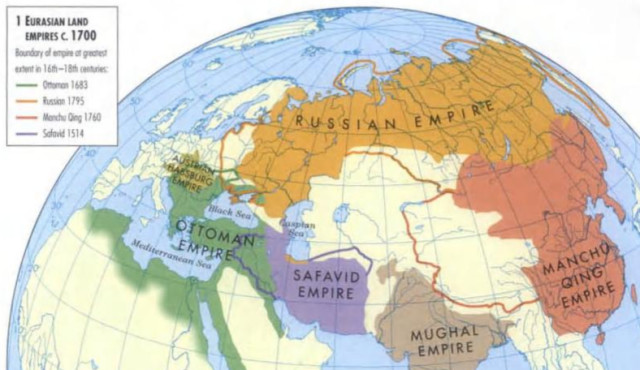
Major Eurasian land empires, c. 1700
The pattern across the whole period is simple. They shared a common imperial toolkit, but each empire adjusted it to local conditions.
Best comparison categories:
- military expansion
- administrative and military elites
- taxation and revenue
- religion and legitimacy
- art and architecture
- governing diverse populations
A strong AP claim sounds like this: Both the Ottomans and Mughals used gunpowder, service elites, and land revenue to expand power, but they governed diversity differently because they ruled different populations.
Military Power and Expansion
Gunpowder mattered because cannons, firearms, forts, and organized armies let rulers defeat rivals and seize cities.
- Ottomans: Mehmed II used huge artillery to conquer Constantinople in 1453. The Janissaries were disciplined infantry, and the empire also used cavalry, supply systems, and naval power.
- Safavids: Shah Ismail I first relied on Qizilbash tribal cavalry. The Ottoman win at Chaldiran in 1514 showed the danger of weak firearm use. Shah Abbas I later built stronger gunpowder forces.
- Mughals: Babur won the First Battle of Panipat in 1526 with artillery and matchlocks, then held gains through alliances with Indian elites.
- Qing: the Manchus used the Eight Banners, cavalry, firearms, and Chinese siege skills. They took Beijing in 1644 and expanded into Mongolia, Tibet, and Central Asia.
- Russia: expansion across Siberia used Cossacks, firearms, forts, and river routes. Yasak tribute in furs tied conquest to revenue.
- Morocco vs. Songhai: Morocco defeated Songhai at Tondibi in 1591 with firearms.
How Empires Controlled Elites and Collected Revenue
Conquest only lasted if rulers could control the people with weapons and money.
Military and bureaucratic elites
- Ottomans used devshirme, recruiting Christian boys for Janissaries and palace service, which tied them directly to the sultan.
- Safavids used ghulams under Shah Abbas I to weaken powerful Qizilbash chiefs.
- Mughals used the mansabdari system, ranking officials by status and military duty. They also incorporated Rajputs.
- Qing kept the Confucian bureaucracy and civil service exams, but preserved Manchu privilege through the Eight Banners.
- Russia tied a service nobility to the tsar. Peter the Great’s Table of Ranks (1722) linked status to state service.
- Tokugawa Japan used sankin-kotai, forcing daimyo to spend time in Edo so the shogun could watch them.
Taxation and revenue
- Ottomans used tax farming and land-revenue systems.
- Mughals collected land revenue through zamindars.
- Safavids taxed agriculture and trade, especially the silk trade, and Shah Abbas expanded crown lands.
- Qing inherited China’s large agrarian tax system. The Ming Single Whip reforms had already increased silver-based taxes.
- Russia depended on peasant taxation, serf labor, and yasak in Siberia.
Religion, Legitimacy, and Governing Diversity
Religion helped rulers justify power and manage mixed populations, but tolerance was usually practical, not modern equality.
- Ottomans claimed Sunni legitimacy and used the millet system, giving Christians and Jews communal autonomy.
- Safavids made Twelver Shi’a Islam the state religion, which helped build a distinct Persian identity and sharpened rivalry with the Sunni Ottomans.
- Mughals under Akbar built inclusion through Rajput alliances, ending jizya, religious debates, and Din-i Ilahi. Aurangzeb restored jizya and ruled more orthodoxly.
- Qing used multiple identities at once. They acted as Confucian emperors in China, Buddhist patrons in Inner Asia, and Manchu rulers among banner elites.
- Russia allied with the Russian Orthodox Church. Peter the Great created the Holy Synod in 1721 to tighten state control.
Political and religious rivalry often overlapped:
- Ottoman-Safavid wars
- Mughal-Safavid struggle over Kandahar
Interhemispheric expansion also spread religion:
- Catholic missions in the Americas and Asia
- Virgin of Guadalupe as a classic example of syncretism
Art, Architecture, and the Best Comparison Claims
Rulers turned wealth into visible authority through monumental building and court culture.
- Ottomans: Süleymaniye Mosque, Topkapı Palace
- Safavids: Isfahan under Shah Abbas I, Shah Mosque
- Mughals: Taj Mahal, plus forts, gardens, and mosques
- Qing: imperial portraits, Forbidden City
- France: Versailles under Louis XIV shows this method was widespread
The strongest comparison pattern:
- Both or all empires used similar methods
- They differed because of geography, religion, demographics, and inherited institutions
High-value pairings:
- Ottoman devshirme vs Mughal mansabdars
- Ottoman Sunni millet system vs Safavid Shi’a state-building
- Akbar’s accommodation vs Aurangzeb’s orthodoxy
- Qing dual rule structure vs Russian service nobility and frontier tribute
