Topic 8.4 Notes – Spread of Communism After 1900
What Communism and Redistribution Meant After 1900
This topic gets tricky because communism, socialism, and redistribution overlap, but they are not the same thing.
- Communism comes from Marx. He argued that history is driven by class struggle, especially between the bourgeoisie (owners) and proletariat (workers). The goal was ending private ownership of the means of production and creating a classless society.
- Marxism-Leninism adapted that idea into a real political system. Lenin argued a vanguard party should lead the revolution. In practice this meant one-party rule, nationalization, and central planning.
- Maoism adapted communism to China. China did not have many factory workers, so Mao treated peasants as the main revolutionary force.
- Socialism is broader. It can mean more equality and more government control of the economy, but it can still work through elections, reform, and mixed economies.
Policies you need to keep straight
| Term | What it means |
|---|---|
| Land reform | Taking land from big landlords and giving it to peasants or tenants |
| Redistribution | Transferring land, wealth, or resources from one group to another |
| Nationalization | Government takeover of industries, banks, mines, oil, or transport |
| Collectivization | Merging small farms into collective or state-run farms |
| Central planning | Government sets production goals and controls resources |
| Communes | Large collective rural units that organize labor, farming, and daily life |
The big AP point is simple. Redistribution did not always equal communism.
Why Communist and Socialist Movements Attracted Support
These movements spread where old systems looked broken.
- Unequal landownership mattered a lot. Peasants often worked land they did not own, paid high rents, and stayed in debt.
- Weak or corrupt governments could not fix inequality, so radical movements looked more credible.
- Foreign imperialism made communism attractive because taking back land or industries could look like national liberation too.
- In anti-colonial struggles, nationalism and class revolution fused together. That is why China and Vietnam matter so much.
- War, occupation, inflation, and collapse created openings for revolution.
- The Soviet Union gave a model and support, but local conditions explain why people joined.
Standard examples
- China and Vietnam tied communism to anti-imperial resistance.
- Ethiopia combined land inequality with state crisis.
- Cuba mixed inequality, dictatorship, and resentment of U.S. influence.
How China Became Communist
China’s revolution makes more sense when you see how state weakness kept piling up.
- The Qing dynasty collapsed in 1911, leaving a weak republic and rule by warlords.
- The May Fourth Movement in 1919 attacked foreign control and Chinese weakness. It helped spread Marxism.
- The CCP was founded in 1921. Its main rival was the Guomindang led by Sun Yat-sen, then Chiang Kai-shek.
- In 1927, Chiang purged communists. That pushed the CCP into the countryside.
- Mao built support through rent reduction, literacy, land promises, and guerrilla warfare.
- The Long March of 1934 to 1935 saved the CCP and made Mao its top leader.
Japanese aggression
Japan changed everything, and this map helps you see why. The shaded occupation zones spread across eastern China, and the striped areas mark communist base regions that expanded during the war.
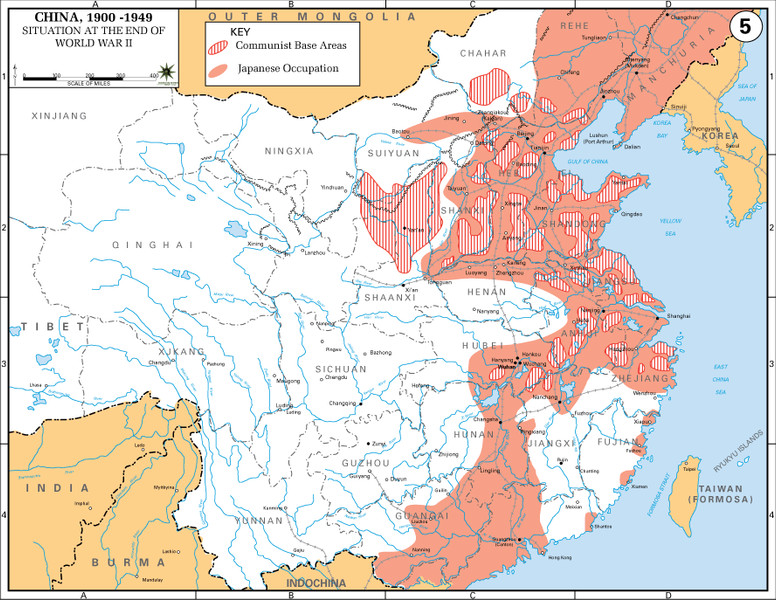
China at the end of World War II
- Manchuria was seized in 1931.
- Japan launched a full invasion in 1937.
- The CCP and Nationalists formed the Second United Front.
- The Nationalists were weakened by war losses, inflation, corruption, and poor morale.
- The CCP gained support by resisting Japan and organizing rural communities.
Communist victory in 1949
After WWII, civil war resumed. The CCP won because it had peasant support, discipline, stronger leadership, and because the Nationalists had lost legitimacy. On October 1, 1949, Mao declared the People’s Republic of China. Chiang retreated to Taiwan.
How Communist Rule Reshaped China
Once in power, the CCP changed both society and the economy.
- Land reform destroyed landlord power, often through struggle sessions, violence, and executions.
- The Marriage Law of 1950 expanded women’s rights.
- The First Five-Year Plan built heavy industry with Soviet-style planning.
- Agriculture moved from redistribution into collectivization.
Great Leap Forward
In 1958, Mao tried to industrialize fast through people’s communes and backyard furnaces.
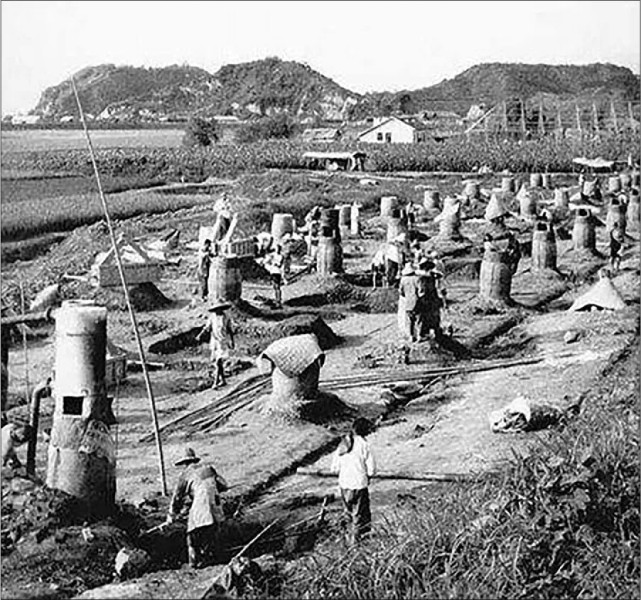
Backyard furnaces during the Great Leap Forward
Local officials lied about harvests, the state took grain based on fake numbers, and villages starved. The famine from 1959 to 1961 killed tens of millions. This is one of the clearest AP examples of how extreme state control plus repression caused catastrophe.
Cultural Revolution
In 1966, Mao launched the Cultural Revolution to attack “capitalist roaders” and regain control. Red Guards targeted intellectuals, officials, and the Four Olds. The result was humiliation, violence, persecution, and chaos. China became a one-party authoritarian state with major social change and repeated repression.
Other Redistribution Movements in Africa, Asia, and Latin America
China was the biggest case, but similar pressures showed up elsewhere.
- Vietnam under Ho Chi Minh tied communism to anti-French and anti-Japanese struggle. After Dien Bien Phu in 1954, Vietnam was divided at the 17th parallel. Communist victory came in 1975. Land reform and later collectivization included coercion and executions.
- Ethiopia saw the Derg overthrow Haile Selassie in 1974. Under Mengistu, it used “land to the tiller,” nationalization, collectivization, and villagization. It also used terror, caused displacement, and ruled harshly.
- Kerala in India elected a communist government in 1957. It passed land reform through law, protected tenants, and stayed democratic.
- Iran’s White Revolution in 1963 was the Shah’s noncommunist land reform program. It also promoted literacy, women’s suffrage, and infrastructure.
- In Latin America, Cuba under Fidel Castro became Marxist-Leninist after the 1959 revolution, used land reform and nationalization, and built one-party rule. Noncommunist examples include Mexico’s ejidos under Lázaro Cárdenas and Chile under Allende.
Key Takeaways
Karl Marx
German theorist who argued that class struggle would lead the proletariat to overthrow capitalism and create a classless society
Communism
Ideology seeking collective ownership of productive property and the elimination of economic classes, usually implemented by twentieth-century one-party states
Vladimir Lenin
Russian revolutionary who argued that a disciplined vanguard party should seize power and direct the transition to socialism
Marxism-Leninism
Marxism modified to give a revolutionary vanguard party the leading role in seizing power and building socialism
Maoism
Mao Zedong’s adaptation of Marxism-Leninism that treated poor peasants rather than urban workers as the main revolutionary class
Socialism
Broad ideology favoring social ownership, economic equality, or government direction of the economy without necessarily requiring one-party rule or abolishing all private property
Land Reform
Changing agricultural landownership by limiting estates, transferring land to cultivators, or protecting tenants
Redistribution
Transfer of land, wealth, or access to resources from one social group to another
Nationalization
Transfer of privately owned industries, banks, transportation systems, or natural resources into government ownership
Collectivization
Combining individually operated farms into collective or state-controlled agricultural units
Central Planning
Government direction of production targets, labor, materials, and investment instead of reliance primarily on markets
Commune
Large collective unit that organizes land, labor, and sometimes food, childcare, and other daily activities communally
May Fourth Movement
Movement beginning with 1919 protests against transferring German privileges in Shandong to Japan and expanding into criticism of imperialism, tradition, and China’s political weakness
Chinese Communist Party (CCP)
Party founded in 1921 that organized rural support, defeated the Nationalists, and established communist rule in China in 1949
Nationalist Party (Kuomintang)
Chinese party led by Chiang Kai-shek that fought the communists and withdrew to Taiwan after its 1949 defeat
Chiang Kai-shek
Nationalist leader whose government lost support through corruption, inflation, military failures, and abuses before retreating to Taiwan in 1949
Mao Zedong
Leader of the CCP who built a peasant-centered revolution, founded the People’s Republic of China, and launched the Great Leap Forward and Cultural Revolution
Long March
The CCP’s 1934–1935 retreat to northwestern China that preserved the movement, strengthened Mao’s leadership, and became a revolutionary legend
Japanese Aggression in China
Japan’s seizure of Manchuria in 1931 and full invasion in 1937 weakened the Nationalists while giving the CCP opportunities to resist and expand rural support
Chinese Communist Revolution
CCP victory in 1949 caused by rural inequality, communist organization, Japanese invasion, and Nationalist corruption, inflation, and military failure
People’s Republic of China (PRC)
Communist-led state proclaimed by Mao Zedong in Beijing on October 1, 1949, after the CCP defeated the Nationalists
Chinese Land Reform
Communist campaign that broke up large estates and transferred land to peasants while persecuting landlords and extending party control into villages
Marriage Law of 1950
Chinese law that outlawed arranged marriage, child marriage, and concubinage while expanding women’s divorce and property rights
First Five-Year Plan
China’s 1953–1957 Soviet-style plan emphasizing heavy industry, infrastructure, urban growth, and expanding agricultural collectivization
Great Leap Forward
Mao’s 1958–1962 campaign of communes, mass mobilization, and rapid industrialization that produced economic disorder and a famine killing tens of millions
Cultural Revolution
Mao’s 1966–1976 campaign against alleged capitalist and traditional influences that caused purges, violence, educational disruption, and renewed authoritarian control
Ho Chi Minh
Vietnamese communist and nationalist leader who linked independence from foreign rule with land reform and socialist revolution
Viet Minh
Independence movement led by Ho Chi Minh that resisted Japanese occupation and then fought to end French colonial rule
Vietnamese Communist Revolution
Anti-colonial and civil conflict that brought communist forces to power in all Vietnam by 1975 and created the Socialist Republic of Vietnam in 1976
Derg
Ethiopian military committee that overthrew Haile Selassie in 1974 and imposed Marxist nationalization, collectivization, and authoritarian rule
Mengistu Haile Mariam
Dominant leader of Ethiopia’s Derg who directed its Marxist-Leninist policies and violent political repression
Red Terror
Derg campaign in the late 1970s that detained, tortured, and killed suspected political opponents in Ethiopia
Kerala Land Reform
Democratic reforms in southern India that limited large estates, strengthened tenants, and transferred security or ownership to cultivators
White Revolution
The shah’s noncommunist modernization program begun in 1963 that redistributed some land and promoted literacy, health, infrastructure, and women’s suffrage
Mohammad Reza Pahlavi
Shah of Iran who launched the White Revolution to weaken landlords, modernize Iran, strengthen the monarchy, and reduce communism’s appeal
Cuban Revolution
Fidel Castro’s 1959 overthrow of Batista that led to land redistribution, nationalization, Marxism-Leninism, and a one-party state allied with the Soviet Union
Fidel Castro
Cuban revolutionary leader who overthrew Batista, redistributed land, nationalized industries, and aligned Cuba with Marxism-Leninism and the Soviet Union
Cuban Agrarian Reform Law of 1959
Law that limited large Cuban estates and redistributed agricultural land after Castro’s revolution
Ejido System
Mexican land-reform system that distributed land for communal use, especially under President Lázaro Cárdenas
Lázaro Cárdenas
Mexican president who greatly expanded land redistribution through the ejido system during the 1930s
Salvador Allende
Democratically elected socialist president of Chile who accelerated land reform and nationalized major industries, including copper, from 1970 to 1973
Bourgeoisie vs. Proletariat
In Marxist theory, the bourgeoisie own the means of production, while the proletariat sell their labor and produce wealth
Chinese Civil War
Conflict between the CCP and Nationalists that resumed after Japan’s 1945 defeat and ended with communist victory on the mainland in 1949
Second United Front
Fragile alliance formed by the Nationalists and CCP to resist Japan after the full-scale invasion of China in 1937
Red Guards
Young Maoist activists who attacked alleged capitalist roaders, intellectuals, officials, and the Four Olds during the Cultural Revolution
Notes
Karl Marx
German theorist who argued that class struggle would lead the proletariat to overthrow capitalism and create a classless society
Communism
Ideology seeking collective ownership of productive property and the elimination of economic classes, usually implemented by twentieth-century one-party states
Vladimir Lenin
Russian revolutionary who argued that a disciplined vanguard party should seize power and direct the transition to socialism
Marxism-Leninism
Marxism modified to give a revolutionary vanguard party the leading role in seizing power and building socialism
Maoism
Mao Zedong’s adaptation of Marxism-Leninism that treated poor peasants rather than urban workers as the main revolutionary class
Socialism
Broad ideology favoring social ownership, economic equality, or government direction of the economy without necessarily requiring one-party rule or abolishing all private property
Land Reform
Changing agricultural landownership by limiting estates, transferring land to cultivators, or protecting tenants
Redistribution
Transfer of land, wealth, or access to resources from one social group to another
Nationalization
Transfer of privately owned industries, banks, transportation systems, or natural resources into government ownership
Collectivization
Combining individually operated farms into collective or state-controlled agricultural units
Central Planning
Government direction of production targets, labor, materials, and investment instead of reliance primarily on markets
Commune
Large collective unit that organizes land, labor, and sometimes food, childcare, and other daily activities communally
May Fourth Movement
Movement beginning with 1919 protests against transferring German privileges in Shandong to Japan and expanding into criticism of imperialism, tradition, and China’s political weakness
Chinese Communist Party (CCP)
Party founded in 1921 that organized rural support, defeated the Nationalists, and established communist rule in China in 1949
Nationalist Party (Kuomintang)
Chinese party led by Chiang Kai-shek that fought the communists and withdrew to Taiwan after its 1949 defeat
Chiang Kai-shek
Nationalist leader whose government lost support through corruption, inflation, military failures, and abuses before retreating to Taiwan in 1949
Mao Zedong
Leader of the CCP who built a peasant-centered revolution, founded the People’s Republic of China, and launched the Great Leap Forward and Cultural Revolution
Long March
The CCP’s 1934–1935 retreat to northwestern China that preserved the movement, strengthened Mao’s leadership, and became a revolutionary legend
Japanese Aggression in China
Japan’s seizure of Manchuria in 1931 and full invasion in 1937 weakened the Nationalists while giving the CCP opportunities to resist and expand rural support
Chinese Communist Revolution
CCP victory in 1949 caused by rural inequality, communist organization, Japanese invasion, and Nationalist corruption, inflation, and military failure
People’s Republic of China (PRC)
Communist-led state proclaimed by Mao Zedong in Beijing on October 1, 1949, after the CCP defeated the Nationalists
Chinese Land Reform
Communist campaign that broke up large estates and transferred land to peasants while persecuting landlords and extending party control into villages
Marriage Law of 1950
Chinese law that outlawed arranged marriage, child marriage, and concubinage while expanding women’s divorce and property rights
First Five-Year Plan
China’s 1953–1957 Soviet-style plan emphasizing heavy industry, infrastructure, urban growth, and expanding agricultural collectivization
Great Leap Forward
Mao’s 1958–1962 campaign of communes, mass mobilization, and rapid industrialization that produced economic disorder and a famine killing tens of millions
Cultural Revolution
Mao’s 1966–1976 campaign against alleged capitalist and traditional influences that caused purges, violence, educational disruption, and renewed authoritarian control
Ho Chi Minh
Vietnamese communist and nationalist leader who linked independence from foreign rule with land reform and socialist revolution
Viet Minh
Independence movement led by Ho Chi Minh that resisted Japanese occupation and then fought to end French colonial rule
Vietnamese Communist Revolution
Anti-colonial and civil conflict that brought communist forces to power in all Vietnam by 1975 and created the Socialist Republic of Vietnam in 1976
Derg
Ethiopian military committee that overthrew Haile Selassie in 1974 and imposed Marxist nationalization, collectivization, and authoritarian rule
Mengistu Haile Mariam
Dominant leader of Ethiopia’s Derg who directed its Marxist-Leninist policies and violent political repression
Red Terror
Derg campaign in the late 1970s that detained, tortured, and killed suspected political opponents in Ethiopia
Kerala Land Reform
Democratic reforms in southern India that limited large estates, strengthened tenants, and transferred security or ownership to cultivators
White Revolution
The shah’s noncommunist modernization program begun in 1963 that redistributed some land and promoted literacy, health, infrastructure, and women’s suffrage
Mohammad Reza Pahlavi
Shah of Iran who launched the White Revolution to weaken landlords, modernize Iran, strengthen the monarchy, and reduce communism’s appeal
Cuban Revolution
Fidel Castro’s 1959 overthrow of Batista that led to land redistribution, nationalization, Marxism-Leninism, and a one-party state allied with the Soviet Union
Fidel Castro
Cuban revolutionary leader who overthrew Batista, redistributed land, nationalized industries, and aligned Cuba with Marxism-Leninism and the Soviet Union
Cuban Agrarian Reform Law of 1959
Law that limited large Cuban estates and redistributed agricultural land after Castro’s revolution
Ejido System
Mexican land-reform system that distributed land for communal use, especially under President Lázaro Cárdenas
Lázaro Cárdenas
Mexican president who greatly expanded land redistribution through the ejido system during the 1930s
Salvador Allende
Democratically elected socialist president of Chile who accelerated land reform and nationalized major industries, including copper, from 1970 to 1973
Bourgeoisie vs. Proletariat
In Marxist theory, the bourgeoisie own the means of production, while the proletariat sell their labor and produce wealth
Chinese Civil War
Conflict between the CCP and Nationalists that resumed after Japan’s 1945 defeat and ended with communist victory on the mainland in 1949
Second United Front
Fragile alliance formed by the Nationalists and CCP to resist Japan after the full-scale invasion of China in 1937
Red Guards
Young Maoist activists who attacked alleged capitalist roaders, intellectuals, officials, and the Four Olds during the Cultural Revolution
