Topic 3.1 Notes – Empires Expand
How Land-Based Empires Expanded from 1450 to 1750
A land-based empire was a large, connected state. Think Ottomans, Safavids, Mughals, and Qing. Their power came from controlling huge stretches of neighboring land.
The pattern stayed pretty consistent. Rulers built stronger governments, collected more taxes, organized armies, and attacked weak or divided neighbors. Gunpowder mattered a lot, but it worked only when a state could afford weapons, move supplies, train soldiers, and hold what it conquered.
On a map of Eurasia around 1700, you can see how massive these connected empires became across the continent.
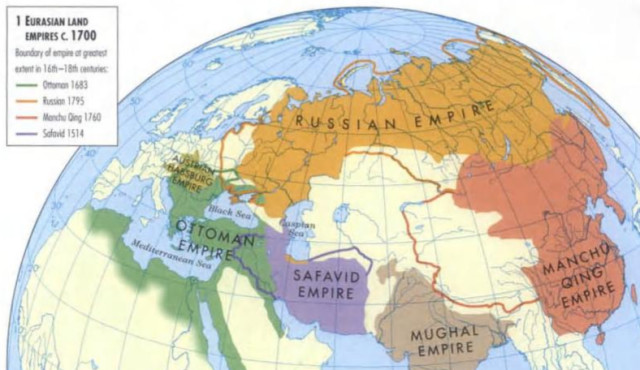
Eurasian land empires c. 1700
Why gunpowder helped:
- Heavy cannon could smash fortified walls in a siege. That changed warfare because old stone defenses were less reliable.
- Muskets and arquebuses made infantry more dangerous, especially when soldiers fought in disciplined formations.
- Field artillery could break up larger enemy forces before hand-to-hand fighting began.
- Firearms were expensive, so richer states had an edge. Military success depended on revenue as much as weapons.
Why rulers expanded:
- Economic gains meant more farmland, taxes, trade routes, cities, and resources.
- Security meant buffer zones and stronger borders.
- Prestige made rulers look powerful and legitimate.
- Religion could intensify conflict, especially the Sunni Ottoman rivalry with the Shi'a Safavids.
- Weak neighbors created openings that ambitious rulers could exploit.
Armed trade meant using force to control trade routes, ports, passes, and cities that produced wealth.
The Main Land Empires and How They Grew
Ottoman Empire
The Ottomans show the clearest gunpowder expansion story. In 1453, Mehmed II used siege artillery to capture Constantinople, ending the Byzantine Empire. The city became Istanbul.
- Expanded through the Balkans and Anatolia
- Selim I beat the Safavids at Chaldiran in 1514
- Conquered the Mamluks in 1516 to 1517
- Suleiman the Magnificent took Belgrade in 1521, Rhodes in 1522, won at Mohács in 1526, and reached Vienna in 1529
Ottoman success came from cannon plus strong administration, manpower, and multi-front warfare.
Safavid Empire
The Safavids rose in Persia under Shah Ismail, who took Tabriz in 1501.
- Made Twelver Shi'a Islam central to the state
- Relied early on Qizilbash cavalry
- Lost at Chaldiran because the Ottomans used firearms and artillery better
- Shah Abbas I later rebuilt the military and restored Safavid strength
Mughal Empire
The Mughals were founded by Babur, who claimed descent from Timur and Chinggis Khan.
- At Panipat in 1526, Babur used cannon and matchlocks behind carts, plus cavalry, to defeat Ibrahim Lodi
- At Khanwa in 1527, he strengthened Mughal control
- Akbar expanded into Gujarat and Bengal and used alliances with Rajputs
- Aurangzeb pushed into the Deccan, reaching the empire’s greatest size
Qing Empire
The Manchus founded the Qing, and that distinction matters. Manchu is the people. Qing is the dynasty.
- Nurhaci unified the Jurchens and created the banner system
- Hong Taiji declared the Qing in 1636
- Ming weakness and Li Zicheng’s rebellion opened the way
- In 1644, Wu Sangui let the Manchus through Shanhai Pass, and they took Beijing
- Under Kangxi, they crushed the Revolt of the Three Feudatories, took Taiwan in 1683, and signed the Treaty of Nerchinsk with Russia in 1689
Key Battles and What They Prove
These battles are worth remembering because they show how gunpowder empires actually won. The siege of Constantinople is the clearest example.
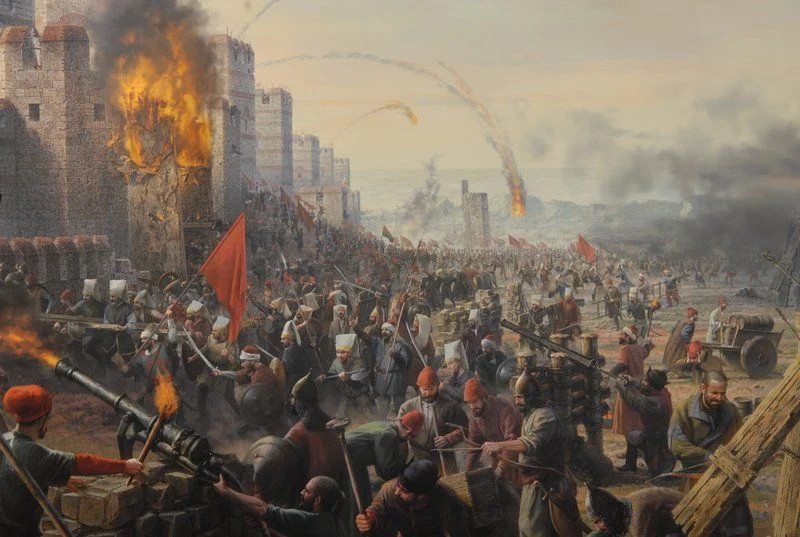
Siege of Constantinople, 1453
- Constantinople 1453
Cannon helped break massive walls, but victory also required naval pressure, manpower, and Byzantine weakness. This is gunpowder plus state capacity.
- Chaldiran 1514
The Ottomans beat the Safavids with better gunpowder tactics. Not every empire adopted firearms equally well at first.
- Panipat 1526
Babur’s battle formation made artillery effective against a larger army and war elephants. Technology worked because of strategy.
- Tondibi 1591
Morocco defeated Songhai with firearms and cannon. Gunpowder could destroy an empire fast, but Morocco struggled to rule such a distant region.
Rivalries, Borders, and Other Expansion Examples
As empires grew, they ran into each other. Expansion created new border fights over land, trade, and religion.
- Ottoman-Safavid rivalry centered on eastern Anatolia, Iraq, and the Caucasus. Sunni versus Shi'a mattered, but strategic territory mattered too.
- Safavid-Mughal rivalry focused on Kandahar, a key link between Persia, Central Asia, and India. It changed hands in 1622, 1638, and 1649.
- Russian expansion followed the same pattern. Ivan IV took Kazan in 1552 and Astrakhan in 1556 with firearms and artillery. Cossacks and Yermak pushed into Siberia in the 1580s for tribute, furs, forts, and settlement.
Key Takeaways
Land-Based Empire
An empire whose power rests mainly on large, connected territories rather than distant overseas colonies
Gunpowder Weapons
Cannons, firearms, and field artillery that strengthened sieges and infantry but required substantial revenue, supplies, and skilled labor
Gunpowder Empires
The Ottoman, Safavid, and Mughal empires, Islamic land empires that combined firearms and artillery with older military forces
Armed Trade
Using organized military force to protect merchants, control routes or goods, and compel favorable commercial relations
Ottoman Empire
Sunni land empire centered in Anatolia that used gunpowder forces to expand into southeastern Europe, the Middle East, and North Africa
Mehmed II
Ottoman sultan who conquered Constantinople in 1453 using siege artillery, ending the Byzantine Empire
Conquest of Constantinople
The 1453 Ottoman capture of the Byzantine capital; artillery helped breach its walls, and the city became the Ottoman capital
Selim I
Ottoman sultan who defeated the Safavids at Chaldiran and conquered the Mamluk Sultanate, adding Syria and Egypt
Battle of Chaldiran
The 1514 Ottoman victory over Shah Ismail in which firearms and artillery defeated the cavalry-heavy Safavid army
Suleiman the Magnificent
Ottoman sultan from 1520 to 1566 who expanded into Hungary and the Mediterranean and reached Vienna
Ottoman–Safavid Rivalry
Conflict between the Sunni Ottomans and Shi'a Safavids over eastern Anatolia, Iraq, the Caucasus, trade, and political influence
Safavid Empire
Persian land empire founded by Shah Ismail that adopted Twelver Shi'a Islam and competed with the Ottomans and Mughals
Shah Ismail
Safavid founder who captured Tabriz in 1501, declared himself shah, and made Shi'a Persia a rival of the Sunni Ottomans
Qizilbash
Turkic tribal warriors whose religious loyalty and cavalry power supported the early Safavid state
Shah Abbas I
Safavid ruler from 1588 to 1629 who strengthened the army, recovered territory, and fought Ottomans, Uzbeks, and Mughals
Mughal Empire
South Asian land empire founded by Babur that combined Central Asian military traditions and gunpowder with India's wealth and manpower
Babur
Central Asian descendant of Timur and Chinggis Khan who founded Mughal rule after winning the First Battle of Panipat
First Battle of Panipat
Babur's 1526 victory over Ibrahim Lodi using cannon, matchlocks, linked carts, and cavalry; it established Mughal rule in northern India
Akbar
Mughal ruler from 1556 to 1605 who expanded across northern and central India through conquest and alliances with Rajput rulers
Aurangzeb
Mughal ruler from 1658 to 1707 whose costly Deccan campaigns brought the empire to its greatest territorial extent
Safavid–Mughal Rivalry over Kandahar
Competition for the strategic trade center of Kandahar, driven by security, commerce, prestige, and the Shi'a–Sunni divide
Nurhaci
Manchu state-builder who unified Jurchen groups and organized them into military and social units called banners
Hong Taiji
Nurhaci's successor who continued Manchu state-building and adopted the dynastic name Qing in 1636
Manchu Conquest of China
The conquest begun in 1644 when Wu Sangui admitted Manchu forces through Shanhai Pass after Li Zicheng captured Beijing
Kangxi Emperor
Qing ruler who consolidated China by defeating the Revolt of the Three Feudatories and bringing Taiwan under Qing control
Russian Expansion across Eurasia
Russia's gunpowder-assisted conquest from the Volga across Siberia, driven by territory, frontier security, tribute, and the fur trade
Ivan IV (Ivan the Terrible)
Russian ruler whose firearm- and artillery-equipped forces conquered Kazan in 1552 and Astrakhan in 1556
Yermak
Cossack leader whose expedition against the Khanate of Sibir in the 1580s began an early stage of Russian expansion across Siberia
Moroccan Invasion of Songhai
Ahmad al-Mansur’s 1591 campaign for gold and trans-Saharan trade broke Songhai’s imperial power but failed to establish stable Moroccan control
Ahmad al-Mansur
Moroccan sultan who ordered the 1591 invasion of Songhai to control gold and trans-Saharan commerce
Judar Pasha
Commander who led Ahmad al-Mansur's gunpowder-equipped Moroccan army across the Sahara against Songhai
Battle of Tondibi
The 1591 battle in which Moroccan firearms and cannon defeated a much larger Songhai force, contributing to Songhai's fragmentation
Manchu-Led Qing Empire
The Manchus were the ruling people who established the Qing dynasty, conquered China during the Ming collapse, and expanded into Mongolia and Tibet
Siege of Vienna
The unsuccessful 1529 Ottoman attempt to capture Vienna, demonstrating Ottoman reach into central Europe without producing lasting control
Notes
Land-Based Empire
An empire whose power rests mainly on large, connected territories rather than distant overseas colonies
Gunpowder Weapons
Cannons, firearms, and field artillery that strengthened sieges and infantry but required substantial revenue, supplies, and skilled labor
Gunpowder Empires
The Ottoman, Safavid, and Mughal empires, Islamic land empires that combined firearms and artillery with older military forces
Armed Trade
Using organized military force to protect merchants, control routes or goods, and compel favorable commercial relations
Ottoman Empire
Sunni land empire centered in Anatolia that used gunpowder forces to expand into southeastern Europe, the Middle East, and North Africa
Mehmed II
Ottoman sultan who conquered Constantinople in 1453 using siege artillery, ending the Byzantine Empire
Conquest of Constantinople
The 1453 Ottoman capture of the Byzantine capital; artillery helped breach its walls, and the city became the Ottoman capital
Selim I
Ottoman sultan who defeated the Safavids at Chaldiran and conquered the Mamluk Sultanate, adding Syria and Egypt
Battle of Chaldiran
The 1514 Ottoman victory over Shah Ismail in which firearms and artillery defeated the cavalry-heavy Safavid army
Suleiman the Magnificent
Ottoman sultan from 1520 to 1566 who expanded into Hungary and the Mediterranean and reached Vienna
Ottoman–Safavid Rivalry
Conflict between the Sunni Ottomans and Shi'a Safavids over eastern Anatolia, Iraq, the Caucasus, trade, and political influence
Safavid Empire
Persian land empire founded by Shah Ismail that adopted Twelver Shi'a Islam and competed with the Ottomans and Mughals
Shah Ismail
Safavid founder who captured Tabriz in 1501, declared himself shah, and made Shi'a Persia a rival of the Sunni Ottomans
Qizilbash
Turkic tribal warriors whose religious loyalty and cavalry power supported the early Safavid state
Shah Abbas I
Safavid ruler from 1588 to 1629 who strengthened the army, recovered territory, and fought Ottomans, Uzbeks, and Mughals
Mughal Empire
South Asian land empire founded by Babur that combined Central Asian military traditions and gunpowder with India's wealth and manpower
Babur
Central Asian descendant of Timur and Chinggis Khan who founded Mughal rule after winning the First Battle of Panipat
First Battle of Panipat
Babur's 1526 victory over Ibrahim Lodi using cannon, matchlocks, linked carts, and cavalry; it established Mughal rule in northern India
Akbar
Mughal ruler from 1556 to 1605 who expanded across northern and central India through conquest and alliances with Rajput rulers
Aurangzeb
Mughal ruler from 1658 to 1707 whose costly Deccan campaigns brought the empire to its greatest territorial extent
Safavid–Mughal Rivalry over Kandahar
Competition for the strategic trade center of Kandahar, driven by security, commerce, prestige, and the Shi'a–Sunni divide
Nurhaci
Manchu state-builder who unified Jurchen groups and organized them into military and social units called banners
Hong Taiji
Nurhaci's successor who continued Manchu state-building and adopted the dynastic name Qing in 1636
Manchu Conquest of China
The conquest begun in 1644 when Wu Sangui admitted Manchu forces through Shanhai Pass after Li Zicheng captured Beijing
Kangxi Emperor
Qing ruler who consolidated China by defeating the Revolt of the Three Feudatories and bringing Taiwan under Qing control
Russian Expansion across Eurasia
Russia's gunpowder-assisted conquest from the Volga across Siberia, driven by territory, frontier security, tribute, and the fur trade
Ivan IV (Ivan the Terrible)
Russian ruler whose firearm- and artillery-equipped forces conquered Kazan in 1552 and Astrakhan in 1556
Yermak
Cossack leader whose expedition against the Khanate of Sibir in the 1580s began an early stage of Russian expansion across Siberia
Moroccan Invasion of Songhai
Ahmad al-Mansur’s 1591 campaign for gold and trans-Saharan trade broke Songhai’s imperial power but failed to establish stable Moroccan control
Ahmad al-Mansur
Moroccan sultan who ordered the 1591 invasion of Songhai to control gold and trans-Saharan commerce
Judar Pasha
Commander who led Ahmad al-Mansur's gunpowder-equipped Moroccan army across the Sahara against Songhai
Battle of Tondibi
The 1591 battle in which Moroccan firearms and cannon defeated a much larger Songhai force, contributing to Songhai's fragmentation
Manchu-Led Qing Empire
The Manchus were the ruling people who established the Qing dynasty, conquered China during the Ming collapse, and expanded into Mongolia and Tibet
Siege of Vienna
The unsuccessful 1529 Ottoman attempt to capture Vienna, demonstrating Ottoman reach into central Europe without producing lasting control
