Topic 6.1 Notes – Rationales for Imperialism from 1750 to 1900
What Imperialist Rationales Were
Imperialism means a state extending power beyond its borders through conquest, colonization, or indirect control. Here, the point is why people said empire was justified, not the military takeover itself.
A rationale is a stated reason used to defend empire. On the exam, that matters. A speech might talk about “civilizing” people, even if the empire also wanted raw materials, markets, strategic territory, or prestige. Those material motives were still there.
Under almost every rationale sat the same three assumptions:
- Ethnocentrism meant judging other cultures by your own standards and assuming yours was better.
- Racism meant believing human groups were unequal in fixed, inherited ways.
- Paternalism meant ruling people while claiming it was for their own good, like treating adults as children.
The core pattern was simple. Imperial powers presented domination as natural, necessary, patriotic, moral, or required by religion.
The Main Ideologies That Justified Empire
These rationales were different, but they often blended together in the same source.
Social Darwinism and scientific racism
Darwin explained biological evolution. Imperial thinkers twisted that idea and applied it to human societies.
- Social Darwinism said struggle among peoples was natural. Herbert Spencer’s phrase “survival of the fittest” got used to argue that stronger nations deserved to win.
- Scientific racism claimed races were biologically unequal. It used fake science like racial classification, craniometry, and hierarchy charts.
That distinction shows up a lot:
| Idea | Main claim |
|---|---|
| Social Darwinism | Competition and domination among peoples is natural |
| Scientific racism | Human races are biologically unequal |
In imperial logic, industrial and military success became “proof” of superiority. That made conquest look inevitable and deserved.
Nationalism
Nationalism meant loyalty to the nation, and in the 1800s it often fed empire.
- Colonies became symbols of greatness, modern power, and prestige.
- Rivalries among industrial states pushed expansion because no nation wanted to look weak while others gained territory.
- Empire was not just about profit. It became part of national glory.
Maps of Africa before the full Scramble make that rivalry easier to see. By 1880, European control was still concentrated along many coasts, but the competition for territory was already underway.
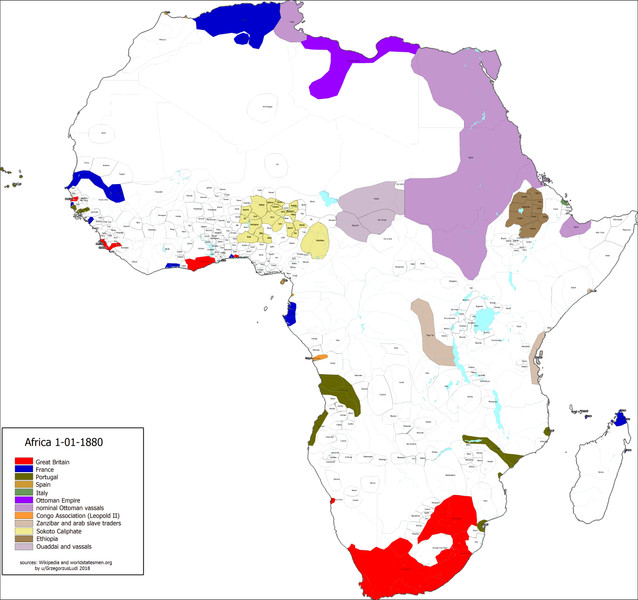
Africa in 1880, before the full Scramble for Africa
The civilizing mission
The civilizing mission claimed imperial powers had a duty to improve supposedly “backward” peoples. The French called it mission civilisatrice.
This justified:
- schools teaching European ideas and languages
- European laws and administrators
- medicine and sanitation
- assimilation policies that tried to replace local culture
The key move here was turning domination into “improvement.”
Religious conversion
Missionaries wanted to spread Christianity and replace indigenous religions.
- They built churches, schools, and medical missions
- They translated the Bible
- They framed conversion as saving souls and bringing moral order
This overlapped with the civilizing mission, but it was not identical. Conversion focused on religion. The civilizing mission covered broader cultural and political control.
Standard Examples and Named Evidence
- Cecil Rhodes in his 1877 Confession of Faith linked British nationalism, racial superiority, and imperial expansion.
- Jules Ferry in 1885 argued that “superior races” had a duty to civilize “inferior races.” This is the classic civilizing mission source.
- David Livingstone used the phrase “Christianity, commerce, and civilization.” That shows missionary work tied to economic and cultural imperialism.
- Rudyard Kipling in “The White Man’s Burden” (1899) urged the U.S. to rule the Philippines through a mix of racial hierarchy, paternalism, nationalism, and civilizing language.
- Manifest Destiny in the United States presented expansion as ordained and beneficial, first against Indigenous peoples and Mexicans, then later overseas.
- Japan also used nationalism and claims of cultural superiority to justify expansion, which reminds you imperial ideology was not only European.
How These Rationales Worked Together
Imperial arguments usually mixed several ideas at once. A common chain of reasoning looked like this:
- Some peoples are superior.
- Industrial and military success proves that superiority.
- Superior nations naturally dominate weaker ones.
- That domination gives them the right or duty to rule.
- Empire supposedly brings progress, order, Christianity, and civilization.
Resistance got twisted too. If colonized people fought back, imperial powers often called that proof they were “backward” or unfit for self-rule.
That is a classic AP move. A source often contains more than one rationale.
Why These Ideas Mattered
These ideas helped build support at home through schools, newspapers, speeches, world’s fairs, maps, and propaganda. They made empire look legitimate to voters, officials, missionaries, and settlers.
There is both continuity and change here:
- Continuity since religion had justified conquest before 1750.
- Change since industrialization, mass nationalism, Social Darwinism, and “scientific” racism made nineteenth-century imperialism more systematic.
Key Takeaways
Imperialism
A policy or process by which a state extends formal or informal political, military, or economic power beyond its borders
Ethnocentrism
Judging other cultures by the standards of one’s own culture and treating those standards as inherently superior
Racism
Assigning supposedly permanent characteristics and unequal worth to constructed racial groups
Paternalism
Exercising authority over people without their consent on the claim that the ruler knows what is best for them
Social Darwinism
The pseudoscientific application of evolutionary competition to societies and supposed races, used to portray domination by powerful peoples as natural and deserved
Charles Darwin
British naturalist whose theory of evolution by natural selection explained biological change but did not establish racial hierarchy or justify imperial conquest
Herbert Spencer
British thinker who coined “survival of the fittest” and applied evolutionary ideas broadly to human society
Scientific Racism
Discredited efforts to classify biological races and rank their intelligence, morality, or fitness for self-government using supposedly scientific methods
Nationalism
Loyalty to and advancement of the nation, which made colonies symbols of national greatness, prestige, and great-power status
Cecil Rhodes
British imperialist who argued that English racial superiority made the expansion of British control beneficial to humanity
Manifest Destiny
The belief that United States expansion across North America was divinely or historically ordained and spread a supposedly superior order
Civilizing Mission (Mission Civilisatrice)
The paternalistic claim that imperial powers had a moral duty to govern, educate, and Westernize supposedly backward peoples
Jules Ferry
French leader who argued in 1885 that “superior races” had a right and duty to civilize “inferior races.”
David Livingstone
Scottish missionary and explorer associated with the formula “Christianity, commerce, and civilization” for European influence in Africa
Christianity, Commerce, and Civilization
A formula associated with David Livingstone expressing the belief that Christian missions, legitimate trade, and Western cultural change would reinforce one another in Africa
The White Man’s Burden
Rudyard Kipling’s 1899 poem urging U.S. rule of the Philippines by portraying white imperialism as a difficult but benevolent civilizing duty
Rudyard Kipling
British writer whose poem “The White Man’s Burden” encouraged the United States to accept colonial rule in the Philippines as a moral duty
Racial Hierarchy
The belief that supposed racial groups had unequal worth and abilities, with Europeans commonly presented as superior and therefore fit to rule others
Religious Conversion
The imperial rationale that expansion would spread Christianity, save souls, and replace indigenous religions portrayed as pagan or immoral
Notes
Imperialism
A policy or process by which a state extends formal or informal political, military, or economic power beyond its borders
Ethnocentrism
Judging other cultures by the standards of one’s own culture and treating those standards as inherently superior
Racism
Assigning supposedly permanent characteristics and unequal worth to constructed racial groups
Paternalism
Exercising authority over people without their consent on the claim that the ruler knows what is best for them
Social Darwinism
The pseudoscientific application of evolutionary competition to societies and supposed races, used to portray domination by powerful peoples as natural and deserved
Charles Darwin
British naturalist whose theory of evolution by natural selection explained biological change but did not establish racial hierarchy or justify imperial conquest
Herbert Spencer
British thinker who coined “survival of the fittest” and applied evolutionary ideas broadly to human society
Scientific Racism
Discredited efforts to classify biological races and rank their intelligence, morality, or fitness for self-government using supposedly scientific methods
Nationalism
Loyalty to and advancement of the nation, which made colonies symbols of national greatness, prestige, and great-power status
Cecil Rhodes
British imperialist who argued that English racial superiority made the expansion of British control beneficial to humanity
Manifest Destiny
The belief that United States expansion across North America was divinely or historically ordained and spread a supposedly superior order
Civilizing Mission (Mission Civilisatrice)
The paternalistic claim that imperial powers had a moral duty to govern, educate, and Westernize supposedly backward peoples
Jules Ferry
French leader who argued in 1885 that “superior races” had a right and duty to civilize “inferior races.”
David Livingstone
Scottish missionary and explorer associated with the formula “Christianity, commerce, and civilization” for European influence in Africa
Christianity, Commerce, and Civilization
A formula associated with David Livingstone expressing the belief that Christian missions, legitimate trade, and Western cultural change would reinforce one another in Africa
The White Man’s Burden
Rudyard Kipling’s 1899 poem urging U.S. rule of the Philippines by portraying white imperialism as a difficult but benevolent civilizing duty
Rudyard Kipling
British writer whose poem “The White Man’s Burden” encouraged the United States to accept colonial rule in the Philippines as a moral duty
Racial Hierarchy
The belief that supposed racial groups had unequal worth and abilities, with Europeans commonly presented as superior and therefore fit to rule others
Religious Conversion
The imperial rationale that expansion would spread Christianity, save souls, and replace indigenous religions portrayed as pagan or immoral
