Topic 1.1 Notes – Developments in East Asia from c. 1200 to c. 1450
How Chinese Dynasties Governed from Song to Ming
China already had a long imperial tradition before 1200. The Song, Yuan, and early Ming changed dynasties, but they kept the core idea of an emperor ruling a huge state through bureaucracy and Confucian values.
It also helps to picture the Song in its regional setting. Around 1200, China was divided between the Song Dynasty in the south and the Jurchen Jin in the north, with other neighboring states on its borders.
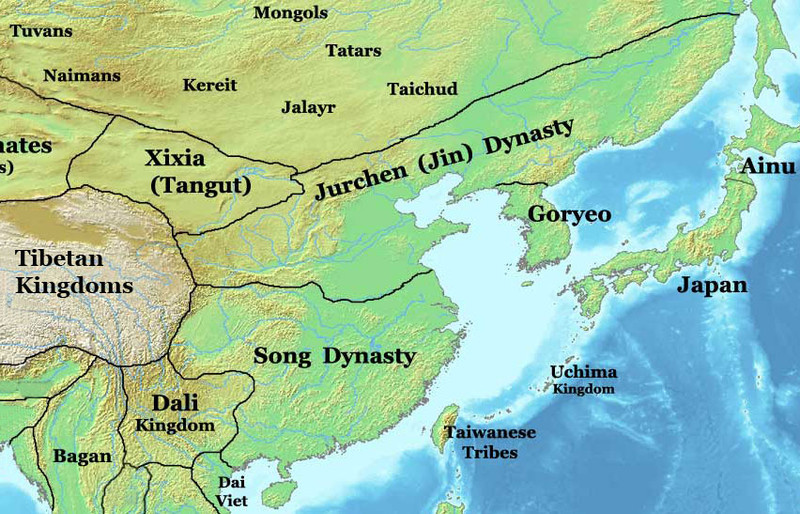
East Asia around 1200
The emperor was the Son of Heaven. His right to rule came from the Mandate of Heaven, which meant a dynasty stayed legitimate only if it governed well. Rebellion or conquest could be explained later as proof that Heaven had withdrawn support.
Confucianism gave this government its moral language. A ruler was supposed to be educated, moral, and benevolent. Society was hierarchical, but that hierarchy was supposed to create order.
The state ran through an imperial bureaucracy of appointed scholar-officials. Most got office through civil service examinations on Confucian classics. This sounds merit-based, and partly was, but wealthy elite men had the time, tutors, and books needed to succeed. Women were excluded. The scholar-gentry became the elite class connecting villages to the state.
Song government
The Song leaned hard on civil officials and feared strong generals because the Tang collapse had involved powerful regional military governors. So the Song used rotation of officials, tighter central control, and civilian oversight of the military.
- Northern Song lasted until 1127, when the Jurchen Jin captured Kaifeng.
- Southern Song ruled from the south after that, with Hangzhou as capital.
- The Song was rich and bureaucratically strong, but militarily weaker than the Liao, Western Xia, and Jin.
Yuan government
The Yuan Dynasty was founded by Kublai Khan after the Mongol conquest.
- Continuity stayed strong. The Yuan used Chinese taxes, provinces, and many Chinese officials.
- Change mattered too. Mongols and other non-Chinese peoples got higher status and better appointments.
- The exam system was reduced, then partly restored.
This is a classic AP pattern. The Yuan adopted Chinese institutions selectively without fully assimilating.
Ming government
The Ming Dynasty began in 1368 after rebellion against Yuan rule. Ming rulers claimed legitimacy by restoring native Chinese rule.
- They revived and expanded the exam system.
- They pushed Neo-Confucian education, especially Zhu Xi’s interpretations.
- They centralized power and increased imperial supervision.
Chinese Cultural Traditions and Their Spread in East Asia
Chinese influence spread because neighboring elites saw Chinese writing, education, religion, and bureaucracy as useful and prestigious.
Filial piety meant respecting, obeying, supporting, and honoring parents and ancestors. The family became a model for the state. If a household had order, the empire could too.
Neo-Confucianism revived Confucian thought and answered challenges from Buddhism and Daoism. Zhu Xi was the key thinker. In society, women were valued in family roles but expected to defer to men. Foot binding spread in Song China. Women could not take the exams or hold office.
How neighboring societies adapted Chinese culture
- Korea under Goryeo and early Joseon used Chinese writing, bureaucracy, exams, and Confucian education. Buddhism stayed important, then Neo-Confucianism grew stronger.
- Japan borrowed Chinese characters, Buddhism, court ritual, and city planning in the Heian era, but after 1185 it kept a decentralized shogunate instead of a Chinese-style bureaucracy. Murasaki Shikibu’s Tale of Genji and Sei Shōnagon’s Pillow Book show literary borrowing and adaptation.
- Vietnam and Đại Việt adopted Confucian learning, exams, bureaucracy, and Mahayana Buddhism, while staying politically independent.
- The tributary system showed respect for Chinese prestige. It did not mean direct Chinese rule.
- Tibet stayed distinct. Tibetan Buddhism developed more from Indian and local traditions than from direct Chinese cultural absorption.
Buddhist branches and East Asia
| Branch | Main region in this topic | Quick anchor |
|---|---|---|
| Theravada | Mostly Southeast Asia | monastic discipline, early teachings |
| Mahayana | China, Korea, Japan, Vietnam | broad path to enlightenment |
| Tibetan | Tibet | Mahayana plus tantric/Vajrayana practices |
In East Asia, Mahayana Buddhism mattered most. In China, key forms included Chan and Pure Land Buddhism. Buddhism sometimes clashed with Confucian family ideals because monks left family life, but the two usually coexisted.
How Song China’s Economy Became More Commercialized
Commercialization means more production for markets, more use of money and credit, and tighter links between regions. Song growth still depended mostly on free peasant and artisanal labor, not serfdom.
Innovations and production
You can picture that commercial growth in the kind of crowded urban market life shown below.
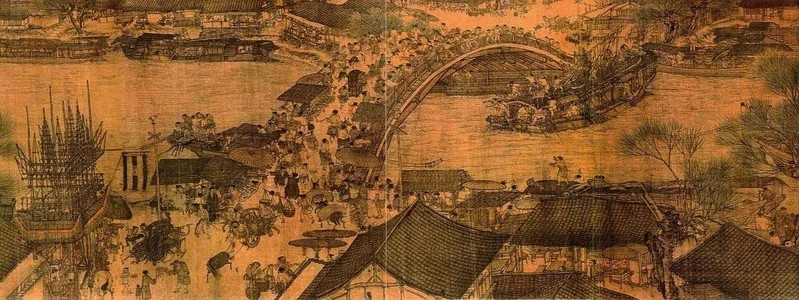
Song urban commercial life
- Champa rice raised yields and helped population growth.
- Grand Canal expansion and maintenance tied north and south together.
- Iron and steel production increased.
- Textiles and porcelain became major export goods.
- Printing and paper spread texts and supported the exam system.
- Paper money and credit made exchange easier.
Effects of commercialization
- Food surpluses fed population growth and urbanization.
- Kaifeng and Hangzhou became huge commercial cities.
- China exported silk, porcelain, tea, and metal goods.
- Merchants gained wealth even though Confucian values ranked them low.
- The state gained taxes, transport control, and stronger regulation of markets.
Why Topic 1.1 Matters
This whole topic is about continuity plus change. Song, Yuan, and Ming all kept the emperor-bureaucracy-Confucian core, but each used it differently. Chinese culture spread across East Asia, yet Korea, Japan, Vietnam, and Tibet adapted it instead of copying it. Song China’s economy became the most productive and commercialized in the region, and that economic strength helped support the bureaucracy, education system, and Chinese prestige abroad.
Key Takeaways
Song Dynasty
Chinese dynasty, 960–1279, that expanded Confucian civil government and oversaw major commercialization; the Southern Song ruled from Hangzhou after losing northern China in 1127
Yuan Dynasty
Mongol dynasty, 1271–1368, that retained Chinese administrative institutions but privileged Mongols and restricted Confucian examination recruitment
Kublai Khan
Mongol ruler who declared the Yuan Dynasty in 1271 and ruled China as an emperor while using many established Chinese institutions
Ming Dynasty
Chinese dynasty founded in 1368 that expelled the Mongols, restored Confucian examinations, and strengthened centralized imperial rule
Mandate of Heaven
Belief that Heaven granted a dynasty authority while it governed properly and transferred that authority when misrule led to successful replacement
Imperial Bureaucracy
Centralized system of appointed officials who administered taxation, law, censuses, public works, grain transport, and local government for the emperor
Civil Service Examinations
Confucian examinations used to recruit educated male officials, reducing reliance on hereditary nobles while favoring families able to afford extensive schooling
Scholar-Gentry
Elite class whose status rested on Confucian education, examination success, government office, landownership, and mastery of literary culture
Confucianism
Ethical and political tradition emphasizing education, moral cultivation, hierarchy, reciprocal duties, and social harmony through proper relationships
Filial Piety (Xiao)
Confucian duty to respect, obey, support, and honor parents and ancestors, making the orderly family a model for the state
Neo-Confucianism
Song-era reformulation of Confucianism that addressed Buddhist and Daoist ideas while reaffirming moral cultivation, family hierarchy, education, and public service
Zhu Xi
Most influential Neo-Confucian thinker, whose teachings stressed disciplined study, moral self-cultivation, social relationships, and investigation of principle
Foot Binding
Practice that spread among elite Han Chinese families of binding girls’ feet as a sign of refinement and respectability, restricting mobility and reinforcing patriarchy
Tributary System
Diplomatic framework in which foreign rulers acknowledged the Chinese emperor and offered tribute in return for recognition, gifts, and access to trade
Hangul
Phonetic Korean script developed by the fifteenth-century Joseon court, demonstrating cultural independence within the Chinese cultural sphere
Japanese Shogunate
Decentralized warrior government headed by a shogun after 1185, with military households and samurai exercising power while the emperor retained symbolic legitimacy
Đại Việt
Independent Vietnamese state that adopted Chinese writing, Confucian education, examinations, and bureaucracy while retaining local customs and political independence
Buddhism
Asian religious tradition teaching that craving causes suffering and that ethical and spiritual practice, shaped by karma and rebirth, can lead to nirvana
Theravada Buddhism
Buddhist tradition emphasizing monastic discipline, early teachings, and the individual path to enlightenment, strongest in Sri Lanka and mainland Southeast Asia
Mahayana Buddhism
Buddhist tradition teaching broad access to enlightenment and emphasizing bodhisattvas who help others, predominant in China, Korea, Japan, and Vietnam
Tibetan Buddhism
Tradition combining Mahayana and Vajrayana practices with Tibetan customs, emphasizing monasteries, ritual, lamas, visual art, and specialized meditation
Chan Buddhism (Zen)
Chinese Mahayana school emphasizing meditation, discipline, and direct insight; transmitted to Japan as Zen
Pure Land Buddhism
Mahayana school centered on devotion to Amitabha Buddha and hope for rebirth in a Pure Land favorable to enlightenment
Song Commercialization
Growth of market production, monetary and credit transactions, regional specialization, urban consumption, and interconnected trade in Song China
Champa Rice
Fast-ripening, drought-resistant rice from Vietnam that increased harvests, food surpluses, population, urbanization, and market production in China
Grand Canal
Waterway linking southern rice-producing regions with northern centers, lowering transport costs and moving grain, taxes, officials, troops, and commercial goods
Iron and Steel Production
Large-scale Song manufacture of metals for farm tools, construction, weapons, and household goods, using improved furnaces and specialized workshops
Porcelain
Durable, high-fired Chinese ceramic produced in specialized kiln centers such as Jingdezhen and exported widely as both standardized and luxury goods
Woodblock Printing
Printing method using carved blocks for whole pages, making Confucian classics, Buddhist scriptures, manuals, calendars, and literature cheaper to reproduce
Bi Sheng
Song inventor who developed movable type in the eleventh century, although woodblock printing remained more practical for written Chinese
Flying Cash
Merchant deposit certificates or bills used to transfer funds over distance without carrying heavy strings of copper coins
Free Peasant and Artisanal Labor
Main basis of Song production: farmers and craftspeople were generally not serfs or slaves, though they still faced rents, taxes, debts, and state obligations
Goryeo Dynasty
Korean dynasty, 918–1392, that adopted Chinese writing, examinations, and bureaucracy while retaining powerful aristocrats and strong Buddhist influence
Joseon Dynasty
Korean dynasty founded in 1392 that gave Neo-Confucianism greater official prominence while preserving an independent Korean monarchy and culture
Ancestor Veneration
Ritual honoring of deceased family members that reinforced kinship, filial obligations, and continuity between living and past generations
Samurai
Japanese warriors who served military households and regional lords within the decentralized political order headed by shoguns
Movable Type
Printing method using reusable individual characters, developed by Bi Sheng, though woodblocks often remained more practical for written Chinese
Paper Money (Jiaozi)
Government-backed Song currency that facilitated large transactions by reducing the need to transport heavy copper coins
Notes
Song Dynasty
Chinese dynasty, 960–1279, that expanded Confucian civil government and oversaw major commercialization; the Southern Song ruled from Hangzhou after losing northern China in 1127
Yuan Dynasty
Mongol dynasty, 1271–1368, that retained Chinese administrative institutions but privileged Mongols and restricted Confucian examination recruitment
Kublai Khan
Mongol ruler who declared the Yuan Dynasty in 1271 and ruled China as an emperor while using many established Chinese institutions
Ming Dynasty
Chinese dynasty founded in 1368 that expelled the Mongols, restored Confucian examinations, and strengthened centralized imperial rule
Mandate of Heaven
Belief that Heaven granted a dynasty authority while it governed properly and transferred that authority when misrule led to successful replacement
Imperial Bureaucracy
Centralized system of appointed officials who administered taxation, law, censuses, public works, grain transport, and local government for the emperor
Civil Service Examinations
Confucian examinations used to recruit educated male officials, reducing reliance on hereditary nobles while favoring families able to afford extensive schooling
Scholar-Gentry
Elite class whose status rested on Confucian education, examination success, government office, landownership, and mastery of literary culture
Confucianism
Ethical and political tradition emphasizing education, moral cultivation, hierarchy, reciprocal duties, and social harmony through proper relationships
Filial Piety (Xiao)
Confucian duty to respect, obey, support, and honor parents and ancestors, making the orderly family a model for the state
Neo-Confucianism
Song-era reformulation of Confucianism that addressed Buddhist and Daoist ideas while reaffirming moral cultivation, family hierarchy, education, and public service
Zhu Xi
Most influential Neo-Confucian thinker, whose teachings stressed disciplined study, moral self-cultivation, social relationships, and investigation of principle
Foot Binding
Practice that spread among elite Han Chinese families of binding girls’ feet as a sign of refinement and respectability, restricting mobility and reinforcing patriarchy
Tributary System
Diplomatic framework in which foreign rulers acknowledged the Chinese emperor and offered tribute in return for recognition, gifts, and access to trade
Hangul
Phonetic Korean script developed by the fifteenth-century Joseon court, demonstrating cultural independence within the Chinese cultural sphere
Japanese Shogunate
Decentralized warrior government headed by a shogun after 1185, with military households and samurai exercising power while the emperor retained symbolic legitimacy
Đại Việt
Independent Vietnamese state that adopted Chinese writing, Confucian education, examinations, and bureaucracy while retaining local customs and political independence
Buddhism
Asian religious tradition teaching that craving causes suffering and that ethical and spiritual practice, shaped by karma and rebirth, can lead to nirvana
Theravada Buddhism
Buddhist tradition emphasizing monastic discipline, early teachings, and the individual path to enlightenment, strongest in Sri Lanka and mainland Southeast Asia
Mahayana Buddhism
Buddhist tradition teaching broad access to enlightenment and emphasizing bodhisattvas who help others, predominant in China, Korea, Japan, and Vietnam
Tibetan Buddhism
Tradition combining Mahayana and Vajrayana practices with Tibetan customs, emphasizing monasteries, ritual, lamas, visual art, and specialized meditation
Chan Buddhism (Zen)
Chinese Mahayana school emphasizing meditation, discipline, and direct insight; transmitted to Japan as Zen
Pure Land Buddhism
Mahayana school centered on devotion to Amitabha Buddha and hope for rebirth in a Pure Land favorable to enlightenment
Song Commercialization
Growth of market production, monetary and credit transactions, regional specialization, urban consumption, and interconnected trade in Song China
Champa Rice
Fast-ripening, drought-resistant rice from Vietnam that increased harvests, food surpluses, population, urbanization, and market production in China
Grand Canal
Waterway linking southern rice-producing regions with northern centers, lowering transport costs and moving grain, taxes, officials, troops, and commercial goods
Iron and Steel Production
Large-scale Song manufacture of metals for farm tools, construction, weapons, and household goods, using improved furnaces and specialized workshops
Porcelain
Durable, high-fired Chinese ceramic produced in specialized kiln centers such as Jingdezhen and exported widely as both standardized and luxury goods
Woodblock Printing
Printing method using carved blocks for whole pages, making Confucian classics, Buddhist scriptures, manuals, calendars, and literature cheaper to reproduce
Bi Sheng
Song inventor who developed movable type in the eleventh century, although woodblock printing remained more practical for written Chinese
Flying Cash
Merchant deposit certificates or bills used to transfer funds over distance without carrying heavy strings of copper coins
Free Peasant and Artisanal Labor
Main basis of Song production: farmers and craftspeople were generally not serfs or slaves, though they still faced rents, taxes, debts, and state obligations
Goryeo Dynasty
Korean dynasty, 918–1392, that adopted Chinese writing, examinations, and bureaucracy while retaining powerful aristocrats and strong Buddhist influence
Joseon Dynasty
Korean dynasty founded in 1392 that gave Neo-Confucianism greater official prominence while preserving an independent Korean monarchy and culture
Ancestor Veneration
Ritual honoring of deceased family members that reinforced kinship, filial obligations, and continuity between living and past generations
Samurai
Japanese warriors who served military households and regional lords within the decentralized political order headed by shoguns
Movable Type
Printing method using reusable individual characters, developed by Bi Sheng, though woodblocks often remained more practical for written Chinese
Paper Money (Jiaozi)
Government-backed Song currency that facilitated large transactions by reducing the need to transport heavy copper coins
