Topic 4.6 Notes – Internal and External Challenges to State Power from 1450 to 1750
Why Stronger States Faced Resistance
This topic is about a pattern you’ll see again and again. States centralized more power, and that created pushback.
- Stronger rulers wanted bigger armies and bureaucracies, so they taxed more heavily.
- They tried to reduce the independence of nobles, judges, peasants, frontier groups, and regional rulers.
- They regulated religion, forced labor, and migration more closely.
- In colonies, expansion often meant land seizure, slavery, tribute, and missionary pressure.
That cause-and-effect chain matters a lot on the exam:
state expansion and centralization → loss of autonomy and heavier burdens → resistance
Resistance could be:
- Internal when people already claimed as subjects rebelled
- Fronde in France
- Cossack revolts in Russia
- enslaved resistance inside colonies
- External when neighboring powers, regional rulers, or colonized peoples resisted conquest
- Ana Nzinga vs Portugal
- Marathas vs Mughals
- Indigenous resistance to settler colonies
Major Local and Regional Resistance Movements
These cases show that resistance came from very different groups, but the trigger was often the same. A state tried to reach farther and control more.
Fronde in France
From 1648 to 1653, nobles and the Parlement of Paris resisted new taxes and royal centralization during Louis XIV’s childhood. Cardinal Mazarin and Anne of Austria needed revenue after expensive wars.
- This was not a democratic revolution.
- The leaders were mostly elites defending their own privileges.
- The revolt failed, and that failure helped later absolutism under Louis XIV.
- Versailles later became a way to keep nobles close and under watch.
Cossack revolts against Russia
Cossacks were semi-independent military communities on the frontier. Many runaway peasants fled there. Russian expansion and stronger serfdom threatened that freedom.
- Stenka Razin’s revolt in 1670 to 1671 attacked officials, landlords, and tsarist authority.
- After suppression, the Russian state tightened control and reinforced serfdom.
Maratha resistance to Mughal expansion
Under Shivaji, the Marathas challenged Mughal authority in the Deccan.
- This was about regional sovereignty, taxes, forts, and power.
- Students often oversimplify it as Hindu vs Muslim. Religion mattered, but that alone does not explain it.
- Aurangzeb’s long campaigns drained Mughal resources.
- Over time, the conflict weakened the Mughal Empire and helped Maratha power grow after 1707.
Ana Nzinga’s resistance to Portugal
Ana Nzinga ruled Ndongo and Matamba in Angola and resisted Portuguese expansion and slave-raiding.
- She used diplomacy, warfare, conversion to Christianity, and alliance with the Dutch.
- She preserved sovereignty for decades.
- In 1656, peace recognized her rule in Matamba.
Indigenous Resistance to Colonial Rule
European colonization brought land loss, labor demands, and pressure to abandon local religion.
Pueblo Revolt
In 1680, Pueblo peoples in New Mexico rose against Spanish forced labor, tribute, and missionary pressure. Popé helped coordinate the revolt.
- The Spanish were expelled from Santa Fe and the region for about 12 years.
- Spain reconquered in 1692 under Diego de Vargas.
- After reconquest, Spain tolerated more Pueblo religious practice.
- This was one of the most successful Indigenous revolts in North America.
The map shows why this revolt mattered so much. It centers on the Rio Grande settlements in New Mexico, including Santa Fe and the pueblos tied to the uprising.
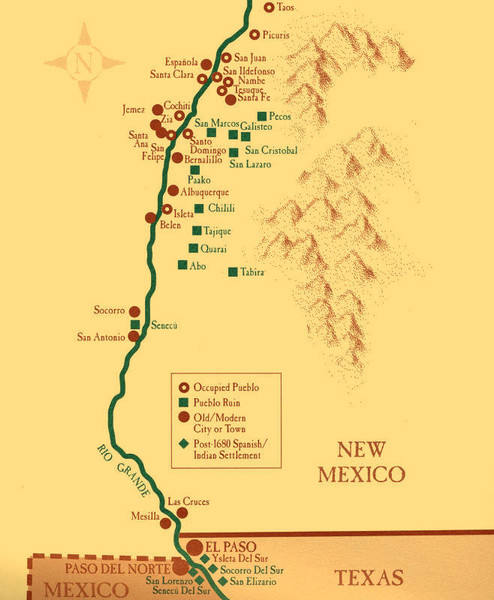
Pueblo settlements in colonial New Mexico
Metacom’s War
Also called King Philip’s War from 1675 to 1676, this was led by Metacom, a Wampanoag leader.
- Causes included English settler expansion, land loss, missionary pressure, and colonial court control.
- Indigenous forces attacked settlements, but colonists won with more manpower and Native allies.
- The result was devastating death, dispossession, enslavement, and faster English expansion.
The comparison to remember is simple. Both resisted colonization, but the Pueblo Revolt temporarily expelled colonizers, while Metacom’s War ended in harsher colonial domination.
Resistance by Enslaved People
Plantation slavery survived only through constant coercion, so resistance by enslaved people directly challenged colonial governments.
Maroon societies
Maroons were escaped enslaved people who built independent communities in remote areas.
- Palmares in Brazil was a major example. Its leaders included Ganga Zumba and Zumbi.
- Jamaica also had important Maroon communities.
- These societies offered refuge, fought colonial forces, and sometimes won treaty recognition.
Revolts in North America
- New York Slave Revolt of 1712 involved arson and attacks on colonists.
- Stono Rebellion in South Carolina in 1739 involved rebels marching south, likely toward Spanish Florida.
- Colonial governments answered with harsher slave codes, especially South Carolina’s Negro Act of 1740.
Patterns in Outcomes and Historical Significance
Resistance often failed militarily, but it still mattered.
| Movement | Main outcome |
|---|---|
| Fronde | failed revolt that helped strengthen French absolutism |
| Cossack revolts | suppression followed by tighter tsarist control |
| Marathas vs Mughals | long-term weakening of empire |
| Ana Nzinga | preserved sovereignty through resistance and diplomacy |
| Pueblo Revolt | temporary autonomy, then partial accommodation |
| Metacom’s War | catastrophic losses for Indigenous peoples |
| Maroons and slave revolts | repression, but also proof slavery was unstable |
The main AP World point is that stronger states never had total control. Local agency still shaped how empires ruled, compromised, expanded, or declined.
Key Takeaways
The Fronde
French rebellions from 1648–1653 against royal taxation and centralization; their failure helped Louis XIV strengthen the monarchy and control the nobility
Fronde of the Parlement vs. Fronde of the Princes
The Parlement phase involved courts and officeholders resisting taxes; the Princes phase involved powerful nobles competing with Cardinal Mazarin for influence
Cardinal Mazarin
Minister who governed France with Anne of Austria during Louis XIV’s minority; his taxes and centralizing policies helped provoke the Fronde
Louis XIV
French king whose experience of the Fronde encouraged closer supervision of nobles and a more centralized, absolutist monarchy
Cossacks
Frontier military communities of warriors, migrants, and fugitives who valued local autonomy and resisted Russian efforts to regulate them, return fugitives, and impose imperial control
Khmelnytsky Uprising
Ukrainian Cossack revolt beginning in 1648 against Poland-Lithuania that sought Russian support, helping expand Russian influence while creating disputes over Cossack autonomy
Pueblo Revolt
1680 Indigenous uprising in New Mexico that expelled the Spanish for about twelve years and led Spain, after reconquest, to tolerate more Pueblo religious practices
Popé
Pueblo religious leader who coordinated the 1680 Pueblo Revolt against Spanish colonial and missionary rule
Ana Nzinga / Njinga Mbande / Ana de Sousa
Ruler of Ndongo and Matamba who used warfare, diplomacy, conversion, and a Dutch alliance to resist Portuguese expansion; Portugal recognized her Matamba rule in 1656
Maratha Resistance
Regional struggle against Mughal expansion in western India whose prolonged Deccan warfare drained Mughal resources and contributed to imperial fragmentation and rising Maratha power
Shivaji
Maratha ruler crowned in 1674 who captured forts and territory using mobile cavalry and Deccan terrain to challenge Mughal and regional authorities
Aurangzeb
Mughal emperor from 1658–1707 whose prolonged, expensive Deccan campaigns against the Marathas and other powers drained imperial resources and weakened Mughal control
Metacom’s War / King Philip’s War
1675–1678 New England war over English settlement, land loss, and sovereignty; colonial victory devastated Native communities and accelerated English territorial expansion
Metacom / King Philip
Wampanoag leader who organized a multi-people Indigenous alliance against English colonial expansion before being killed in 1676
Maroon Societies (Quilombos in Brazil)
Independent communities founded by escaped enslaved people that defended autonomy, aided fugitives, and challenged colonial governments through settlement, trade, raids, and guerrilla warfare
Palmares
Large seventeenth-century quilombo complex in northeastern Brazil led by figures including Ganga Zumba and Zumbi; Portuguese forces destroyed its principal center in 1694
New York Uprising of 1712
Revolt in which enslaved Africans set a fire and attacked responding colonists; authorities executed participants and imposed harsher restrictions afterward
Stono Rebellion
1739 South Carolina revolt in which enslaved people seized weapons and marched toward Spanish Florida before militia defeat; it prompted stricter slave controls
Stenka Razin
Don Cossack leader who led a major uprising against Russian officials, landlords, and expanding state control and was executed after its defeat
Razin’s Rebellion
1670–1671 uprising of Cossacks, peasants, townspeople, and non-Russian communities against Russian officials and landlords; its defeat strengthened state and elite control
Notes
The Fronde
French rebellions from 1648–1653 against royal taxation and centralization; their failure helped Louis XIV strengthen the monarchy and control the nobility
Fronde of the Parlement vs. Fronde of the Princes
The Parlement phase involved courts and officeholders resisting taxes; the Princes phase involved powerful nobles competing with Cardinal Mazarin for influence
Cardinal Mazarin
Minister who governed France with Anne of Austria during Louis XIV’s minority; his taxes and centralizing policies helped provoke the Fronde
Louis XIV
French king whose experience of the Fronde encouraged closer supervision of nobles and a more centralized, absolutist monarchy
Cossacks
Frontier military communities of warriors, migrants, and fugitives who valued local autonomy and resisted Russian efforts to regulate them, return fugitives, and impose imperial control
Khmelnytsky Uprising
Ukrainian Cossack revolt beginning in 1648 against Poland-Lithuania that sought Russian support, helping expand Russian influence while creating disputes over Cossack autonomy
Pueblo Revolt
1680 Indigenous uprising in New Mexico that expelled the Spanish for about twelve years and led Spain, after reconquest, to tolerate more Pueblo religious practices
Popé
Pueblo religious leader who coordinated the 1680 Pueblo Revolt against Spanish colonial and missionary rule
Ana Nzinga / Njinga Mbande / Ana de Sousa
Ruler of Ndongo and Matamba who used warfare, diplomacy, conversion, and a Dutch alliance to resist Portuguese expansion; Portugal recognized her Matamba rule in 1656
Maratha Resistance
Regional struggle against Mughal expansion in western India whose prolonged Deccan warfare drained Mughal resources and contributed to imperial fragmentation and rising Maratha power
Shivaji
Maratha ruler crowned in 1674 who captured forts and territory using mobile cavalry and Deccan terrain to challenge Mughal and regional authorities
Aurangzeb
Mughal emperor from 1658–1707 whose prolonged, expensive Deccan campaigns against the Marathas and other powers drained imperial resources and weakened Mughal control
Metacom’s War / King Philip’s War
1675–1678 New England war over English settlement, land loss, and sovereignty; colonial victory devastated Native communities and accelerated English territorial expansion
Metacom / King Philip
Wampanoag leader who organized a multi-people Indigenous alliance against English colonial expansion before being killed in 1676
Maroon Societies (Quilombos in Brazil)
Independent communities founded by escaped enslaved people that defended autonomy, aided fugitives, and challenged colonial governments through settlement, trade, raids, and guerrilla warfare
Palmares
Large seventeenth-century quilombo complex in northeastern Brazil led by figures including Ganga Zumba and Zumbi; Portuguese forces destroyed its principal center in 1694
New York Uprising of 1712
Revolt in which enslaved Africans set a fire and attacked responding colonists; authorities executed participants and imposed harsher restrictions afterward
Stono Rebellion
1739 South Carolina revolt in which enslaved people seized weapons and marched toward Spanish Florida before militia defeat; it prompted stricter slave controls
Stenka Razin
Don Cossack leader who led a major uprising against Russian officials, landlords, and expanding state control and was executed after its defeat
Razin’s Rebellion
1670–1671 uprising of Cossacks, peasants, townspeople, and non-Russian communities against Russian officials and landlords; its defeat strengthened state and elite control
