Topic 7.9 Notes – Causation in Global Conflict
How to Explain Causes of Global Conflict
When AP World asks for causation, you have to explain why something happened. An event coming first does not make it a cause by itself. The cause is the mechanism that pushes events toward conflict.
Different cause categories help you sort that out:
- Long-term causes built pressure over years. Before WWI, that meant nationalism, imperial rivalry, militarism, and alliances.
- Short-term causes turned tension into a live crisis. The July Crisis in 1914 is the classic example.
- Triggers were the final sparks. The assassination of Franz Ferdinand triggered WWI. Germany’s invasion of Poland triggered war in Europe in 1939. A trigger is immediate, not automatically most important.
- Internal causes came from inside states, like repression, inequality, weak government, or revolution.
- External causes came from outside, like invasion, foreign pressure, imperial competition, or the Great Depression spreading globally.
AP questions also want relative significance. That means ranking causes by asking which one lasted longest, affected the most places, strengthened other causes, most directly caused outbreak, or best explains timing.
The strongest AP argument usually shows interaction. Wars almost never come from one cause alone. Across this topic, the best overall claim is that challenges to political and imperial order were usually the deepest cause, while technology mattered most for the scale and destruction of war.
Why the Global Order Was Unstable Around 1900
Western industrial powers dominated the world, and Japan had also become an imperial power. The map below gives you the big picture of how much of Africa and Asia was under imperial control by 1900, which helps explain why that dominance created rivalry instead of stability.
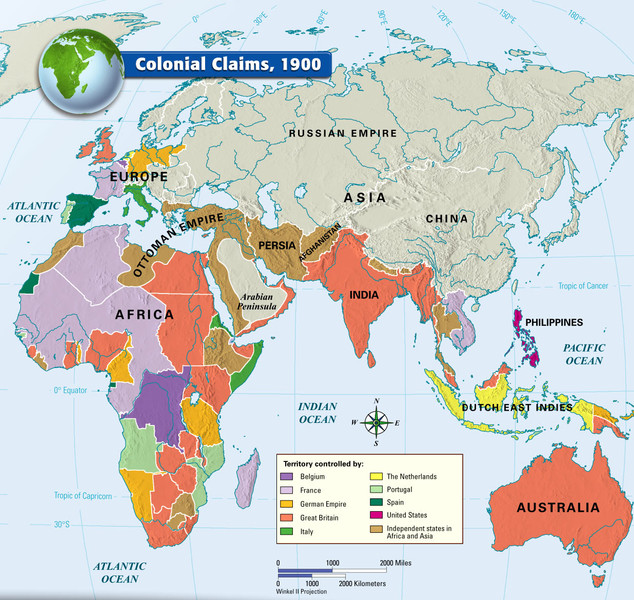
Colonial claims in Africa and Asia, c. 1900
Instability came from several connected pressures:
- Imperial competition meant rivalry over colonies, resources, markets, prestige, and strategic routes.
- Nationalism pushed colonized peoples and ethnic groups to demand self-rule.
- Militarism encouraged arms races, bigger armies and navies, and offensive war planning.
- Weakening land-based empires faced both internal problems and outside pressure.
Qing Empire
- The Qing faced rebellions, weak central authority, and foreign intrusion through unequal treaties.
- The Revolution of 1911 ended the dynasty, but China stayed unstable under regional warlords and rival movements.
Russian Empire
- The Russian Empire struggled with inequality, autocracy, nationalist tensions, and defeat in the Russo-Japanese War.
- WWI made those weaknesses explode into the 1917 Revolutions, which brought the Bolsheviks to power.
Ottoman Empire
- The Ottoman Empire faced separatism, administrative weakness, European intervention, and territorial loss.
- Defeat in WWI ended the empire, and the Republic of Turkey was founded in 1923.
Mexican Revolution
- The Mexican Revolution began in 1910 during the crisis of Porfirio Díaz.
- Its causes included concentrated landholding, labor grievances, elite privilege, and restricted political participation.
The Causes of World War I
WWI came from a whole system of tension, not one gunshot in Sarajevo.
The full set
| Cause | How it pushed Europe toward war |
|---|---|
| Imperialism | Powers competed for colonies, influence, and prestige |
| Nationalism | Patriotism fed aggression; ethnic nationalism weakened empires |
| Militarism | Arms races and war plans made compromise harder |
| Alliances | Rival blocs widened a regional crisis |
| Territorial disputes | Places like the Balkans and Alsace-Lorraine stayed explosive |
| Trigger | Assassination of Archduke Franz Ferdinand in 1914 |
- Imperialism sharpened rivalry. The Moroccan Crises increased Germany-France tension, and empires made the war global by pulling in colonial troops, labor, and resources.
- Nationalism worked in two directions. Governments used it to justify expansion, and ethnic groups used it to demand independence. Pan-Slavism and Serbian nationalism threatened Austria-Hungary.
- Militarism and planning mattered because the British-German naval race raised tensions, and plans like the Schlieffen Plan made leaders think in rigid timetables.
- Alliances mattered because the Triple Alliance included Germany, Austria-Hungary, and Italy, while the Triple Entente linked Britain, France, and Russia. The map shows how those rival blocs sat across Europe and helped turn a Balkan crisis into a wider war, even though states still made choices.
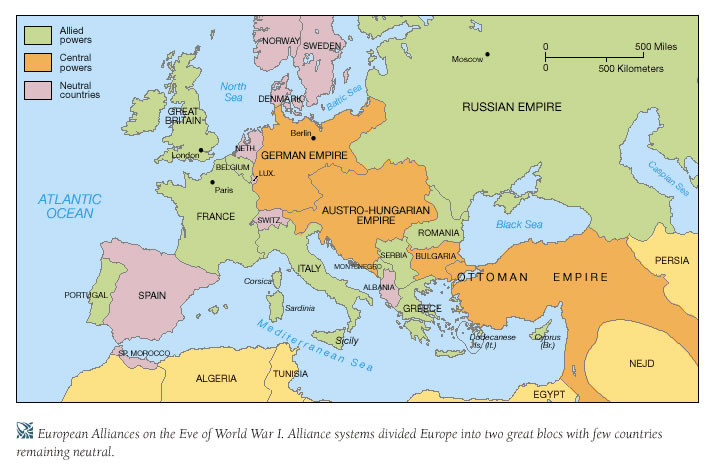
European alliance blocs on the eve of World War I
- Territorial disputes stayed dangerous in the Balkans after Ottoman decline and over Alsace-Lorraine between France and Germany.
- Trigger means Gavrilo Princip’s assassination of Archduke Franz Ferdinand in Sarajevo. On the AP exam, the key move is saying the assassination mattered less than the unstable system around it.
Why Conflict Expanded After World War I
WWI did not solve the old tensions. It created new ones.
- Mass casualties, shortages, inflation, debt, and radicalization destabilized societies.
- The Ottoman and Austro-Hungarian empires collapsed.
- The Russian Revolution created the first lasting communist state.
The peace settlement made things worse:
- The Treaty of Versailles imposed reparations, territorial losses, military restrictions, and war guilt on Germany.
- That humiliation fed later extremist movements.
- Self-determination was applied unevenly. Some Europeans got states. Colonized peoples usually did not.
- The League of Nations was weak, and the U.S. never joined.
The Great Depression then deepened the crisis through unemployment, falling trade, bank failures, and political instability. It strengthened extremist parties, especially the Nazis, and encouraged expansion for resources and markets.
Fascism added ideology to the crisis. It promoted authoritarianism, nationalism, anti-communism, and violence. Hitler wanted antisemitic racial empire, Lebensraum, and the overturning of Versailles. Mussolini invaded Ethiopia. Japan seized Manchuria in 1931 and launched wider war in China in 1937.
The international response stayed weak. The League failed in Manchuria and Ethiopia. The Munich Agreement gave Hitler the Sudetenland. Germany’s invasion of Poland in 1939 triggered war in Europe.
What Made Twentieth-Century Conflict So Destructive
Technology explains why these wars became so massive and deadly.
- In WWI, machine guns, heavy artillery, poison gas, submarines, and aircraft produced huge casualties.
- In WWII, tanks, aircraft carriers, radar, strategic bombing, firebombing, and atomic bombs at Hiroshima and Nagasaki pushed destruction even further.
- Railroads, radio, telegraphs, film, and bureaucracy let states mobilize whole societies for total war.
WWI trench warfare captures how industrial technology turned the battlefield into a killing zone.
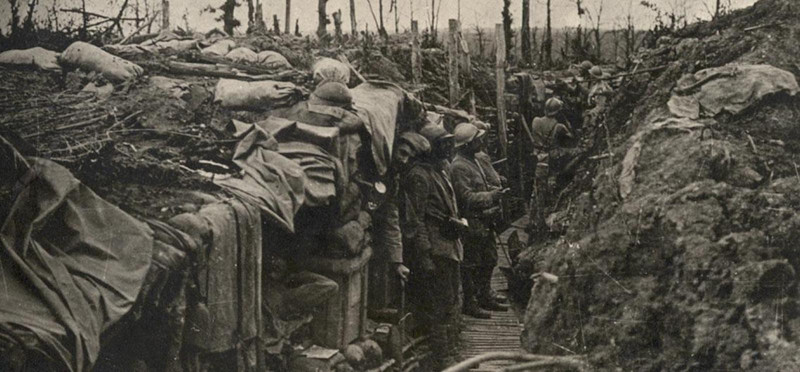
WWI trench warfare
Mass atrocities grew out of the same century of crisis:
- The Holocaust came from Nazi antisemitism, racial ideology, bureaucracy, conquest, and total war.
- The Armenian genocide happened during WWI under conditions of war, fear, and extreme nationalism.
- Other examples include Stalin’s famine in Ukraine, the Khmer Rouge in Cambodia, and Rwanda in 1994.
The common pattern is extremist ideology + state power + dehumanization + crisis or war.
