Topic 9.7 Notes – Resistance to Globalization After 1900
What Resistance to Globalization Was
Globalization in this era meant deeper economic and cultural integration. Goods, money, ideas, movies, music, and information crossed borders faster than ever through trade, multinational corporations, international financial institutions, television, and later the internet.
Resistance usually did not mean wanting isolation. Most groups objected to the terms of globalization. They asked who controlled it, who profited, and who paid the costs.
The pattern you want to remember is simple:
- Integration increased.
- Benefits and harms were uneven.
- Workers, farmers, activists, governments, and cultural groups reacted.
- Their response matched what they felt threatened by, such as jobs, sovereignty, or identity.
A key twist is that globalization also gave resistance its tools. Protesters used air travel, TV coverage, email, websites, and social media to organize across borders. That is why many movements are better called alter-globalization. They wanted a fairer global system, not the end of global connection.
Why People Resisted Economic Globalization
Economic resistance centered on the feeling that global markets were powerful, but not fair.
| Target | What it did | Why people criticized it |
|---|---|---|
| IMF | Short-term loans for currency and balance-of-payments crises | Loan conditions reduced sovereignty and hurt the poor |
| World Bank | Long-term development financing | Projects and policy demands often favored outside interests |
| Multinational corporations | Moved production to low-wage regions | Sweatshops, unsafe work, child labor, weak labor rights |
| Imported goods and debt | Undercut local producers; debt drained budgets | Farmers and small businesses struggled; repayment blocked spending on health and education |
A huge source of anger was structural adjustment. Borrowing countries were often pushed to adopt austerity, privatization, deregulation, trade liberalization, subsidy cuts, currency devaluation, and export-oriented production. Critics argued these policies gave wealthy countries and lenders too much power.
Common responses included strikes, union campaigns, consumer boycotts, demands for labor standards in trade deals, buy-local campaigns, fair-trade movements, and government tariffs, subsidies, or import restrictions.
Anti-IMF and Anti-World Bank Activism
This became one of the clearest examples of resistance to economic globalization. Activists connected IMF and World Bank lending policies to poverty, inequality, and weaker national control.
One major flashpoint came in Washington, D.C., where large demonstrations gathered during IMF and World Bank meetings.
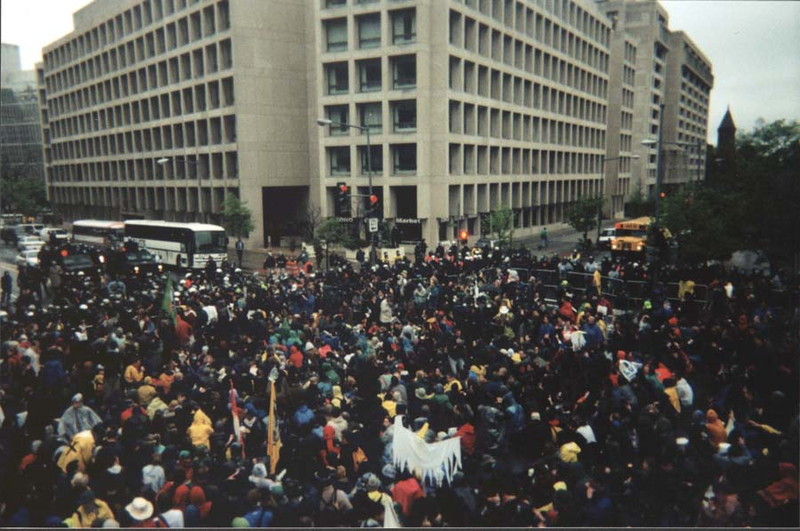
April 2000 anti-IMF and World Bank protests in Washington, D.C.
The movement was transnational. It crossed borders and linked many kinds of groups:
- Labor unions worried about wages and jobs
- Environmentalists criticized development and extraction
- Students joined broader anti-corporate activism
- Religious organizations pushed debt relief and justice
- Human-rights and development activists attacked inequality
Important examples you need by name:
- Anti-IMF activism
- Anti-World Bank activism
- 1999 Seattle protests against the WTO as the wider protest wave
- April 2000 Washington, D.C. demonstrations during IMF and World Bank spring meetings
Their demands varied. Some wanted the institutions abolished. Others wanted debt cancellation, transparency, labor and environmental standards, and a greater voice for poorer countries.
How Cultural Resistance Worked
Economic globalization spread products. Cultural globalization spread films, TV, music, brands, advertising, and online platforms. The fear was cultural homogenization, meaning local cultures becoming too similar under global consumer culture.
Common responses included:
- promoting local languages in schools and media
- supporting domestic film, music, and television
- restricting foreign media
- defending religious or customary practices
- favoring local brands and businesses
- creating domestic alternatives to foreign technology
This rarely meant sealing off a culture completely. More often, outside influences were adapted into local forms. That is localization or hybridization.
Governments also resisted for political reasons. Controlling media could preserve sovereignty, shape national identity, and limit dissent.
Weibo and the Bigger Significance
Weibo in China, launched in 2009, shows what this looked like in practice. The mobile screens here highlight that it functioned as a Chinese social media platform with familiar features like trending topics, feeds, and user posts.

Weibo mobile app screens
Weibo mattered because it:
- resembled global platforms like Twitter, so it was still part of globalization
- reduced dependence on a foreign company
- fit Chinese language and business needs
- supported domestic tech firms
- let the Chinese state censor and monitor communication
So Weibo was not rejection of modern technology. It was domestic adaptation of a global form.
Key Takeaways
International Monetary Fund (IMF)
Bretton Woods institution that provides short-term assistance during financial crises, often with policy conditions criticized for imposing austerity and limiting sovereignty
World Bank
Bretton Woods institution that finances long-term development projects and programs but faced criticism over loan conditions and wealthy-country influence
Structural Adjustment Programs
Loan conditions promoting austerity, privatization, deregulation, trade liberalization, and export production to stabilize and market-orient borrowing economies
April 2000 IMF and World Bank Protests
Washington, D.C., demonstrations demanding reforms such as debt cancellation, transparency, labor protections, and greater influence for poorer countries
Cultural Homogenization
The feared displacement of distinct local cultures by increasingly similar global media, brands, languages, and consumer practices
Sina Weibo
Chinese microblogging platform launched in 2009 as a domestic alternative to blocked foreign platforms, combining localized technology with state monitoring and censorship
Anti-Globalization vs. Alter-Globalization
Anti-globalization opposes global integration or its institutions; alter-globalization seeks fairer, more democratic global connections rather than isolation
Anti-IMF and Anti-World Bank Activism
Campaigns opposing loan conditions and wealthy-state influence while demanding reforms such as debt relief, transparency, and a greater voice for poorer countries
Notes
International Monetary Fund (IMF)
Bretton Woods institution that provides short-term assistance during financial crises, often with policy conditions criticized for imposing austerity and limiting sovereignty
World Bank
Bretton Woods institution that finances long-term development projects and programs but faced criticism over loan conditions and wealthy-country influence
Structural Adjustment Programs
Loan conditions promoting austerity, privatization, deregulation, trade liberalization, and export production to stabilize and market-orient borrowing economies
April 2000 IMF and World Bank Protests
Washington, D.C., demonstrations demanding reforms such as debt cancellation, transparency, labor protections, and greater influence for poorer countries
Cultural Homogenization
The feared displacement of distinct local cultures by increasingly similar global media, brands, languages, and consumer practices
Sina Weibo
Chinese microblogging platform launched in 2009 as a domestic alternative to blocked foreign platforms, combining localized technology with state monitoring and censorship
Anti-Globalization vs. Alter-Globalization
Anti-globalization opposes global integration or its institutions; alter-globalization seeks fairer, more democratic global connections rather than isolation
Anti-IMF and Anti-World Bank Activism
Campaigns opposing loan conditions and wealthy-state influence while demanding reforms such as debt relief, transparency, and a greater voice for poorer countries
