Topic 5.9 Notes – Society and the Industrial Age
How Industrialization Reshaped Social Hierarchy
Before factories, status came mostly from land, birth, and inherited rank. Industrialization added a new path to power through factories, banking, trade, and investment.
- Old aristocracies still mattered. Landowners kept titles, prestige, and political influence through the 1800s.
- New industrialists and financiers rose alongside them. In many places they competed with nobles, joined them, bought land, or married into elite families.
- This is a classic AP change-and-continuity point. The basis of status changed, but hierarchy itself stayed.
The main chain to remember is simple:
- Factories concentrated production
- They needed lots of wage laborers
- Workers moved to cities for jobs
- Cities grew fast
- A new class structure took shape
That did not erase older groups. Peasants, artisans, landowners, and rural society still mattered through 1900, especially outside the most industrialized regions.
The New Social Classes
Industrial society produced three big layers, and AP likes you to compare them together.
Industrial elites and business owners
These were factory owners, mine owners, merchants, bankers, and investors. Their power came from owning capital and the means of production.
- Bourgeoisie can mean the broad property-owning/business class in the 1800s.
- In Marxist language, it means the people who own the means of production.
- Don’t confuse bourgeoisie with everyone in the middle class. A wealthy capitalist and a clerk were not the same.
The growing middle class
Industrial economies needed managers and trained professionals, so the middle class grew.
- Included managers, engineers, doctors, lawyers, teachers, clerks, officials, shopkeepers, and small business owners
- Associated with education, steady income, professional respectability, cleaner housing, and consumer goods
- Still very mixed internally. A clerk had far less wealth than a major industrial owner.
The industrial working class
This was the proletariat, meaning wage-dependent workers such as factory laborers, miners, transport workers, and construction workers.
- Their defining feature was dependence on wages
- Factory labor often meant long hours, repetitive work, dangerous machines, low pay, and insecure jobs
- Compared with artisans, workers had less control over tools, pace, and the full production process
Class, Gender, and Family Work
Industrialization affected women and children differently depending on class.
Working-class women
Many families needed more than one income, so women worked for wages in textile mills, garment production, domestic service, food processing, home piecework, and sometimes mines.
- They were usually paid less than men
- They often carried a double burden of wage labor plus cooking, cleaning, and childcare
Meiji Japan is the standard example. Young women worked heavily in silk-reeling and cotton-spinning mills under long hours, strict supervision, low pay, and dormitory life.
Child labor
Children worked in factories, mines, workshops, domestic service, agriculture, and street trades.
- Child labor existed before industrialization
- Industrialization changed its intensity, discipline, and danger
- It often kept children out of school
- Britain later became the standard case for factory laws limiting child labor
Middle-class women and domesticity
Middle-class families had less pressure for women to earn wages. This helped spread the idea of separate spheres or the cult of domesticity.
- Men were linked to public work and politics
- Women were linked to home, morality, and child-rearing
This was an ideal, not everyone’s reality.
Urban Life in the Industrial Age
Factories and mines pulled people into cities, so industrialization sped up urbanization.
Manchester is the classic case. It grew through textile mills, warehouses, canals, and rail links, but also became known for pollution, overcrowding, and class segregation. Friedrich Engels wrote about this in The Condition of the Working Class in England.
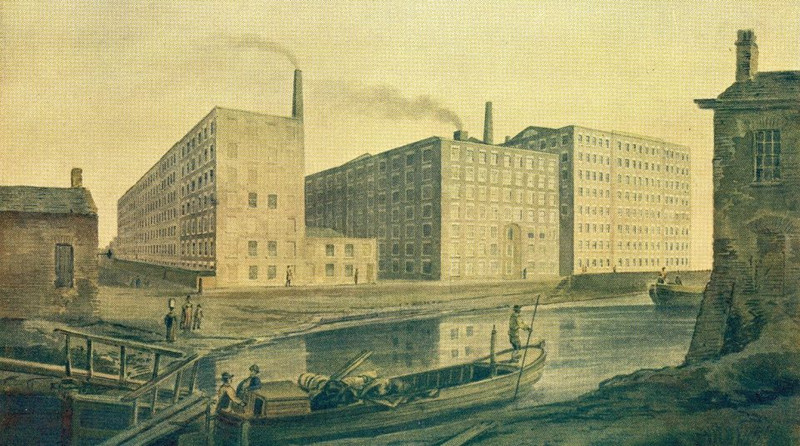
Industrial Manchester mills and canal
London also grew massively, becoming an industrial, commercial, and imperial city.
Common urban problems included:
- tenements and slums
- coal smoke and industrial waste
- weak sanitation, water, sewers, roads, transport, policing, and hospitals
- poverty, crime, and fear of disorder
Public health became a crisis. Cholera epidemics spread through dirty water. John Snow traced the 1854 London outbreak to the Broad Street pump. The map below marks deaths as black bars clustered near the pump. The Great Stink of 1858 pushed sewer reform.
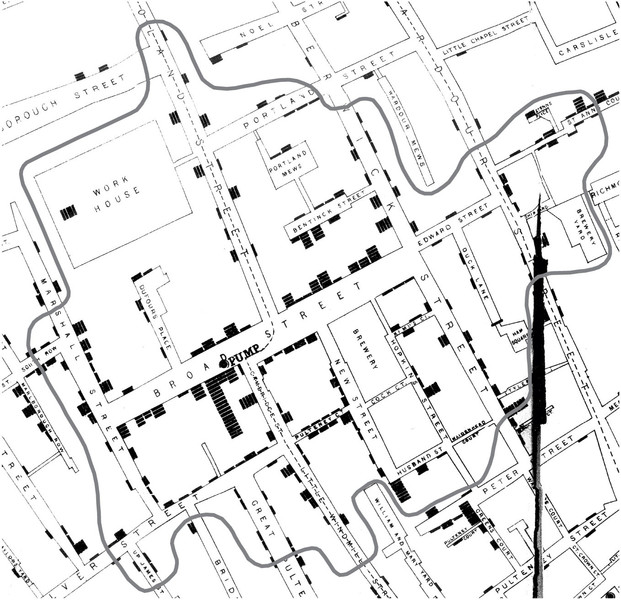
John Snow's cholera map, London, 1854
Cities also showed class on the landscape. Workers lived near factories because they walked to work. Middle-class families moved to cleaner neighborhoods farther away.
How Standards of Living Changed Unevenly
Industrialization created more total wealth and made many goods cheaper, especially manufactured goods like clothing and household items. But the gains were uneven.
| Group | Typical outcome |
|---|---|
| Upper and middle classes | Benefited earliest through income, goods, cleaner housing, and services |
| Skilled workers | Some later saw rising real wages and better access to goods |
| Many early industrial workers | Faced low pay, long hours, unsafe work, crowded housing, pollution, and disease |
The exam loves this argument. Standards of living did not simply rise or fall. They changed unevenly by class, gender, age, place, and time.
Key Takeaways
Bourgeoisie
Property-owning business class; in Marxist analysis, those who owned the means of production, overlapping with but not identical to the middle class
Middle Class
Growing class of managers, professionals, officials, clerks, shopkeepers, and small business owners between wealthy elites and wage laborers
Industrial Working Class / Proletariat
Factory, mine, transport, and other manual workers who lacked productive property and depended primarily on wages
Working-Class Women vs. Middle-Class Women
Economic necessity drew working-class women into wage labor, while greater middle-class income increasingly confined middle-class women to household and child-rearing roles
Separate Spheres / Cult of Domesticity
Middle-class ideal assigning men to wage earning and public affairs and women to household management, morality, and child development
Double Burden
Working-class women’s combined responsibility for paid employment and unpaid household and childcare labor
Child Labor
Poor families’ need for income led children to work, while industrialization concentrated many in factories and mines under strict schedules and dangerous conditions
Urbanization
Growth of cities and the urban share of the population, accelerated by industrial jobs and rural-to-urban migration
Tenements / Slums
Dense, cheaply built or subdivided urban housing marked by overcrowding, poor ventilation, inadequate sanitation, and contaminated water
Standard of Living
Material well-being measured through income, consumption, housing, health, nutrition, safety, working hours, sanitation, and services
Notes
Bourgeoisie
Property-owning business class; in Marxist analysis, those who owned the means of production, overlapping with but not identical to the middle class
Middle Class
Growing class of managers, professionals, officials, clerks, shopkeepers, and small business owners between wealthy elites and wage laborers
Industrial Working Class / Proletariat
Factory, mine, transport, and other manual workers who lacked productive property and depended primarily on wages
Working-Class Women vs. Middle-Class Women
Economic necessity drew working-class women into wage labor, while greater middle-class income increasingly confined middle-class women to household and child-rearing roles
Separate Spheres / Cult of Domesticity
Middle-class ideal assigning men to wage earning and public affairs and women to household management, morality, and child development
Double Burden
Working-class women’s combined responsibility for paid employment and unpaid household and childcare labor
Child Labor
Poor families’ need for income led children to work, while industrialization concentrated many in factories and mines under strict schedules and dangerous conditions
Urbanization
Growth of cities and the urban share of the population, accelerated by industrial jobs and rural-to-urban migration
Tenements / Slums
Dense, cheaply built or subdivided urban housing marked by overcrowding, poor ventilation, inadequate sanitation, and contaminated water
Standard of Living
Material well-being measured through income, consumption, housing, health, nutrition, safety, working hours, sanitation, and services
