Topic 4.2 Notes – Exploration: Causes and Events from 1450 to 1750
Why European States Backed Maritime Exploration
Europeans were not inventing long-distance trade. They were trying to break into it more directly. Asian spices, silk, porcelain, and African gold already moved through networks run by Muslim merchants, Indian Ocean traders, and Italian cities like Venice and Genoa.
Ottoman expansion, especially Constantinople in 1453, did not shut trade down. Goods still reached Europe. The issue was profit. More middlemen meant more tolls, higher prices, and less revenue for European states.
Main motives
- Economic motives
- Direct access to the spice trade promised huge profits because spices were expensive and easy to ship.
- Fewer intermediaries meant lower transaction costs and more money for merchants and rulers.
- States wanted customs revenue and bullion, since wealth helped them fund armies and governments.
- Political motives
- Portugal and Spain competed first, then England, France, and the Dutch joined in.
- Overseas routes could increase a state's prestige, military reach, and claims to land.
- Religious motives
- Christian rulers wanted to spread Christianity.
- Expansion also connected to conflict with Muslim powers.
- Portugal hoped to find Christian allies like Prester John.
- Spain had just finished the Reconquista with the fall of Granada in 1492, so expansion carried a strong crusading and missionary energy.
State sponsorship is the key idea here. Explorers needed ships, money, legal authority, monopolies, and protection. Individual ambition mattered, but rulers made repeated voyages possible. The map below helps you picture the scale of the routes they were trying to control, from Atlantic crossings to the route around Africa and into the Indian Ocean.
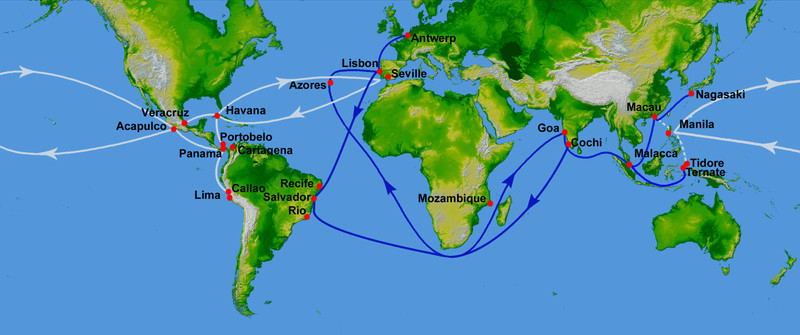
Iberian maritime trade routes
Quick 4.1 reminder: these voyages worked because Europeans combined caravels and carracks, compasses, lateen sails, cannon, better maps, and knowledge borrowed from Classical, Islamic, Asian, and Mediterranean traditions.
Portugal and the Route Around Africa
Portugal created the first sustained state-backed exploration program.
- Ceuta, 1415 gave Portugal an early foothold in North Africa.
- Prince Henry the Navigator sponsored voyages, mapmaking, and knowledge gathering.
- Portuguese sailors explored Atlantic islands and the west coast of Africa, trading for gold and enslaved people.
- Volta do mar mattered because sailors learned that using winds and currents often meant sailing far into the Atlantic before turning back.
Major voyages
- Bartolomeu Dias rounded the Cape of Good Hope in 1488.
- Vasco da Gama reached Calicut in India in 1498, using both Portuguese experience and Indian Ocean pilot knowledge.
Immediate effects
Portugal entered an existing Indian Ocean trade system. It did not create that system. Its empire was a trading-post empire built on feitorias rather than giant inland conquests.
| Base | Importance |
|---|---|
| Goa | Main Portuguese base in India |
| Malacca | Controlled a key strait in Southeast Asia |
| Hormuz | Controlled access to the Persian Gulf |
| Macao | Linked Portugal to trade with China |
The exam loves this distinction. Portugal controlled strategic ports and sea lanes, not all Indian Ocean commerce.
Spain and Westward Exploration
Spain supported a westward route because Portugal had the African route.
Christopher Columbus
- A Genoese sailor backed by Ferdinand and Isabella
- In 1492, he crossed the Atlantic and reached the Caribbean
- He thought he had reached islands near Asia because he underestimated Earth's size and did not know the Americas were in the way
His importance is not "discovering" empty land. The Americas were already inhabited. His importance is creating sustained, state-backed Atlantic contact between Europe and the Americas.
Treaty of Tordesillas
In 1494, Spain and Portugal divided overseas claims with papal backing. This helps explain why Brazil became Portuguese while most of the Americas became Spanish.
Expansion of Spanish exploration
- Columbus's later voyages strengthened Spanish claims.
- Balboa crossed Panama and saw the Pacific in 1513.
- Magellan's Spanish-sponsored expedition began in 1519.
- Passed through the Strait of Magellan
- Magellan died in the Philippines in 1521
- Juan Sebastián Elcano completed the first circumnavigation in 1522
These voyages proved the oceans were globally connected and showed how enormous the Pacific was.
England, France, and the Dutch Search for Alternate Routes
These states wanted a Northwest or Northeast Passage to Asia so they could avoid Iberian-controlled routes.
- England
- John Cabot reached northeastern North America in 1497.
- Martin Frobisher searched the Canadian Arctic in the 1570s.
- Henry Hudson entered Hudson Bay in 1610.
- France
- Jacques Cartier explored the Gulf of St. Lawrence and St. Lawrence River starting in 1534.
- Samuel de Champlain founded Quebec in 1608.
- Dutch Republic
- Willem Barents searched for a Northeast Passage in the 1590s.
- Henry Hudson, sailing for the Dutch in 1609, explored the Hudson River.
They failed to find a practical northern route to Asia, but they still gained maps, claims, fisheries access, fur trade opportunities, and a basis for later colonization.
The Big Pattern and Why It Matters
Three patterns define this topic:
- Portugal went around Africa into the Indian Ocean.
- Spain went west across the Atlantic and then into the Pacific.
- England, France, and the Dutch searched northern routes.
The cause-and-effect chain is simple. Demand for trade goods led to state sponsorship. State sponsorship led to repeated voyages. Repeated voyages led to new routes, claims, and commercial opportunities.
Key Takeaways
State Sponsorship of Maritime Exploration
Government financing, ships, commissions, legal privileges, claims, and military protection made repeated long-distance voyages sustainable
God, Gold, and Glory
Summary of exploration’s linked motives: Christian expansion, commercial wealth, and political or personal prestige
Reconquista
Christian reconquest of Iberia, completed when Ferdinand and Isabella captured Granada in 1492; it helped connect Spanish exploration with Christian expansion
Prince Henry the Navigator
Portuguese prince who provided sustained royal patronage for African expeditions, geographic knowledge, and commerce, though he did not lead the major voyages
Volta do Mar
Portuguese “turn of the sea” technique of sailing into the open Atlantic to use prevailing winds for a faster return voyage
Bartolomeu Dias
Portuguese explorer who rounded southern Africa in 1488, proving that the Atlantic connected to the Indian Ocean around the continent
Cape of Good Hope
Southern African cape rounded by Dias whose name reflected Portugal’s hope of reaching the Indian Ocean and Asia by sea
Vasco da Gama
Portuguese explorer who rounded Africa and reached Calicut, India, in 1498, giving Portugal direct maritime access to Indian Ocean trade
Feitorias (Portuguese Trading Posts)
Coastal commercial bases, sometimes fortified, where Portuguese merchants stored goods, traded, and supported shipping
Portuguese Trading-Post Empire
Dispersed network of strategic coastal bases such as Goa, Malacca, Hormuz, and Macao used to influence shipping and trade with limited inland rule
Ferdinand of Aragon and Isabella of Castile
Spanish monarchs who sponsored Columbus’s westward voyage after completing the conquest of Granada in 1492
Christopher Columbus
Genoese mariner sponsored by Spain who reached the Caribbean in 1492 while seeking Asia, initiating a permanent state-supported Europe-Americas connection
Treaty of Tordesillas
The 1494 agreement dividing overseas claims: Portugal received lands east of a line west of Cape Verde, while Spain received lands west of it
Vasco Núñez de Balboa
Spanish explorer who crossed Panama in 1513 and became the first European expedition leader to view the Pacific from the Americas
Ferdinand Magellan
Portuguese navigator under Spanish sponsorship who led the 1519 expedition around South America and across the Pacific but died in the Philippines
Juan Sebastián Elcano
Spanish mariner who commanded Magellan’s remaining ship back to Spain in 1522 and completed the first circumnavigation
First Circumnavigation
The 1519–1522 Magellan-Elcano expedition that first sailed around the world, proving the oceans were connected and revealing the Pacific’s immense scale
Northwest Passage vs. Northeast Passage
The Northwest Passage was a proposed route through or around northern North America; the Northeast Passage followed northern Eurasia
John Cabot
Venetian mariner sponsored by Henry VII who reached northeastern North America in 1497 while seeking a shorter route to Asia
Martin Frobisher
English explorer who made three 1570s voyages into the Canadian Arctic while searching unsuccessfully for a Northwest Passage
Henry Hudson
Explorer who searched for northern routes under Dutch and English sponsorship, exploring the Hudson River in 1609 and Hudson Bay in 1610
Jacques Cartier
French explorer who entered the Gulf and River of St. Lawrence beginning in 1534 while seeking a passage to Asia
Willem Barents
Dutch navigator whose 1590s expeditions sought a Northeast Passage but were blocked by Arctic ice
Notes
State Sponsorship of Maritime Exploration
Government financing, ships, commissions, legal privileges, claims, and military protection made repeated long-distance voyages sustainable
God, Gold, and Glory
Summary of exploration’s linked motives: Christian expansion, commercial wealth, and political or personal prestige
Reconquista
Christian reconquest of Iberia, completed when Ferdinand and Isabella captured Granada in 1492; it helped connect Spanish exploration with Christian expansion
Prince Henry the Navigator
Portuguese prince who provided sustained royal patronage for African expeditions, geographic knowledge, and commerce, though he did not lead the major voyages
Volta do Mar
Portuguese “turn of the sea” technique of sailing into the open Atlantic to use prevailing winds for a faster return voyage
Bartolomeu Dias
Portuguese explorer who rounded southern Africa in 1488, proving that the Atlantic connected to the Indian Ocean around the continent
Cape of Good Hope
Southern African cape rounded by Dias whose name reflected Portugal’s hope of reaching the Indian Ocean and Asia by sea
Vasco da Gama
Portuguese explorer who rounded Africa and reached Calicut, India, in 1498, giving Portugal direct maritime access to Indian Ocean trade
Feitorias (Portuguese Trading Posts)
Coastal commercial bases, sometimes fortified, where Portuguese merchants stored goods, traded, and supported shipping
Portuguese Trading-Post Empire
Dispersed network of strategic coastal bases such as Goa, Malacca, Hormuz, and Macao used to influence shipping and trade with limited inland rule
Ferdinand of Aragon and Isabella of Castile
Spanish monarchs who sponsored Columbus’s westward voyage after completing the conquest of Granada in 1492
Christopher Columbus
Genoese mariner sponsored by Spain who reached the Caribbean in 1492 while seeking Asia, initiating a permanent state-supported Europe-Americas connection
Treaty of Tordesillas
The 1494 agreement dividing overseas claims: Portugal received lands east of a line west of Cape Verde, while Spain received lands west of it
Vasco Núñez de Balboa
Spanish explorer who crossed Panama in 1513 and became the first European expedition leader to view the Pacific from the Americas
Ferdinand Magellan
Portuguese navigator under Spanish sponsorship who led the 1519 expedition around South America and across the Pacific but died in the Philippines
Juan Sebastián Elcano
Spanish mariner who commanded Magellan’s remaining ship back to Spain in 1522 and completed the first circumnavigation
First Circumnavigation
The 1519–1522 Magellan-Elcano expedition that first sailed around the world, proving the oceans were connected and revealing the Pacific’s immense scale
Northwest Passage vs. Northeast Passage
The Northwest Passage was a proposed route through or around northern North America; the Northeast Passage followed northern Eurasia
John Cabot
Venetian mariner sponsored by Henry VII who reached northeastern North America in 1497 while seeking a shorter route to Asia
Martin Frobisher
English explorer who made three 1570s voyages into the Canadian Arctic while searching unsuccessfully for a Northwest Passage
Henry Hudson
Explorer who searched for northern routes under Dutch and English sponsorship, exploring the Hudson River in 1609 and Hudson Bay in 1610
Jacques Cartier
French explorer who entered the Gulf and River of St. Lawrence beginning in 1534 while seeking a passage to Asia
Willem Barents
Dutch navigator whose 1590s expeditions sought a Northeast Passage but were blocked by Arctic ice
