Topic 4.5 Notes – Maritime Empires Maintained and Developed
How Maritime Empires Were Maintained
Earlier land empires usually depended on controlling territory by land. Maritime empires depended on ships, sea lanes, ports, and trade routes. That meant conquest was only the beginning. A state had to keep colonies tied to the empire, move wealth home, and keep enemies out.
Political power and economic policy worked together:
- Colonies sent bullion, raw materials, and plantation crops back to Europe.
- Imperial states sent protection, laws, naval power, and military force.
- Governments worked with merchants and companies because overseas empire was expensive and risky.
So when you see maritime empire on the AP exam, think trade + state power + naval force.
Mercantilism and Chartered Companies
European rulers treated world trade like a competition. Mercantilism said a state grew stronger by getting more wealth than its rivals, especially gold and silver.
Mercantilism
Major goals:
- Accumulate bullion because precious metals helped fund armies, navies, and governments.
- Export more than import so wealth flowed into the country.
- Use tariffs and restrictions to protect home industries.
- Build merchant marines and navies to carry and defend trade.
- Keep colonial trade reserved for the mother country.
Examples:
- England’s Navigation Acts from 1651 required trade with English colonies to use English ships. This also targeted Dutch merchants.
- Jean-Baptiste Colbert in France pushed manufacturing and state-directed trade.
- Spain tightly regulated silver fleets and authorized ports, though smuggling was common.
Chartered companies
Long-distance trade was dangerous, so joint-stock companies pooled money from many investors and spread risk.
Chartered monopoly companies got state permission to trade exclusively in a region and often had powers that look almost governmental.
| Company | Key facts |
|---|---|
| Dutch East India Company (VOC) | Founded 1602; based at Batavia on Java; used blockades and force to dominate the spice trade |
| English East India Company | Chartered 1600; built trading posts in India and Asia; mostly commercial before 1750, but set up later British empire |
| Royal African Company | English company involved in the Atlantic slave trade |
The pattern the AP likes is simple. States used private capital to advance imperial competition.
Global Trade Networks and Economic Rivalry
European expansion plugged the Atlantic, Pacific, and Indian Ocean together. Older Afro-Eurasian trade did not disappear.
Silver
Silver was the great connector of the early modern world.
- Major mines were Potosí and Zacatecas.
- Silver crossed the Atlantic to Europe, then moved toward Asia.
- After 1571, Manila galleons linked Acapulco and Manila across the Pacific.
- Ming China wanted silver partly because taxes had to be paid in it.
- Europeans used silver to buy Asian silk, porcelain, spices, and cotton textiles.
This trade map helps you see how American silver connected Spanish Pacific routes to older Indian Ocean and Atlantic networks.
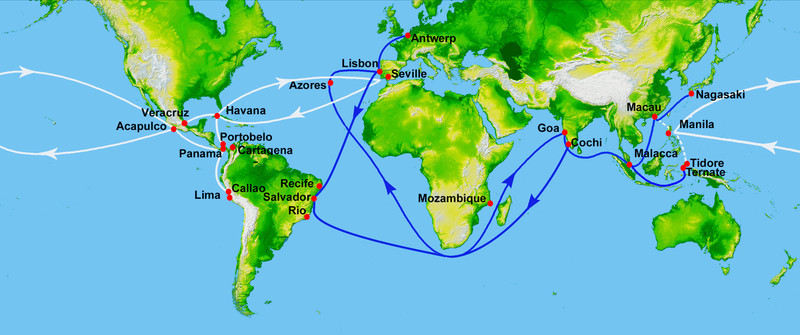
Early modern global maritime trade routes
Atlantic trading system
- Europe sent manufactured goods to Africa.
- Africa sent enslaved people through the Middle Passage.
- The Americas sent sugar, tobacco, dyestuffs, and silver to Europe.
The triangular trade model helps, but real routes were more complicated.
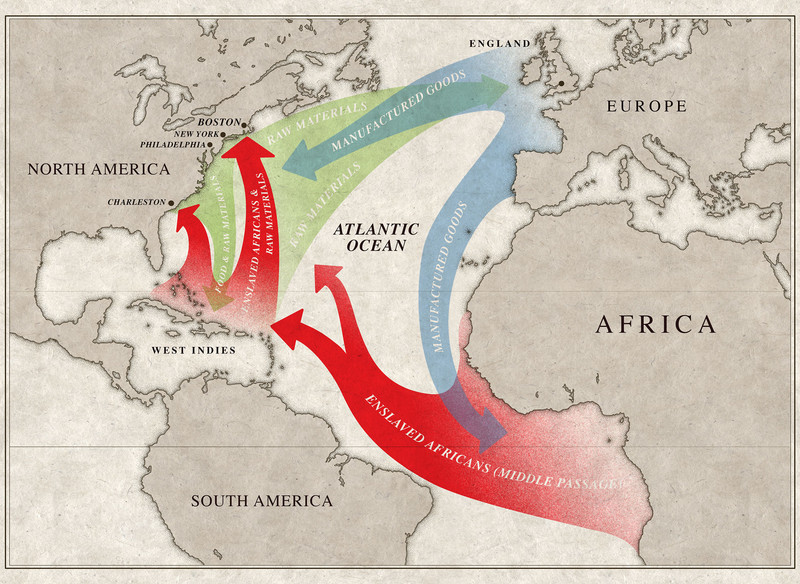
Atlantic triangular trade
Continuity and conflict
Older networks kept going through merchants such as Gujarati, Arab, Swahili, Armenian, Jewish, Chinese, and Southeast Asian traders. They still used credit, brokers, diasporic communities, and bills of exchange.
Labor also intensified:
- European putting-out system expanded wool and linen production.
- Indian cotton textiles grew for world markets.
- Chinese silk and handicrafts also expanded.
Competition turned violent:
- Anglo-Dutch Wars came out of trade rivalry.
- Portuguese fought Muslim merchants and states in the Indian Ocean.
- Oman expelled Portugal from Muscat in 1650 and Mombasa in 1698.
- Morocco invaded Songhai in 1591, winning at Tondibi to gain trade access.
Social and Cultural Effects of Maritime Empires
Trade moved wealth and goods, but it also moved people by force and reshaped societies.
Atlantic slavery changed Africa deeply:
- Many regions lost young adults, often more men than women.
- This hurt population growth and disrupted families.
- Warfare increased as states and traders captured people.
- In some places, polygyny expanded.
- Women often took on more farm and household labor.
In the Americas, cultures blended:
- African, Indigenous American, and European peoples all shaped food, language, music, and daily life.
- Power was unequal, but subordinated peoples still preserved and adapted traditions.
Religion also spread and mixed:
- Christianity spread through Spanish and Portuguese conquest and missions in the Americas and Philippines.
- Islam kept spreading through trade in Africa and Southeast Asia.
- Conquest often brought religious conflict.
- Syncretism blended traditions.
Examples you should know:
- Virgin of Guadalupe in Mexico shows Catholicism in an Indigenous setting.
- Haitian Vodou, Cuban Santería, and Brazilian Candomblé mixed African beliefs with Catholic symbols.
Key Takeaways
Mercantilism
European policies that used trade regulation, bullion accumulation, protected manufacturing, colonies, and naval power to increase state wealth and power
Bullion
Gold and silver accumulated by mercantilist states as sources of national wealth and military power
Navigation Acts
English laws beginning in 1651 that reserved English and colonial commerce for English ships and challenged Dutch carrying trade
Jean-Baptiste Colbert
French minister who promoted manufacturing, regulated trade, and expanded France’s merchant marine through state-directed mercantilism
Joint-Stock Company
A company in which investors pooled capital, purchased shares, and divided profits and risks to finance expensive overseas ventures
Chartered Monopoly Company
A company granted exclusive trade rights and governmental powers by a ruler in return for advancing the state’s commercial and imperial interests
English East India Company
English company chartered in 1600 that traded in Asian goods and operated trading posts, armed forces, and political privileges
Dutch East India Company (VOC)
Dutch company founded in 1602 that used Batavia, armed force, and monopoly policies to dominate parts of the Southeast Asian spice trade
Factory
A European organized or fortified trading station in Asia or another overseas commercial region
Royal African Company
English chartered company that participated in the Atlantic trade in enslaved Africans
Anglo-Dutch Wars
Seventeenth-century wars driven partly by English efforts to challenge Dutch dominance of shipping and colonial commerce
Potosí
Major Spanish-controlled silver-mining center in the Andes whose enormous output helped connect American labor to global commerce
Global Silver Trade
The circulation of American silver across the Atlantic and Pacific to Europe and Asia, especially China, in exchange for Asian goods
Manila Galleons
Spanish ships that carried American silver from Acapulco to Manila and returned with Chinese and other Asian goods
Atlantic Trading System
The interconnected movement of commodities, capital, manufactured goods, and labor, including enslaved people, among Europe, Africa, and the Americas
Triangular Trade
A simplified model of European goods going to Africa, enslaved Africans to the Americas, and American commodities to Europe
Middle Passage
The violent forced voyage that transported enslaved Africans across the Atlantic to the Americas
Atlantic Slave Trade
The forced transportation of millions of Africans to the Americas, enriching Atlantic commerce while causing demographic loss, warfare, and family disruption in Africa
Plantation Economy
Large-scale American production of export crops such as sugar and tobacco using coerced, especially enslaved, labor
Putting-Out System
A system in which merchants supplied raw materials to rural households that spun or wove goods at home for payment
Polygyny
Marriage in which one man has multiple wives; it became more common in some African regions affected by the export of men through the slave trade
Cultural Synthesis
The creation of new languages, foods, music, customs, and beliefs from African, Indigenous American, and European traditions
Religious Syncretism
The blending or accommodation of beliefs and practices from different religions into a new or locally adapted tradition
Virgin of Guadalupe
Mexican Catholic devotion associated with 1531 apparitions that expressed Christianity through an Indigenous Nahua cultural setting
Haitian Vodou
A syncretic Haitian religious tradition with colonial roots combining West and Central African sacred practices with elements of Catholicism
Cuban Santería
A syncretic Cuban religious tradition combining African sacred beings and rituals with Catholic saints and observances
Brazilian Candomblé
A syncretic Brazilian religious tradition preserving African-derived spirits and rituals alongside elements of Catholic practice
Muslim-European Rivalry in the Indian Ocean
Commercial and military competition as Europeans, especially the Portuguese, tried to control trade routes already used by Muslim merchants and states
Moroccan-Songhai Conflict
Morocco invaded Songhai in 1591 to gain access to trans-Saharan gold and salt trade, defeating it at Tondibi but failing to establish stable regional control
Intensification of Peasant and Artisan Labor
Peasant and household production persisted but expanded as growing regional and global demand increased market-oriented agriculture and manufacturing
Demographic and Family Restructuring in Africa
The slave trade removed many young adults, altered sex ratios and population growth, disrupted families, and increased women’s responsibilities in some African regions
Notes
Mercantilism
European policies that used trade regulation, bullion accumulation, protected manufacturing, colonies, and naval power to increase state wealth and power
Bullion
Gold and silver accumulated by mercantilist states as sources of national wealth and military power
Navigation Acts
English laws beginning in 1651 that reserved English and colonial commerce for English ships and challenged Dutch carrying trade
Jean-Baptiste Colbert
French minister who promoted manufacturing, regulated trade, and expanded France’s merchant marine through state-directed mercantilism
Joint-Stock Company
A company in which investors pooled capital, purchased shares, and divided profits and risks to finance expensive overseas ventures
Chartered Monopoly Company
A company granted exclusive trade rights and governmental powers by a ruler in return for advancing the state’s commercial and imperial interests
English East India Company
English company chartered in 1600 that traded in Asian goods and operated trading posts, armed forces, and political privileges
Dutch East India Company (VOC)
Dutch company founded in 1602 that used Batavia, armed force, and monopoly policies to dominate parts of the Southeast Asian spice trade
Factory
A European organized or fortified trading station in Asia or another overseas commercial region
Royal African Company
English chartered company that participated in the Atlantic trade in enslaved Africans
Anglo-Dutch Wars
Seventeenth-century wars driven partly by English efforts to challenge Dutch dominance of shipping and colonial commerce
Potosí
Major Spanish-controlled silver-mining center in the Andes whose enormous output helped connect American labor to global commerce
Global Silver Trade
The circulation of American silver across the Atlantic and Pacific to Europe and Asia, especially China, in exchange for Asian goods
Manila Galleons
Spanish ships that carried American silver from Acapulco to Manila and returned with Chinese and other Asian goods
Atlantic Trading System
The interconnected movement of commodities, capital, manufactured goods, and labor, including enslaved people, among Europe, Africa, and the Americas
Triangular Trade
A simplified model of European goods going to Africa, enslaved Africans to the Americas, and American commodities to Europe
Middle Passage
The violent forced voyage that transported enslaved Africans across the Atlantic to the Americas
Atlantic Slave Trade
The forced transportation of millions of Africans to the Americas, enriching Atlantic commerce while causing demographic loss, warfare, and family disruption in Africa
Plantation Economy
Large-scale American production of export crops such as sugar and tobacco using coerced, especially enslaved, labor
Putting-Out System
A system in which merchants supplied raw materials to rural households that spun or wove goods at home for payment
Polygyny
Marriage in which one man has multiple wives; it became more common in some African regions affected by the export of men through the slave trade
Cultural Synthesis
The creation of new languages, foods, music, customs, and beliefs from African, Indigenous American, and European traditions
Religious Syncretism
The blending or accommodation of beliefs and practices from different religions into a new or locally adapted tradition
Virgin of Guadalupe
Mexican Catholic devotion associated with 1531 apparitions that expressed Christianity through an Indigenous Nahua cultural setting
Haitian Vodou
A syncretic Haitian religious tradition with colonial roots combining West and Central African sacred practices with elements of Catholicism
Cuban Santería
A syncretic Cuban religious tradition combining African sacred beings and rituals with Catholic saints and observances
Brazilian Candomblé
A syncretic Brazilian religious tradition preserving African-derived spirits and rituals alongside elements of Catholic practice
Muslim-European Rivalry in the Indian Ocean
Commercial and military competition as Europeans, especially the Portuguese, tried to control trade routes already used by Muslim merchants and states
Moroccan-Songhai Conflict
Morocco invaded Songhai in 1591 to gain access to trans-Saharan gold and salt trade, defeating it at Tondibi but failing to establish stable regional control
Intensification of Peasant and Artisan Labor
Peasant and household production persisted but expanded as growing regional and global demand increased market-oriented agriculture and manufacturing
Demographic and Family Restructuring in Africa
The slave trade removed many young adults, altered sex ratios and population growth, disrupted families, and increased women’s responsibilities in some African regions
