Topic 7.8 Notes – Mass Atrocities After 1900
What Mass Atrocities Are
A mass atrocity is the broad category. It means large-scale, deliberate violence against civilians.
Genocide is narrower. Raphael Lemkin coined the term in 1944, and the UN Genocide Convention in 1948 defined it as intent to destroy, in whole or in part, a national, ethnic, racial, or religious group. That means intent matters more than death toll alone. A huge number of deaths does not automatically make something genocide.
Other terms show up with this topic too:
- Ethnic cleansing means forcing a population out of a territory through expulsion, terror, or killing. It can overlap with genocide, but its immediate goal is removal.
- Crimes against humanity means widespread or systematic attacks on civilians, including murder, deportation, imprisonment, and torture, without needing genocidal intent.
A pattern shows up again and again. Leaders label a group as dangerous, gain coercive power, then use law, propaganda, deportation, forced labor, famine, imprisonment, or killing against that group. After 1900, stronger states, total war, railroads, records, and bureaucracy made this much easier to organize.
Why Mass Atrocities Happened
These cases are connected by the same engine. Extremist ideas identified enemies, and state institutions made the violence systematic.
- Victims were painted as traitors, parasites, class enemies, racial threats, or outsiders.
- Propaganda turned murder into supposed self-defense or purification.
- Narrow nationalism made minorities look like obstacles to the nation.
- Racism and fake racial “science” gave persecution a false scientific excuse.
- Revolutionary regimes claimed society could be remade only by removing whole categories of people.
Ideas alone were not enough. The exam loves this point. Police, military, prisons, records, railroads, local officials, and censorship turned hatred into organized persecution.
War and crisis opened the door:
- World War I helped enable the Armenian genocide.
- World War II enabled the Holocaust.
- Civil war shaped Cambodia and Rwanda.
- Collectivization crisis shaped the Holodomor.
Outside powers often failed to act. The response to Armenians was weak, the Allies prioritized winning WWII over stopping the Holocaust, and the UN failed in Rwanda.
Major Cases to Know
Armenian genocide
Under the Ottoman Empire and the Young Turks, 1915 to 1917, Armenians were accused of disloyalty during WWI. On April 24, 1915, Armenian leaders in Constantinople were arrested. Deportation marches toward the Syrian desert brought massacre, starvation, and disease. About 1 to 1.5 million died, and a major Armenian diaspora followed.
Holodomor in Soviet Ukraine
Ukraine in the Soviet Union in the 1920s and 1930s saw Stalin’s forced collectivization and attack on kulaks lead to famine in 1932 to 1933. Grain requisitions, confiscation, and movement restrictions made starvation worse. Several million died in Ukraine, with famine elsewhere too, especially Kazakhstan. The debated point is whether it was legally genocide or a mass atrocity caused by coercive state policy.
Holocaust
The scale of Nazi persecution becomes clearer when you see it mapped across occupied Europe.
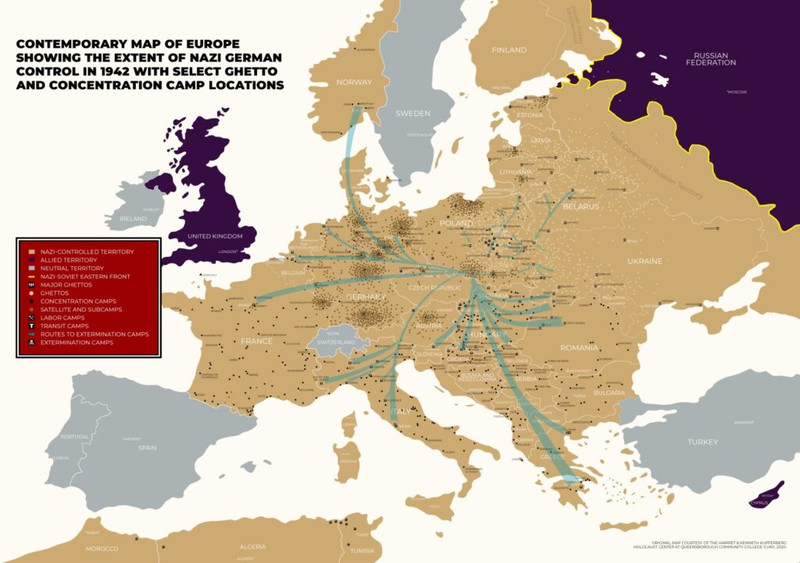
Nazi-controlled Europe, ghettos, and camps
Nazi antisemitism, Hitler’s dictatorship, and racial ideology drove this case. The Nuremberg Laws in 1935 stripped Jews of citizenship. Kristallnacht in 1938 escalated open violence. Ghettos followed the invasion of Poland. Einsatzgruppen followed the 1941 invasion of the USSR. The Wannsee Conference in 1942 coordinated the Final Solution. Key camps were Auschwitz-Birkenau, Treblinka, Sobibor, Belzec, Chelmno, and Majdanek. About 6 million Jews were murdered, along with Roma, disabled people, Slavs, Soviet POWs, gay men, and political opponents.
Cambodia under the Khmer Rouge
Pol Pot ruled from 1975 to 1979. The Khmer Rouge pushed radical agrarian communism, emptied cities, abolished money and markets, and imposed forced labor. Targets included educated people, urban residents, monks, Cham Muslims, ethnic Vietnamese, and perceived enemies. Tuol Sleng and the killing fields became symbols of the terror.
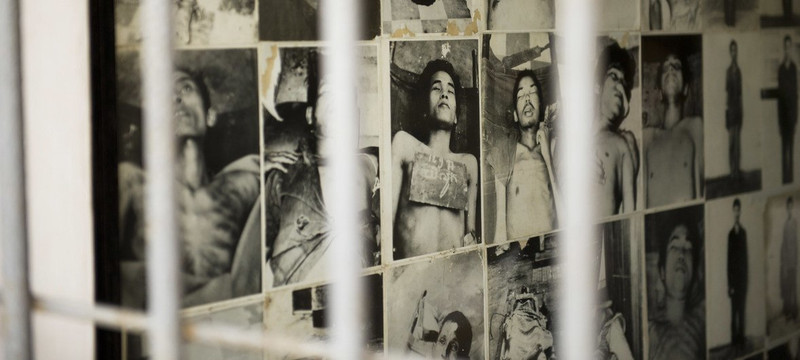
Tuol Sleng Genocide Museum, Cambodia
About 1.5 to 2 million died.
Rwanda
In 1994, extremists carried out genocide against the Tutsi. Belgian colonial rule had hardened Hutu and Tutsi identities. The trigger was the assassination of President Habyarimana. Interahamwe militias, local officials, radio propaganda, roadblocks, and machetes were central. About 800,000 were killed in around 100 days, mostly Tutsi plus moderate Hutu. It ended when the Rwandan Patriotic Front won.
Shared Methods and Major Differences
Across these cases, the methods repeat:
- Legal discrimination and identity classification
- Propaganda and dehumanization
- Confiscation of property and loss of rights
- Arrests, camps, ghettos, prisons, labor collectives
- Deportation, death marches, famine, shootings, gassing, torture, rape
The differences matter too:
| Case | Distinct feature |
|---|---|
| Holocaust | Racial extermination of Jews |
| Armenians | Deportation and destruction during imperial collapse |
| Holodomor | Engineered famine and repression |
| Khmer Rouge | Revolutionary remaking of society |
| Rwanda | Local militias and heavy civilian participation |
Consequences and Historical Significance
The immediate result was mass death, trauma, refugee flows, diaspora, and cultural destruction. People lost homes, property, religious institutions, and professional classes. Rwanda also helped destabilize Zaire/Congo.
After the Holocaust, the Nuremberg Trials established that individuals could be held responsible under international law. Later justice efforts included the ICTR for Rwanda, Khmer Rouge tribunals, and Rwanda’s gacaca courts.
The postwar human rights framework came directly from this history:
- UN Genocide Convention (1948)
- Universal Declaration of Human Rights (1948)
Key Takeaways
Mass Atrocity
Large-scale, deliberate violence against civilians, including genocide, ethnic cleansing, crimes against humanity, and extensive war crimes
Genocide
Acts committed with intent to destroy, wholly or partly, a national, ethnic, racial, or religious group
Raphael Lemkin
Polish Jewish legal scholar who coined the word genocide in 1944
Genocide Convention
The 1948 UN treaty that defined genocide as an international crime and committed states to prevent and punish it
Ethnic Violence
Violence directed against people because they are identified as members of an ethnic group
Ethnic Cleansing vs. Genocide
Ethnic cleansing seeks to remove a population from a territory; genocide intends to destroy the group, though the two can overlap
Crimes Against Humanity
Widespread or systematic attacks on civilians, such as murder, enslavement, deportation, imprisonment, torture, or persecution
Othering / Dehumanization
Portraying a population as alien, inferior, or dangerous so that exclusion and violence appear necessary or justified
Armenian Genocide
The Young Turk government's 1915–1917 deportation, deprivation, and mass killing of Ottoman Armenians, causing about one to 1.5 million deaths and a diaspora
Committee of Union and Progress / Young Turks
The Ottoman ruling movement that accused Armenians of disloyalty and organized their wartime deportation and destruction
Forced Collectivization
Stalin's policy beginning in 1929 of combining private farms into state-controlled collectives through confiscation, deportation, and coercion
Kulaks
Peasants labeled wealthy or resistant by Soviet authorities and targeted with confiscation, deportation, imprisonment, and execution
Joseph Stalin
Soviet leader whose forced collectivization, grain seizures, movement restrictions, and repression caused and intensified mass famine
Holodomor
The catastrophic 1932–1933 famine in Ukraine intensified by Soviet grain seizures, punitive quotas, and movement restrictions, killing several million there
Holocaust
Nazi Germany's systematic persecution and murder of approximately six million European Jews during World War II.
Antisemitism
Hostility toward or prejudice against Jews; Nazi racial antisemitism falsely defined Jews as a biological and conspiratorial threat
Adolf Hitler
Nazi leader who established Germany's racial dictatorship and directed the escalating persecution and attempted annihilation of European Jews
Nazi Party
Hitler's extremist political movement, which established a racial dictatorship and used German state power to carry out the Holocaust
Nuremberg Laws
The 1935 Nazi laws that stripped Jews of citizenship, banned relations with people of German blood, and classified Jewish identity by ancestry
Kristallnacht / Night of Broken Glass
The Nazi-directed violence of November 9–10, 1938 that destroyed synagogues and businesses and sent about 30,000 Jewish men to camps
Nazi Ghettos
Crowded, enclosed urban districts where Nazis confined Jews under conditions of hunger, disease, forced labor, and execution
Einsatzgruppen
Mobile Nazi killing units that followed the German army into the Soviet Union and conducted mass shootings of Jews and other targeted groups
Final Solution
The Nazi plan to murder Europe's Jews through coordinated deportation, mass shooting, forced labor, and killing centers
Wannsee Conference
The January 1942 meeting where Nazi officials coordinated the administration of the Final Solution after mass murder had already begun
Concentration Camps vs. Killing Centers
Concentration camps confined and exploited prisoners; killing centers were designed primarily for systematic mass murder, though lethal conditions existed in both
Auschwitz-Birkenau
The largest site of Nazi murder, where victims were killed in gas chambers and through forced labor, starvation, disease, and abuse
Aktion T4
The Nazi program that murdered people with disabilities and developed personnel and killing techniques later used at extermination centers
Khmer Rouge
Cambodian communist movement that ruled from 1975 to 1979 and caused 1.5 to two million deaths through execution, forced labor, starvation, and disease
Pol Pot
Leader of the Khmer Rouge who pursued a radically self-sufficient agrarian communist society through forced evacuation, labor, repression, and killing
Killing Fields
The mass graves and execution sites across Cambodia associated with the Khmer Rouge's systematic killing of perceived enemies
Genocide Against the Tutsi in Rwanda
The organized 1994 murder of about 800,000 people, primarily Tutsi and moderate Hutu, by government forces, militias, officials, and participating civilians
Juvénal Habyarimana
Rwandan president whose assassination on April 6, 1994 gave Hutu extremists the immediate pretext to begin the genocide
Interahamwe
Hutu extremist militia that joined soldiers, officials, and civilians in carrying out the 1994 genocide against the Tutsi
Rwandan Patriotic Front
Tutsi-led rebel movement whose invasion began Rwanda's civil war and whose 1994 victory ended the genocidal government's killing campaign
Nuremberg Trials / International Military Tribunal
The 1945–1946 trials of leading Nazi officials that established a precedent for holding state leaders individually responsible under international law
International Criminal Tribunal for Rwanda
International tribunal established in 1994 to address crimes committed during the Rwandan genocide
Gacaca Proceedings
Rwandan community-based proceedings used alongside domestic and international courts to address the enormous number of genocide cases
Universal Declaration of Human Rights
The 1948 UN declaration asserting that fundamental rights belong to every person regardless of nationality, race, religion, or other status
Notes
Mass Atrocity
Large-scale, deliberate violence against civilians, including genocide, ethnic cleansing, crimes against humanity, and extensive war crimes
Genocide
Acts committed with intent to destroy, wholly or partly, a national, ethnic, racial, or religious group
Raphael Lemkin
Polish Jewish legal scholar who coined the word genocide in 1944
Genocide Convention
The 1948 UN treaty that defined genocide as an international crime and committed states to prevent and punish it
Ethnic Violence
Violence directed against people because they are identified as members of an ethnic group
Ethnic Cleansing vs. Genocide
Ethnic cleansing seeks to remove a population from a territory; genocide intends to destroy the group, though the two can overlap
Crimes Against Humanity
Widespread or systematic attacks on civilians, such as murder, enslavement, deportation, imprisonment, torture, or persecution
Othering / Dehumanization
Portraying a population as alien, inferior, or dangerous so that exclusion and violence appear necessary or justified
Armenian Genocide
The Young Turk government's 1915–1917 deportation, deprivation, and mass killing of Ottoman Armenians, causing about one to 1.5 million deaths and a diaspora
Committee of Union and Progress / Young Turks
The Ottoman ruling movement that accused Armenians of disloyalty and organized their wartime deportation and destruction
Forced Collectivization
Stalin's policy beginning in 1929 of combining private farms into state-controlled collectives through confiscation, deportation, and coercion
Kulaks
Peasants labeled wealthy or resistant by Soviet authorities and targeted with confiscation, deportation, imprisonment, and execution
Joseph Stalin
Soviet leader whose forced collectivization, grain seizures, movement restrictions, and repression caused and intensified mass famine
Holodomor
The catastrophic 1932–1933 famine in Ukraine intensified by Soviet grain seizures, punitive quotas, and movement restrictions, killing several million there
Holocaust
Nazi Germany's systematic persecution and murder of approximately six million European Jews during World War II.
Antisemitism
Hostility toward or prejudice against Jews; Nazi racial antisemitism falsely defined Jews as a biological and conspiratorial threat
Adolf Hitler
Nazi leader who established Germany's racial dictatorship and directed the escalating persecution and attempted annihilation of European Jews
Nazi Party
Hitler's extremist political movement, which established a racial dictatorship and used German state power to carry out the Holocaust
Nuremberg Laws
The 1935 Nazi laws that stripped Jews of citizenship, banned relations with people of German blood, and classified Jewish identity by ancestry
Kristallnacht / Night of Broken Glass
The Nazi-directed violence of November 9–10, 1938 that destroyed synagogues and businesses and sent about 30,000 Jewish men to camps
Nazi Ghettos
Crowded, enclosed urban districts where Nazis confined Jews under conditions of hunger, disease, forced labor, and execution
Einsatzgruppen
Mobile Nazi killing units that followed the German army into the Soviet Union and conducted mass shootings of Jews and other targeted groups
Final Solution
The Nazi plan to murder Europe's Jews through coordinated deportation, mass shooting, forced labor, and killing centers
Wannsee Conference
The January 1942 meeting where Nazi officials coordinated the administration of the Final Solution after mass murder had already begun
Concentration Camps vs. Killing Centers
Concentration camps confined and exploited prisoners; killing centers were designed primarily for systematic mass murder, though lethal conditions existed in both
Auschwitz-Birkenau
The largest site of Nazi murder, where victims were killed in gas chambers and through forced labor, starvation, disease, and abuse
Aktion T4
The Nazi program that murdered people with disabilities and developed personnel and killing techniques later used at extermination centers
Khmer Rouge
Cambodian communist movement that ruled from 1975 to 1979 and caused 1.5 to two million deaths through execution, forced labor, starvation, and disease
Pol Pot
Leader of the Khmer Rouge who pursued a radically self-sufficient agrarian communist society through forced evacuation, labor, repression, and killing
Killing Fields
The mass graves and execution sites across Cambodia associated with the Khmer Rouge's systematic killing of perceived enemies
Genocide Against the Tutsi in Rwanda
The organized 1994 murder of about 800,000 people, primarily Tutsi and moderate Hutu, by government forces, militias, officials, and participating civilians
Juvénal Habyarimana
Rwandan president whose assassination on April 6, 1994 gave Hutu extremists the immediate pretext to begin the genocide
Interahamwe
Hutu extremist militia that joined soldiers, officials, and civilians in carrying out the 1994 genocide against the Tutsi
Rwandan Patriotic Front
Tutsi-led rebel movement whose invasion began Rwanda's civil war and whose 1994 victory ended the genocidal government's killing campaign
Nuremberg Trials / International Military Tribunal
The 1945–1946 trials of leading Nazi officials that established a precedent for holding state leaders individually responsible under international law
International Criminal Tribunal for Rwanda
International tribunal established in 1994 to address crimes committed during the Rwandan genocide
Gacaca Proceedings
Rwandan community-based proceedings used alongside domestic and international courts to address the enormous number of genocide cases
Universal Declaration of Human Rights
The 1948 UN declaration asserting that fundamental rights belong to every person regardless of nationality, race, religion, or other status
