Topic 5.3 Notes – Industrial Revolution Begins
What the Industrial Revolution Changed
Before factories, many goods were made through the domestic system or putting-out system. Merchants gave raw materials to rural households, those families spun or wove at home, and the merchant picked up the finished goods.
The big change was not just higher output. It was a new organization of production.
- Factories brought workers, machines, raw materials, power, and supervision into one place.
- That made it easier to control speed, quality, and timing.
- Early industrial growth showed up most clearly in textiles and iron production.
- This began in Great Britain in the mid-1700s.
A common test trap is focusing too much on famous inventions. Here, the main question is why Britain industrialized first, not memorizing machines yet.
Why Great Britain Industrialized First
Britain did not industrialize first because of one miracle cause. It had a strong combination of geography, labor, money, law, and global trade.
Waterways and transportation
Britain’s rivers and streams could power early mills through waterwheels. Water also moved heavy goods cheaply, which mattered a lot before railroads.
- Coal, iron ore, timber, and finished goods were bulky and expensive to move by road.
- Britain’s short distances, navigable rivers, canals, ports, and coastline lowered transport costs.
- The Bridgewater Canal opened in 1761 and linked the coal mines at Worsley to Manchester. Cheaper transport lowered coal prices in Manchester and helped industry grow there.
This canal map helps you see the point. The key route to notice is the line running from Worsley toward Manchester, with other waterways showing how well connected the region became.
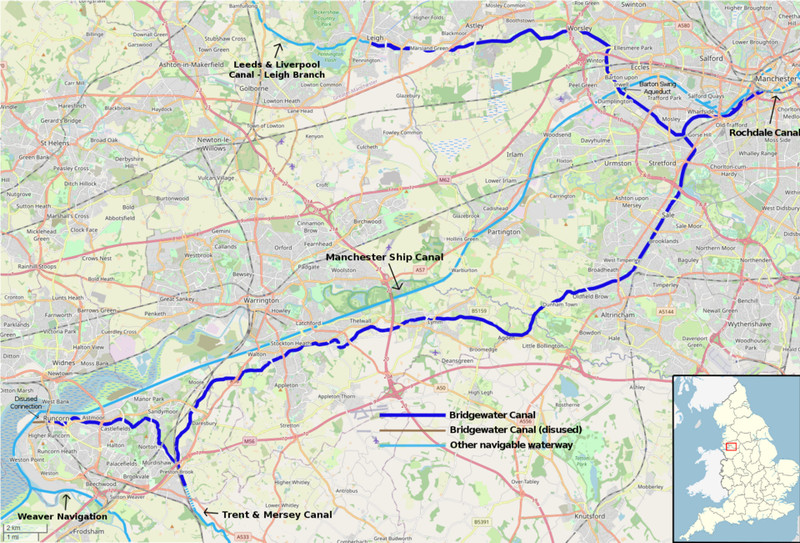
Bridgewater Canal and nearby waterways around Manchester
Natural resources near production centers
Resources mattered because they were close to towns and transport routes.
- Coal supplied concentrated energy.
- Iron supplied material for tools, machines, and equipment.
- Timber still mattered for ships, buildings, mine supports, and fuel.
- Places tied to industrial Britain include Manchester, Birmingham, Leeds, Liverpool, Bristol, London, and South Wales.
The pattern to remember is proximity. Coalfields, iron deposits, towns, and transport routes were near one another.
Agriculture, population, and urbanization
Better farming helped create industrial workers and consumers.
- The British Agricultural Revolution increased food output through crop rotation, selective breeding, systematic cultivation, and enclosure.
- More food supported population growth.
- Farms needed fewer workers, so more people could move into towns and factory work.
- Enclosure also pushed some small farmers off common land, increasing migration to cities.
Urbanization worked both ways. Growing towns helped industrialization by concentrating workers, merchants, consumers, and credit. Then factories made towns grow even faster.
Capital, property, and global connections
Factories cost money. Britain had both wealth and rules that made investment safer.
- Private property and contracts were legally protected.
- Patents helped inventors and investors keep profits.
- Britain had accumulated capital from trade, shipping, banking, plantation economies, and empire.
- Overseas regions supplied raw materials, especially cotton from India, the Caribbean, and especially the slaveholding United States.
- Overseas and colonial markets also bought British manufactured goods.
AP usually wants this nuance: slavery and the Atlantic economy helped fund industrialization, but they were part of the story, not the only cause.
How the Factory System Worked
The factory system meant production in one place with growing division of labor.
In a textile factory, different groups did different repeated jobs:
- prepared fibers
- spun thread
- wove cloth
- inspected and packaged finished goods
Factories were more efficient because owners could supervise workers, use big expensive machines, run many machines from one power source, and train workers in narrow tasks so they became faster. Compared with artisans, workers lost control over their own pace, schedule, and full-product craftsmanship.
How the Causes Fit Together
This is the chain you want in your head:
- Improved agriculture increased food and released labor.
- Population growth and migration built up towns.
- Trade, empire, and banking created capital.
- Property law and contracts encouraged investment.
- Waterways and ports moved coal, cotton, iron, and goods cheaply.
- Nearby coal and iron lowered energy and production costs.
- Imported cotton and overseas markets made textile production profitable.
- Factories and division of labor sustained industrial growth.
Manchester ties it all together. It had urban labor, investors, imported cotton through Liverpool, nearby coal, and the Bridgewater Canal reducing transport costs. Britain industrialized first because these factors reinforced one another.
Key Takeaways
Industrial Revolution
The sustained shift from hand production in households and workshops to mechanized factory production, beginning in Great Britain in the mid-18th century
Domestic System / Cottage System / Putting-Out System
Preindustrial system in which merchants supplied raw materials to dispersed households, collected their finished goods, and sold them
Waterways, Rivers, and Canals
They powered early machinery and lowered the cost of transporting bulky resources and goods among mines, factories, cities, and ports
British Agricultural Revolution
Rising farm productivity from crop rotation, selective breeding, systematic cultivation, and land consolidation that supported population growth, urban labor, and investment
Enclosure
Consolidation of common and small agricultural lands into private commercial farms, increasing productivity while displacing some rural people into wage labor
Urbanization
The growth of cities, which concentrated workers, merchants, consumers, credit, and transportation links and was then accelerated by factory growth
Legal Protection of Private Property
Reliable protection of ownership, contracts, patents, and profits that encouraged investment in mines, canals, machinery, and factories
Accumulation of Capital
The buildup of wealth and credit that could finance factory buildings, machinery, mines, transportation, raw materials, and wages
Factory System
A production system that concentrated workers, machinery, materials, and power in one location and divided production into specialized tasks
Specialization of Labor / Division of Labor
Breaking production into separate repetitive tasks performed by different workers, increasing output and reducing reliance on fully skilled artisans
Coal
An abundant source of concentrated energy whose accessibility near manufacturing regions and transportation routes favored British industrialization
Iron
The material used for tools, machinery, factory equipment, and infrastructure; proximity to coal lowered the cost of processing it
Timber
A resource used for construction, tools, mine supports, ships, and fuel, while pressure on wood supplies made coal more attractive
Access to Foreign Resources
Overseas trade and empire supplied British factories with raw materials, especially cotton
Foreign Markets
Overseas trading networks and colonial markets provided additional buyers for British manufactured goods
Notes
Industrial Revolution
The sustained shift from hand production in households and workshops to mechanized factory production, beginning in Great Britain in the mid-18th century
Domestic System / Cottage System / Putting-Out System
Preindustrial system in which merchants supplied raw materials to dispersed households, collected their finished goods, and sold them
Waterways, Rivers, and Canals
They powered early machinery and lowered the cost of transporting bulky resources and goods among mines, factories, cities, and ports
British Agricultural Revolution
Rising farm productivity from crop rotation, selective breeding, systematic cultivation, and land consolidation that supported population growth, urban labor, and investment
Enclosure
Consolidation of common and small agricultural lands into private commercial farms, increasing productivity while displacing some rural people into wage labor
Urbanization
The growth of cities, which concentrated workers, merchants, consumers, credit, and transportation links and was then accelerated by factory growth
Legal Protection of Private Property
Reliable protection of ownership, contracts, patents, and profits that encouraged investment in mines, canals, machinery, and factories
Accumulation of Capital
The buildup of wealth and credit that could finance factory buildings, machinery, mines, transportation, raw materials, and wages
Factory System
A production system that concentrated workers, machinery, materials, and power in one location and divided production into specialized tasks
Specialization of Labor / Division of Labor
Breaking production into separate repetitive tasks performed by different workers, increasing output and reducing reliance on fully skilled artisans
Coal
An abundant source of concentrated energy whose accessibility near manufacturing regions and transportation routes favored British industrialization
Iron
The material used for tools, machinery, factory equipment, and infrastructure; proximity to coal lowered the cost of processing it
Timber
A resource used for construction, tools, mine supports, ships, and fuel, while pressure on wood supplies made coal more attractive
Access to Foreign Resources
Overseas trade and empire supplied British factories with raw materials, especially cotton
Foreign Markets
Overseas trading networks and colonial markets provided additional buyers for British manufactured goods
