Topic 7.1 Notes – Shifting Power After 1900
How States Shifted Power After 1900
Western industrial powers had the advantage at the start of the 1900s. Industry gave them modern weapons, railroads, steamships, and stronger economies. Imperialism gave them colonies, resources, and influence over world trade. Japan joined this group after the Meiji Restoration and proved it by defeating China and Russia.
The key pattern in this topic is that old land empires did not collapse from one cause. Internal weakness and external pressure kept feeding each other.
- Internal factors
- Ineffective government meant rulers could not respond well to crisis.
- Corruption and weak administration made reform slow and uneven.
- Social and economic inequality pushed anger downward into revolts.
- Peasant and worker hardship made daily life unstable.
- Nationalist and revolutionary movements challenged dynastic rule.
- Legitimacy crises meant people stopped believing the regime deserved to rule.
- External factors
- Military defeat exposed weakness fast.
- Foreign intervention damaged sovereignty.
- Unequal treaties and economic penetration let outsiders control trade and money.
- Territorial loss made governments look incompetent.
- Pressure from industrial rivals raised the stakes.
- Major wars often became the final blow.
What AP World wants from you is the interaction. A defeat abroad could spark revolt at home. Foreign influence increased resentment. Reform mattered, but partial reform often raised expectations without fixing the system. When collapse came, the old imperial regime was replaced by a substantially new political order.
The Three Major Imperial Collapses
Ottoman Empire
The Ottomans had been weakening for a long time because of Balkan nationalism, territorial loss, and European interference. The Tanzimat reforms and the 1876 constitution tried to centralize and modernize the empire, but they did not solve debt, separatism, or outside pressure. Abdülhamid II suspended the constitution and ruled as an autocrat.
The Young Turk Revolution in 1908 restored constitutional rule, and the Committee of Union and Progress became dominant. Still, the Balkan Wars weakened the empire even more. World War I was the decisive external blow. The map below helps you see the long arc from early expansion to the empire’s dramatic contraction by the early 1900s.
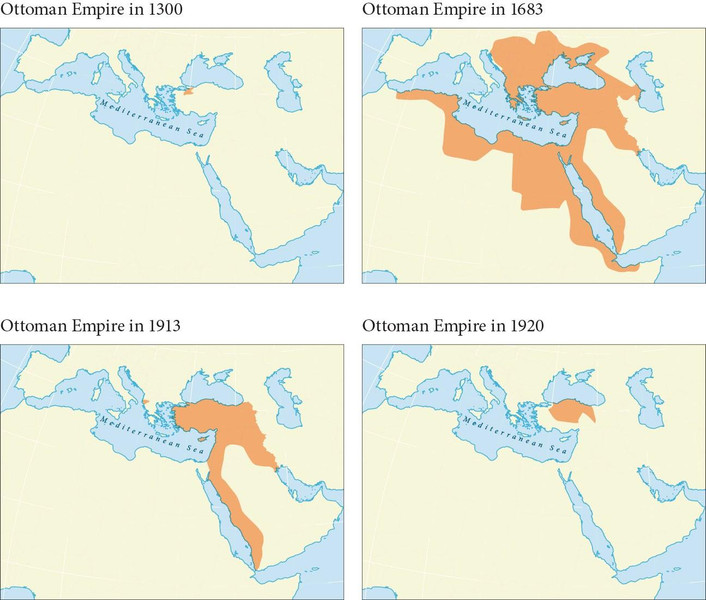
Ottoman territorial change, 1300 to 1920
After defeat, the sultanate was abolished in 1922, and Mustafa Kemal Atatürk founded the Republic of Turkey in 1923.
Qing China
The Qing were hit hard by foreign imperialism. The Opium Wars, unequal treaties, treaty ports, and spheres of influence all weakened sovereignty. Inside China, population pressure, peasant suffering, corruption, and anti-Qing feeling made things worse. The Taiping Rebellion devastated the state.
The Self-Strengthening Movement adopted some Western technology but kept old political structures. That is a classic example of reform being real but incomplete. Defeat in the Sino-Japanese War in 1894 to 1895 badly damaged Qing legitimacy. The Hundred Days’ Reform failed. The Boxer Uprising and Boxer Protocol made foreign control and Qing weakness even clearer.
The Wuchang Uprising started the 1911 Revolution. The last emperor abdicated in 1912. China became the Republic of China under Sun Yat-sen, then Yuan Shikai, but it soon broke into warlordism instead of becoming stable.
Russian Empire
Russia still had a huge empire, but Nicholas II ruled as an autocrat. Industrialization grew, yet peasants still faced land hunger, workers had terrible conditions, and minorities resisted Russification. The Russo-Japanese War exposed state weakness.
In 1905, Bloody Sunday triggered revolution and forced the tsar to allow the Duma through the October Manifesto, but reform stayed limited. World War I created casualties, shortages, inflation, and transport breakdown. That pressure led to the February Revolution in 1917 and the tsar’s abdication.
The provisional government shared power with soviets but stayed in the war, which destroyed its support. In the October Revolution, Lenin and the Bolsheviks took power with “peace, land, bread.” Civil war followed, and the USSR was created in 1922.
What These Collapses Had in Common and How They Were Different
These empires shared a lot:
| Shared pattern | What it looked like |
|---|---|
| Multiethnic dynastic empires | They ruled many peoples with different identities |
| Partial modernization | Reform happened, but political systems stayed too rigid |
| External pressure exposing internal weakness | Defeat made old problems impossible to hide |
| Declining legitimacy | Elites and ordinary people lost faith in the regime |
Their outside pressures were different. The Ottomans faced European intervention and WWI defeat. The Qing faced unequal treaties and spheres of influence. Russia faced defeat by Japan and the disaster of WWI.
Their outcomes also differed:
- Ottoman Empire → Turkish nationalist republic
- Qing Empire → republic, then fragmentation
- Russian Empire → communist state, the USSR
A common AP nuance is that a “new state” did not erase the past. Successor states often kept territory, bureaucracy, and centralized power from the old empire.
The Mexican Revolution
Mexico was not an empire collapse, but it still fits this topic because people challenged the political and social order after 1900.
Under Porfirio Díaz, the Porfiriato brought railroads, mining, and foreign investment. It also meant rigged elections, repression, and concentrated landownership. Peasants and Indigenous communities lost land, so modernization helped elites more than ordinary people.
The immediate crisis came in 1910 when Díaz blocked Francisco Madero in the election. Madero’s Plan of San Luis Potosí called for revolt.
Main leaders mattered because they wanted different things:
- Madero wanted political democracy.
- Emiliano Zapata wanted land reform and issued the Plan of Ayala.
- Pancho Villa led major northern forces.
- Victoriano Huerta overthrew and murdered Madero in 1913.
- Venustiano Carranza and Álvaro Obregón helped defeat Huerta, then revolutionary factions fought each other.
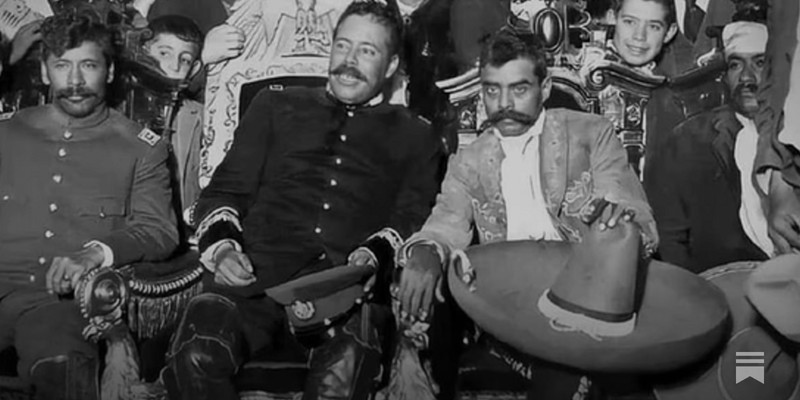
Pancho Villa and Emiliano Zapata during the Mexican Revolution
The Constitution of 1917 showed what the revolution changed:
- Article 27 allowed land redistribution and national control of subsoil resources.
- Article 123 gave labor rights.
- It also limited foreign ownership and church power.
This revolution came mainly from a domestic political crisis, even though foreign investment was part of the background. It pushed Mexico toward nationalism and social reform without becoming communist.
Key Takeaways
Tanzimat Reforms
Ottoman reforms from 1839–1876 that centralized administration, modernized the military, schools, taxes, and laws, and promised greater legal equality
Young Turks
Ottoman reformist officers, intellectuals, and officials who favored constitutional government, centralization, and modernization
Young Turk Revolution
The 1908 movement that forced the Ottoman government to restore the suspended constitution of 1876
Committee of Union and Progress
The most influential Young Turk organization, which dominated Ottoman politics after 1913 and pursued centralization and modernization
Collapse of the Ottoman Empire
Internal political and fiscal weakness, nationalism, territorial losses, and defeat in World War I ended Ottoman rule; Turkey and other states or foreign-controlled territories replaced it
Mustafa Kemal Atatürk
Leader of the Turkish nationalist movement that resisted Allied partition and established the Republic of Turkey after the Ottoman sultanate was abolished
Republic of Turkey
Nationalist republic proclaimed in 1923 after the Ottoman sultanate was abolished, smaller and more explicitly Turkish than the former empire
Opium Wars
Wars of 1839–1842 and 1856–1860 in which Qing defeats produced unequal treaties, treaty ports, indemnities, and reduced Chinese sovereignty
Unequal Treaties
Agreements imposed on Qing China that opened ports, granted foreigners special privileges, required indemnities, and limited Chinese sovereignty
Taiping Rebellion
Massive anti-Qing rebellion from 1850–1864 whose destruction and regional armies weakened Qing central authority
Self-Strengthening Movement
Qing program from the 1860s–1890s that adopted selected Western military and industrial technology while preserving Confucian institutions
Sino-Japanese War
The 1894–1895 war in which modernized Japan defeated Qing China, gained Taiwan, and expanded its influence in Korea
Hundred Days’ Reform
The Qing government’s brief 1898 attempt at rapid institutional modernization, ended by conservative court forces
Empress Dowager Cixi
Powerful Qing court figure associated with the conservative forces that ended the Hundred Days’ Reform
Boxer Uprising
Anti-foreign uprising of 1899–1901 that attacked missionaries and Chinese Christians before an eight-nation force defeated it
Boxer Protocol
Settlement imposed after the Boxer Uprising that required a large indemnity and allowed additional foreign military presence in China
Wuchang Uprising
The October 10, 1911 revolt that began the immediate revolutionary crisis leading Chinese provinces to abandon the Qing
1911 Revolution
Revolution that forced the last Qing emperor to abdicate in 1912 and replaced imperial monarchy with the Republic of China
Sun Yat-sen
Chinese revolutionary nationalist who promoted nationalism, representative government, and popular livelihood and briefly became provisional president
Republic of China
Republic established after the Qing abdication in 1912 that struggled to overcome foreign influence and regional political fragmentation
Yuan Shikai
Military leader who succeeded Sun Yat-sen as president, concentrated power, and left China fragmented after his death in 1916
Chinese Warlords
Regional military leaders who controlled much of China after Yuan Shikai’s death, preventing effective national unification
Tsar Nicholas II
Russia’s last tsar, whose defense of autocracy and failures during war helped discredit the monarchy before his 1917 abdication
Russification
Russian imperial policies promoting Russian language and culture among national and religious minorities, often increasing resentment
Russo-Japanese War
The 1904–1905 war in which Japan defeated Russia, exposing tsarist weakness and contributing to the Revolution of 1905
Bloody Sunday
The January 1905 shooting of peaceful demonstrators in St. Petersburg, which triggered strikes, unrest, and mutinies
Revolution of 1905
Russian uprising of strikes, peasant unrest, mutinies, and nationalist disturbances that forced limited constitutional concessions from Nicholas II.
October Manifesto
Nicholas II’s 1905 concession that permitted the creation of an elected legislative assembly called the Duma
Duma
Russia’s elected legislative assembly created after the Revolution of 1905 but repeatedly restricted or dismissed by the tsar
February Revolution
The 1917 uprising in which strikes, demonstrations, and soldiers’ refusal to repress crowds forced Nicholas II to abdicate
Russian Provisional Government
Temporary government formed after the tsar’s abdication whose decision to continue World War I undermined its support
Soviets
Councils of workers and soldiers that competed with the provisional government for authority during 1917
Dual Power
The unstable sharing of authority in 1917 between the Russian provisional government and workers’ and soldiers’ soviets
Bolsheviks
Revolutionary Marxist party led by Lenin that seized power in October 1917 and established communist rule
Vladimir Lenin
Bolshevik leader who promised peace, land, and bread and led the October 1917 seizure of power
October Revolution
The Bolshevik seizure of power from the provisional government in 1917, led by Lenin
Russian Civil War: Reds vs. Whites
Conflict in which the communist Red Army defeated diverse anti-Bolshevik White forces, securing Bolshevik control
Union of Soviet Socialist Republics (USSR)
Communist federation established by the victorious Bolsheviks in 1922 as the successor to the Russian Empire
Porfirio Díaz
Authoritarian Mexican ruler who promoted modernization and foreign investment while protecting elite power and suppressing political opposition
Porfiriato
The era of Díaz’s rule, marked by economic modernization, foreign investment, unequal landholding, manipulated elections, and coercion
Francisco Madero
Political reformer who challenged Díaz, called for revolt after the blocked 1910 election, and was overthrown and murdered in 1913
Plan of San Luis Potosí
Madero’s call for revolt after Díaz blocked his challenge in the 1910 presidential election
Mexican Revolution
Revolution beginning in 1910 that overthrew Díaz and became a prolonged struggle over democracy, land, labor, and political authority
Emiliano Zapata
Southern Mexican agrarian leader who demanded the restoration and redistribution of village lands under the principle of land and liberty
Plan of Ayala
Zapata’s agrarian program demanding land restoration and redistribution and condemning Madero’s limited reforms
Pancho Villa
Northern Mexican revolutionary leader supported by ranchers, workers, and others opposed to the established order
Victoriano Huerta
Mexican general who overthrew and murdered Madero in 1913, provoking renewed revolutionary opposition
Venustiano Carranza
Constitutionalist leader who opposed Huerta and became a leading figure in the revolutionary government associated with the Constitution of 1917
Mexican Constitution of 1917
Revolutionary constitution authorizing land reform, national resource ownership, labor protections, limits on foreign ownership, and restrictions on the Church
Nation-State
A state claiming to govern a population united by a common national identity within defined borders
World War I
Major external crisis whose military defeats, casualties, shortages, and economic pressures accelerated the collapse of the Ottoman and Russian empires
Spheres of Influence
Areas of China where foreign powers held special economic and political privileges that weakened Qing sovereignty
Article 27
Provision of Mexico’s 1917 constitution authorizing land redistribution and asserting national ownership of subsoil resources
Article 123
Provision of Mexico’s 1917 constitution establishing labor protections, including workers’ rights to organize and strike
Notes
Tanzimat Reforms
Ottoman reforms from 1839–1876 that centralized administration, modernized the military, schools, taxes, and laws, and promised greater legal equality
Young Turks
Ottoman reformist officers, intellectuals, and officials who favored constitutional government, centralization, and modernization
Young Turk Revolution
The 1908 movement that forced the Ottoman government to restore the suspended constitution of 1876
Committee of Union and Progress
The most influential Young Turk organization, which dominated Ottoman politics after 1913 and pursued centralization and modernization
Collapse of the Ottoman Empire
Internal political and fiscal weakness, nationalism, territorial losses, and defeat in World War I ended Ottoman rule; Turkey and other states or foreign-controlled territories replaced it
Mustafa Kemal Atatürk
Leader of the Turkish nationalist movement that resisted Allied partition and established the Republic of Turkey after the Ottoman sultanate was abolished
Republic of Turkey
Nationalist republic proclaimed in 1923 after the Ottoman sultanate was abolished, smaller and more explicitly Turkish than the former empire
Opium Wars
Wars of 1839–1842 and 1856–1860 in which Qing defeats produced unequal treaties, treaty ports, indemnities, and reduced Chinese sovereignty
Unequal Treaties
Agreements imposed on Qing China that opened ports, granted foreigners special privileges, required indemnities, and limited Chinese sovereignty
Taiping Rebellion
Massive anti-Qing rebellion from 1850–1864 whose destruction and regional armies weakened Qing central authority
Self-Strengthening Movement
Qing program from the 1860s–1890s that adopted selected Western military and industrial technology while preserving Confucian institutions
Sino-Japanese War
The 1894–1895 war in which modernized Japan defeated Qing China, gained Taiwan, and expanded its influence in Korea
Hundred Days’ Reform
The Qing government’s brief 1898 attempt at rapid institutional modernization, ended by conservative court forces
Empress Dowager Cixi
Powerful Qing court figure associated with the conservative forces that ended the Hundred Days’ Reform
Boxer Uprising
Anti-foreign uprising of 1899–1901 that attacked missionaries and Chinese Christians before an eight-nation force defeated it
Boxer Protocol
Settlement imposed after the Boxer Uprising that required a large indemnity and allowed additional foreign military presence in China
Wuchang Uprising
The October 10, 1911 revolt that began the immediate revolutionary crisis leading Chinese provinces to abandon the Qing
1911 Revolution
Revolution that forced the last Qing emperor to abdicate in 1912 and replaced imperial monarchy with the Republic of China
Sun Yat-sen
Chinese revolutionary nationalist who promoted nationalism, representative government, and popular livelihood and briefly became provisional president
Republic of China
Republic established after the Qing abdication in 1912 that struggled to overcome foreign influence and regional political fragmentation
Yuan Shikai
Military leader who succeeded Sun Yat-sen as president, concentrated power, and left China fragmented after his death in 1916
Chinese Warlords
Regional military leaders who controlled much of China after Yuan Shikai’s death, preventing effective national unification
Tsar Nicholas II
Russia’s last tsar, whose defense of autocracy and failures during war helped discredit the monarchy before his 1917 abdication
Russification
Russian imperial policies promoting Russian language and culture among national and religious minorities, often increasing resentment
Russo-Japanese War
The 1904–1905 war in which Japan defeated Russia, exposing tsarist weakness and contributing to the Revolution of 1905
Bloody Sunday
The January 1905 shooting of peaceful demonstrators in St. Petersburg, which triggered strikes, unrest, and mutinies
Revolution of 1905
Russian uprising of strikes, peasant unrest, mutinies, and nationalist disturbances that forced limited constitutional concessions from Nicholas II.
October Manifesto
Nicholas II’s 1905 concession that permitted the creation of an elected legislative assembly called the Duma
Duma
Russia’s elected legislative assembly created after the Revolution of 1905 but repeatedly restricted or dismissed by the tsar
February Revolution
The 1917 uprising in which strikes, demonstrations, and soldiers’ refusal to repress crowds forced Nicholas II to abdicate
Russian Provisional Government
Temporary government formed after the tsar’s abdication whose decision to continue World War I undermined its support
Soviets
Councils of workers and soldiers that competed with the provisional government for authority during 1917
Dual Power
The unstable sharing of authority in 1917 between the Russian provisional government and workers’ and soldiers’ soviets
Bolsheviks
Revolutionary Marxist party led by Lenin that seized power in October 1917 and established communist rule
Vladimir Lenin
Bolshevik leader who promised peace, land, and bread and led the October 1917 seizure of power
October Revolution
The Bolshevik seizure of power from the provisional government in 1917, led by Lenin
Russian Civil War: Reds vs. Whites
Conflict in which the communist Red Army defeated diverse anti-Bolshevik White forces, securing Bolshevik control
Union of Soviet Socialist Republics (USSR)
Communist federation established by the victorious Bolsheviks in 1922 as the successor to the Russian Empire
Porfirio Díaz
Authoritarian Mexican ruler who promoted modernization and foreign investment while protecting elite power and suppressing political opposition
Porfiriato
The era of Díaz’s rule, marked by economic modernization, foreign investment, unequal landholding, manipulated elections, and coercion
Francisco Madero
Political reformer who challenged Díaz, called for revolt after the blocked 1910 election, and was overthrown and murdered in 1913
Plan of San Luis Potosí
Madero’s call for revolt after Díaz blocked his challenge in the 1910 presidential election
Mexican Revolution
Revolution beginning in 1910 that overthrew Díaz and became a prolonged struggle over democracy, land, labor, and political authority
Emiliano Zapata
Southern Mexican agrarian leader who demanded the restoration and redistribution of village lands under the principle of land and liberty
Plan of Ayala
Zapata’s agrarian program demanding land restoration and redistribution and condemning Madero’s limited reforms
Pancho Villa
Northern Mexican revolutionary leader supported by ranchers, workers, and others opposed to the established order
Victoriano Huerta
Mexican general who overthrew and murdered Madero in 1913, provoking renewed revolutionary opposition
Venustiano Carranza
Constitutionalist leader who opposed Huerta and became a leading figure in the revolutionary government associated with the Constitution of 1917
Mexican Constitution of 1917
Revolutionary constitution authorizing land reform, national resource ownership, labor protections, limits on foreign ownership, and restrictions on the Church
Nation-State
A state claiming to govern a population united by a common national identity within defined borders
World War I
Major external crisis whose military defeats, casualties, shortages, and economic pressures accelerated the collapse of the Ottoman and Russian empires
Spheres of Influence
Areas of China where foreign powers held special economic and political privileges that weakened Qing sovereignty
Article 27
Provision of Mexico’s 1917 constitution authorizing land redistribution and asserting national ownership of subsoil resources
Article 123
Provision of Mexico’s 1917 constitution establishing labor protections, including workers’ rights to organize and strike
