Topic 2.5 Notes – Cultural Consequences of Connectivity
How Connectivity Spread Culture Across Afro-Eurasia
The Silk Roads, Indian Ocean, and trans-Saharan routes already moved goods. In this topic, what matters is that the same routes also moved people, and people carry culture.
- Cultural diffusion means religions, ideas, art, literature, and technology spread from one society to another through trade and travel.
- Syncretism means incoming beliefs mix with local traditions instead of wiping them out.
- The exam loves this distinction. Most questions want diffusion + adaptation, not “one culture replaced another.”
This trade-route map is a good reminder that Afro-Eurasia was connected by both land and sea, so cultural exchange did not happen in just one region or through just one network.
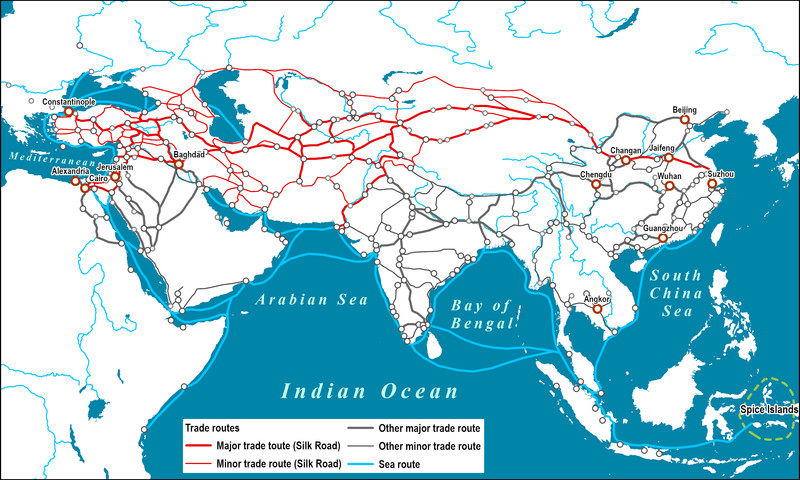
Afro-Eurasian trade routes, c. 1200-1450
Different groups spread culture in different ways:
- Merchants and diasporic communities built long-term contact.
- A diaspora is a community living outside its homeland while keeping ties to it.
- Arab and Persian merchants in East Africa and Chinese merchants in Southeast Asia carried language, religion, and customs with them.
- Missionaries, scholars, and pilgrims spread beliefs, books, and learning.
- Conquering states and officials moved ideas across large empires.
- The Mongol Empire mattered here because it made travel and exchange across Eurasia faster, even though conquest could also destroy cities.
- Artisans and technical specialists spread production methods and designs.
- Travelers recorded what they saw and helped ideas travel home too.
Religions and Cultural Traditions on the Move
Religion is the clearest place to see diffusion and adaptation happening at the same time.
Buddhism in East Asia
Buddhism had arrived earlier, but from 1200 to 1450 it kept spreading through monasteries, texts, art, and new schools.
- Chan Buddhism developed in China and influenced Seon in Korea and Zen in Japan.
- Buddhism adapted to Confucian ethics, Daoist ideas, and ancestor veneration.
- That’s the pattern to remember. Buddhism stayed Buddhist, but it changed shape in East Asia.
Hinduism and Buddhism in Southeast Asia
Trade across the Bay of Bengal carried Indian influence into Southeast Asia.
- Indian influence included Sanskrit, the Ramayana, temple architecture, and divine kingship.
- Angkor Wat shows adaptation perfectly. It was first Hindu and dedicated to Vishnu, then later became Buddhist.
- The Majapahit Empire drew on both Hindu and Buddhist traditions.
Islam in Africa and Asia
Islam spread through merchants, scholars, and states, but it did not spread the same way everywhere.
- West Africa
- Islam moved mainly through trans-Saharan trade.
- Rulers and merchants often converted before rural populations.
- In Mali, Mansa Musa’s hajj in 1324-1325 showed Mali’s place in the Islamic world.
- Timbuktu became a center of trade, mosques, and scholarship.
- Indigenous beliefs persisted, so Islamization was gradual.
- East Africa
- Islam spread through Indian Ocean trade.
- The Swahili coast developed a syncretic culture.
- Swahili had a Bantu base with strong Arabic influence.
- South and Southeast Asia
- Islam spread through merchants, scholars, and Muslim states.
- Samudra-Pasai and Malacca became major Muslim port states.
- Conversion often brought commercial advantages and stronger trade links.
Literature, Art, and Technology That Spread Through the Networks
As religions moved, so did stories, styles, and practical knowledge.
- The Ramayana was adapted into Southeast Asian literature, dance, and theater.
- Buddhist artistic styles spread across China, Korea, and Japan.
- Arabic spread as a language of religion and scholarship.
- Persian spread as a language of court culture in parts of Central and South Asia.
- Islamic architecture used calligraphy and geometric ornament, but local builders used local materials and styles.
- Chinese ceramics influenced other regions and were also made for foreign markets.
Two technologies show this process clearly:
| Technology | Origin | Spread | Why it mattered |
|---|---|---|---|
| Paper | China | Through Central Asia and the Islamic world to Europe | Helped administration, contracts, scholarship, libraries, and preserving texts |
| Gunpowder | China | Westward by the 1200s and 1300s | Early use in cannons and firearms; shows Chinese technology spreading across Afro-Eurasia |
Cities and Travelers in a Connected World
Trade networks changed cities because commerce and agricultural surplus supported urban life.
- Growing cities included Hangzhou, Cairo, Timbuktu, and Malacca.
- These cities became hubs for merchants, scholars, artisans, and religious institutions.
- Some cities declined.
- Baghdad was devastated by the Mongols in 1258.
- Samarkand was damaged, then revived under Timur after 1370.
- The Black Death later caused urban contraction through trade networks.
Travel writing gives you direct evidence of connectivity, but every account has a point of view.
- Marco Polo was a Venetian merchant who described Yuan China and Asian wealth for European readers. His account was shaped by Rustichello of Pisa and by what his audience wanted to hear.
- Ibn Battuta was a Moroccan Muslim jurist who traveled across dar al-Islam, India, Southeast Asia, China, and Mali. He shows both Islamic unity and regional diversity. His criticism of women’s dress in Mali reveals his values, not just Mali’s customs.
- Margery Kempe was an English Christian pilgrim whose travels to Jerusalem, Rome, and Santiago show Christian pilgrimage networks and women’s religious experience.
When you use these sources, think point of view, purpose, audience, and historical situation. Travel accounts tell you about the places visited, and they also tell you what the writer cared about.
Key Takeaways
Cultural Diffusion
Spread of beliefs, practices, knowledge, art, and technologies between societies through expanding networks of exchange
Syncretism
Blending elements from different cultural traditions into a new or locally distinctive form
Diaspora
A community living outside its ancestral homeland while retaining connections to its place of origin
Buddhism in East Asia
Connections continued spreading Buddhist texts, monasteries, art, and schools that adapted to Confucian, Daoist, and local traditions
Chan Buddhism (Seon and Zen)
Meditation-centered Buddhism developed in China as Chan and influenced Korean Seon and Japanese Zen
Hinduism and Buddhism in Southeast Asia
Indian Ocean exchange spread Indian religious ideas, Sanskrit, rulership traditions, and temple forms that Southeast Asians blended with local beliefs
Angkor Wat
Khmer temple originally dedicated to Vishnu that later became Buddhist, illustrating Southeast Asian adaptation of Indian religions
Ramayana in Southeast Asia
Indian Sanskrit epic adapted into distinctively local Southeast Asian literature, theater, dance, and art
Islam in Sub-Saharan Africa
Trans-Saharan merchants and scholars spread Islam, Arabic literacy, and Islamic learning, while indigenous beliefs and languages persisted
Mansa Musa
Mali ruler whose 1324–1325 pilgrimage and support for mosques and scholarship strengthened Mali’s connections to the Islamic world
Swahili Culture
East African coastal culture blending Bantu foundations with Islamic, Arab, Persian, and broader Indian Ocean influences
Swahili Language
Fundamentally Bantu language containing many Arabic-derived words from centuries of commercial and religious interaction
Islam in South Asia
Muslim states, merchants, and religious figures carried Islam through northern India and coastal trading communities among non-Muslim majorities
Islam in Southeast Asia
Muslim merchants and scholars spread Islam through commercial ports, where rulers adopted it while accommodating existing customs
Paper
Chinese papermaking technology diffused westward, lowering the cost of written records and supporting administration, commerce, education, and manuscripts
Gunpowder
Chinese explosive technology spread west through Eurasian networks and contributed to the growing use of artillery and firearms
Urbanization
Growth of cities and the urban population; trade and productivity supported it, while conquest, disease, instability, and shifting routes could reverse it
Hangzhou
Southern Song capital until the Mongol conquest of 1276 and a major commercial center connected to internal waterways and maritime trade
Cairo
Commercial city that prospered from its strategic position linking Mediterranean, Red Sea, and overland trade routes
Timbuktu
West African city that grew into a center of trans-Saharan commerce, Islamic scholarship, and manuscript culture
Malacca
Port founded around 1400 that grew near the Strait of Malacca into a major commercial center and center of Islamic influence
Baghdad
Leading Islamic city devastated by Hülegü’s Mongol army in 1258, after which its political and intellectual importance declined
Hülegü
Mongol commander whose army captured and devastated Baghdad in 1258
Samarkand
City damaged by Mongol conquest in 1220 but revived after Timur made it his imperial capital in 1370
Timur
Conqueror who made Samarkand his capital and used wealth and relocated skilled workers to rebuild it as an imperial center
Travel Writing
Accounts of long-distance journeys that reveal expanding connectivity but reflect each traveler’s viewpoint, purpose, audience, and circumstances
Marco Polo
Venetian merchant whose dictated account of late-thirteenth-century Asia described its cities, courts, goods, and technologies for European readers
Ibn Battuta and the Rihla
Moroccan Muslim jurist whose dictated travel narrative described journeys across Africa and Asia through the perspective of Islamic law
Margery Kempe and The Book of Margery Kempe
English Christian mystic whose dictated pilgrimage account combined spiritual autobiography with travel to Jerusalem, Rome, and Santiago
Mongol Empire
Empire whose integration of much of Eurasia eased Silk Roads travel and accelerated cultural and technological transfer, even as its conquests damaged cities
Mali Empire
West African empire whose trans-Saharan trade connections encouraged elite conversion to Islam while indigenous practices persisted
Arabic Language
Language of religion, scholarship, diplomacy, and record keeping that spread through Islamic networks while local languages persisted
Persian Language
Influential language of courtly culture and literature across much of the Islamic world, especially Central and South Asia
Notes
Cultural Diffusion
Spread of beliefs, practices, knowledge, art, and technologies between societies through expanding networks of exchange
Syncretism
Blending elements from different cultural traditions into a new or locally distinctive form
Diaspora
A community living outside its ancestral homeland while retaining connections to its place of origin
Buddhism in East Asia
Connections continued spreading Buddhist texts, monasteries, art, and schools that adapted to Confucian, Daoist, and local traditions
Chan Buddhism (Seon and Zen)
Meditation-centered Buddhism developed in China as Chan and influenced Korean Seon and Japanese Zen
Hinduism and Buddhism in Southeast Asia
Indian Ocean exchange spread Indian religious ideas, Sanskrit, rulership traditions, and temple forms that Southeast Asians blended with local beliefs
Angkor Wat
Khmer temple originally dedicated to Vishnu that later became Buddhist, illustrating Southeast Asian adaptation of Indian religions
Ramayana in Southeast Asia
Indian Sanskrit epic adapted into distinctively local Southeast Asian literature, theater, dance, and art
Islam in Sub-Saharan Africa
Trans-Saharan merchants and scholars spread Islam, Arabic literacy, and Islamic learning, while indigenous beliefs and languages persisted
Mansa Musa
Mali ruler whose 1324–1325 pilgrimage and support for mosques and scholarship strengthened Mali’s connections to the Islamic world
Swahili Culture
East African coastal culture blending Bantu foundations with Islamic, Arab, Persian, and broader Indian Ocean influences
Swahili Language
Fundamentally Bantu language containing many Arabic-derived words from centuries of commercial and religious interaction
Islam in South Asia
Muslim states, merchants, and religious figures carried Islam through northern India and coastal trading communities among non-Muslim majorities
Islam in Southeast Asia
Muslim merchants and scholars spread Islam through commercial ports, where rulers adopted it while accommodating existing customs
Paper
Chinese papermaking technology diffused westward, lowering the cost of written records and supporting administration, commerce, education, and manuscripts
Gunpowder
Chinese explosive technology spread west through Eurasian networks and contributed to the growing use of artillery and firearms
Urbanization
Growth of cities and the urban population; trade and productivity supported it, while conquest, disease, instability, and shifting routes could reverse it
Hangzhou
Southern Song capital until the Mongol conquest of 1276 and a major commercial center connected to internal waterways and maritime trade
Cairo
Commercial city that prospered from its strategic position linking Mediterranean, Red Sea, and overland trade routes
Timbuktu
West African city that grew into a center of trans-Saharan commerce, Islamic scholarship, and manuscript culture
Malacca
Port founded around 1400 that grew near the Strait of Malacca into a major commercial center and center of Islamic influence
Baghdad
Leading Islamic city devastated by Hülegü’s Mongol army in 1258, after which its political and intellectual importance declined
Hülegü
Mongol commander whose army captured and devastated Baghdad in 1258
Samarkand
City damaged by Mongol conquest in 1220 but revived after Timur made it his imperial capital in 1370
Timur
Conqueror who made Samarkand his capital and used wealth and relocated skilled workers to rebuild it as an imperial center
Travel Writing
Accounts of long-distance journeys that reveal expanding connectivity but reflect each traveler’s viewpoint, purpose, audience, and circumstances
Marco Polo
Venetian merchant whose dictated account of late-thirteenth-century Asia described its cities, courts, goods, and technologies for European readers
Ibn Battuta and the Rihla
Moroccan Muslim jurist whose dictated travel narrative described journeys across Africa and Asia through the perspective of Islamic law
Margery Kempe and The Book of Margery Kempe
English Christian mystic whose dictated pilgrimage account combined spiritual autobiography with travel to Jerusalem, Rome, and Santiago
Mongol Empire
Empire whose integration of much of Eurasia eased Silk Roads travel and accelerated cultural and technological transfer, even as its conquests damaged cities
Mali Empire
West African empire whose trans-Saharan trade connections encouraged elite conversion to Islam while indigenous practices persisted
Arabic Language
Language of religion, scholarship, diplomacy, and record keeping that spread through Islamic networks while local languages persisted
Persian Language
Influential language of courtly culture and literature across much of the Islamic world, especially Central and South Asia
