Topic 7.3 Notes – Conducting World War I
What Total War Meant in World War I
World War I was the first total war. That means the war effort included everything a state could use: soldiers, workers, factories, food, money, newspapers, schools, and colonial empires. The home front and battlefront were tied together, because armies could not keep fighting unless civilians kept producing and obeying.
The two sides you need together are:
| Allies | Central Powers |
|---|---|
| Britain, France, Russia, later Italy, Japan, U.S. | Germany, Austria-Hungary, Ottoman Empire, Bulgaria |
Global geography mattered because imperial powers used colonies as part of the war machine. Colonies supplied soldiers, laborers, food, and raw materials, so this was never just a European war.
How Governments Mobilized Society for War
Conscription and manpower
Mass armies needed constant replacement, so governments expanded conscription, or compulsory military service. Britain began with volunteers but switched to conscription in 1916 when enlistment fell short. The U.S. used the Selective Service Act in 1917.
Governments also decided where civilians would work. Men were sent to the front, and other workers were directed into farms, mines, railroads, and weapons factories.
Economic control and the home front
To keep the war going, states intervened in the economy far more than before.
- Factories switched from civilian goods to munitions, uniforms, weapons, and vehicles.
- Britain created the Ministry of Munitions to coordinate production.
- Germany tightly managed scarce raw materials, especially because the British blockade caused shortages.
- Wars were financed through taxes, borrowing, and war bonds.
- Rationing and price controls tried to stretch limited food and fuel.
Labor and women
The war pulled women into jobs in munitions, transport, agriculture, offices, and nursing. Their public role expanded, but equality did not suddenly appear. Women were often paid less and pushed back out after the war.
Governments also managed labor more directly. They bargained with unions, limited strikes, and imposed work discipline because factories were now part of the war effort.
Imperial and colonial mobilization
European empires made the war global in practice, not just in theory.
- Indian troops fought for Britain on the Western Front, at Gallipoli, in East Africa, and in the Middle East.
- France recruited from North and West Africa, including tirailleurs sénégalais.
- The Chinese Labour Corps supported Allied operations behind the lines.
Colonial service mixed patriotism with coercion. Many recruits faced unequal pay, racism, and pressure to serve.
How Propaganda and Nationalism Kept the War Going
A long war needed belief as much as bullets. Governments used propaganda through posters, newspapers, speeches, songs, films, photographs, and cartoons.
Recruitment posters made that message personal by addressing the viewer directly.
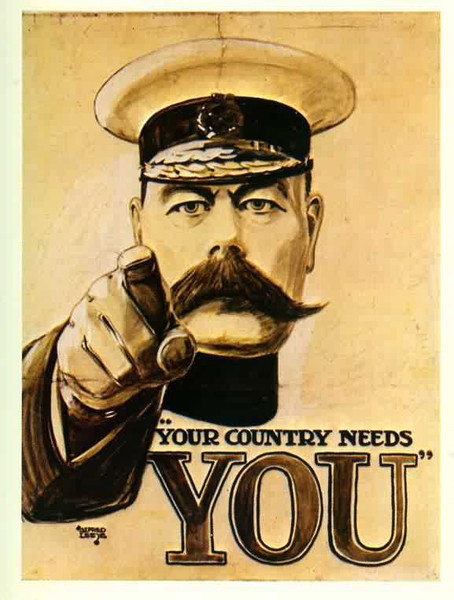
British World War I recruiting poster
Propaganda helped governments:
- recruit soldiers and laborers
- sell war bonds
- encourage rationing and sacrifice
- maintain morale despite huge losses
- paint the enemy as savage or barbaric
- shame dissenters as unpatriotic
This worked with nationalism. Governments told people that sacrifice was a duty to the nation, so dying, working, or going without food became framed as honorable.
Censorship reinforced propaganda. Britain’s Defence of the Realm Act let the government control information. Newspapers, soldiers’ letters, and reports of defeat or unrest could be suppressed. On the exam, remember this point: propaganda shows what governments wanted people to believe, not the full reality.
How New Technology Made the War So Deadly
The deadliness came from several technologies working together: machine guns, heavy artillery, barbed wire, poison gas, tanks, aircraft, submarines, railroads, telegraph, and telephone.
Trench warfare on the Western Front
Defensive technology was stronger than offensive tactics, so armies dug in. Soldiers crossing no man’s land were cut down by machine guns and artillery. This trench diagram gives you the basic layout behind that stalemate.
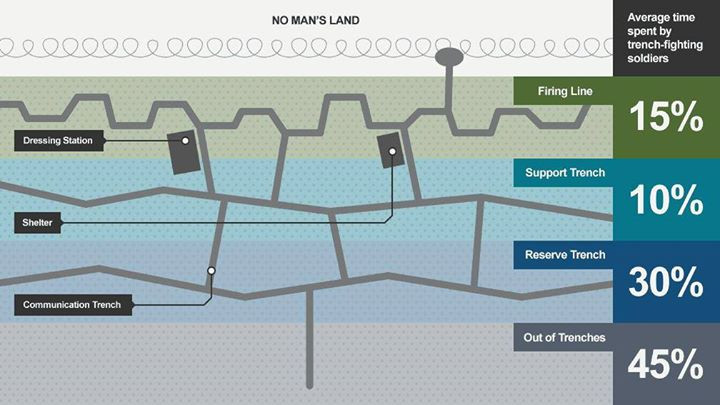
World War I trench system
Life in trenches meant mud, rats, lice, disease, shell shock, and constant bombardment.
Major weapons and their effects
- Machine guns and barbed wire made infantry charges disastrous.
- Artillery caused most battlefield deaths.
- Poison gas was first used on a large scale at the Second Battle of Ypres in 1915.
- Tanks first appeared at the Somme in 1916, but early tanks broke down often.
- Aircraft first helped with reconnaissance, then later as fighters and bombers.
At Verdun and the Somme in 1916, armies suffered enormous casualties for tiny territorial gains. That is attrition in action.
Naval warfare
Britain’s blockade cut Germany off from food and raw materials. Germany answered with U-boats and unrestricted submarine warfare. The Allied convoy system reduced shipping losses, but German submarine attacks helped bring the U.S. into the war.
Why the War Ended as a Test of Total Mobilization
Germany’s Schlieffen Plan failed after the First Battle of the Marne, so Germany got stuck in a two-front war. From there, victory depended on which side could last longer in soldiers, supplies, money, and morale.
Russia collapsed under military losses and home-front crisis, then left in the Treaty of Brest-Litovsk in 1918. Germany tried one last major push in the spring offensive of 1918, but it failed. U.S. troops, industry, and loans strengthened the Allies. The Hundred Days Offensive and deep shortages inside the Central Powers broke resistance, leading to the armistice on November 11, 1918.
World War I proved that modern war depended on technology plus state control over whole societies and empires.
Key Takeaways
Total War
War in which governments mobilize armed forces, civilians, economies, information, culture, and imperial resources for the war effort
Allied Powers vs. Central Powers
Allies: France, Britain and its empire, Russia, Serbia, later Japan, Italy, and the United States; Central Powers: Germany, Austria-Hungary, the Ottoman Empire, and Bulgaria
Industrialized Warfare
Mass warfare sustained by factories, conscript armies, railroads, communications, and large-scale production of weapons and ammunition
Schlieffen Plan
Germany’s plan to defeat France quickly through neutral Belgium before turning against slower-mobilizing Russia
First Battle of the Marne
September 1914 battle in which French and British forces halted Germany outside Paris, ending hopes for a quick German victory and helping produce stalemate on the Western Front
Western Front vs. Eastern Front
The Western Front became a dense, trench-bound stalemate, while the larger and less concentrated Eastern Front remained more mobile
War of Attrition
A strategy of defeating an enemy by exhausting its soldiers, supplies, economy, and willingness to continue rather than winning one quick breakthrough
Trench Warfare
Defensive warfare using interconnected front-line, support, reserve, and communication trenches, especially on the Western Front
No Man’s Land
The exposed ground between opposing front-line trenches, covered by barbed wire, shell craters, artillery, and machine-gun fire
Shell Shock
World War I term for psychological trauma caused by combat and prolonged shelling, now associated with post-traumatic stress disorder
Machine Guns
Rapid-fire defensive weapons that made mass infantry attacks across exposed ground extremely costly
Heavy Artillery
Large guns used for prolonged bombardment; they caused many casualties but often failed to destroy deep defenses and instead churned terrain into mud and craters
Barbed Wire
Defensive wire that slowed and trapped attackers in areas covered by machine-gun and artillery fire
Battle of Verdun
A 1916 German attempt to bleed France through attrition at a position the French defended as a national symbol
Battle of the Somme
A 1916 British and French offensive intended partly to relieve Verdun; it produced over one million combined casualties without a decisive breakthrough
Chemical Weapons (Poison Gas)
Chlorine, phosgene, and mustard gas used to blind, burn, suffocate, or disable soldiers; masks limited their strategic effectiveness
Tanks
Armored vehicles first used by Britain at the Somme to cross trenches and wire; early models were slow and unreliable but later showed greater potential
Military Aircraft
Airplanes first used for reconnaissance and artillery spotting, then developed into fighters and limited bombers
British Naval Blockade
Britain’s effort to cut the Central Powers off from overseas food, fuel, fertilizer, and industrial materials, causing shortages and malnutrition
U-Boats
German submarines used to attack Allied and neutral shipping and threaten Britain’s overseas supply lines
Unrestricted Submarine Warfare
German policy of sinking ships in designated waters without warning, damaging Allied shipping but helping bring the United States into the war
Convoy System
Method of reducing U-boat losses by having merchant ships travel together under naval escort
Gallipoli Campaign
Failed 1915 Allied campaign to seize the Dardanelles, open a supply route to Russia, and possibly force the Ottoman Empire out of the war
ANZAC
Australian and New Zealand Army Corps, whose troops became especially associated with the Gallipoli campaign
Conscription
Compulsory military service imposed by a government to provide the large numbers of soldiers required for total war
Wartime Economic Mobilization
Government direction of factories, raw materials, transportation, labor, agriculture, and finance to sustain military production
War Bonds
Loans purchased by civilians from the government to finance the war, promoted as a form of patriotic service
Rationing
Government limits on civilian purchases of scarce goods to reserve supplies for the military, distribute shortages, and reduce hoarding
Women’s Wartime Labor
Women expanded into munitions, transportation, agriculture, offices, nursing, and public services, increasing their economic roles despite unequal pay and postwar displacement
Imperial and Colonial Mobilization
Empires recruited or coerced colonial soldiers and laborers and drew food, money, and raw materials from their colonies
Propaganda
Selective and emotional information used to recruit, sell bonds, promote conservation and production, sustain morale, and demonize the enemy
Intensified Nationalism
Wartime appeals portraying sacrifice as a patriotic duty necessary to defend the nation’s survival, honor, and civilization
Censorship
Government restriction of reports, letters, publications, and speech about troop movements, casualties, defeats, shortages, and opposition
Home Front
Civilian society organized to support military operations through production, agriculture, transportation, finance, rationing, and morale
Armistice of November 11, 1918
Agreement that ended fighting on the Western Front after military losses, blockade, shortages, unrest, and Allied pressure exhausted Germany
Treaty of Brest-Litovsk
March 1918 treaty that withdrew Bolshevik Russia from the war, allowing Germany to transfer troops from the Eastern Front to the west
Notes
Total War
War in which governments mobilize armed forces, civilians, economies, information, culture, and imperial resources for the war effort
Allied Powers vs. Central Powers
Allies: France, Britain and its empire, Russia, Serbia, later Japan, Italy, and the United States; Central Powers: Germany, Austria-Hungary, the Ottoman Empire, and Bulgaria
Industrialized Warfare
Mass warfare sustained by factories, conscript armies, railroads, communications, and large-scale production of weapons and ammunition
Schlieffen Plan
Germany’s plan to defeat France quickly through neutral Belgium before turning against slower-mobilizing Russia
First Battle of the Marne
September 1914 battle in which French and British forces halted Germany outside Paris, ending hopes for a quick German victory and helping produce stalemate on the Western Front
Western Front vs. Eastern Front
The Western Front became a dense, trench-bound stalemate, while the larger and less concentrated Eastern Front remained more mobile
War of Attrition
A strategy of defeating an enemy by exhausting its soldiers, supplies, economy, and willingness to continue rather than winning one quick breakthrough
Trench Warfare
Defensive warfare using interconnected front-line, support, reserve, and communication trenches, especially on the Western Front
No Man’s Land
The exposed ground between opposing front-line trenches, covered by barbed wire, shell craters, artillery, and machine-gun fire
Shell Shock
World War I term for psychological trauma caused by combat and prolonged shelling, now associated with post-traumatic stress disorder
Machine Guns
Rapid-fire defensive weapons that made mass infantry attacks across exposed ground extremely costly
Heavy Artillery
Large guns used for prolonged bombardment; they caused many casualties but often failed to destroy deep defenses and instead churned terrain into mud and craters
Barbed Wire
Defensive wire that slowed and trapped attackers in areas covered by machine-gun and artillery fire
Battle of Verdun
A 1916 German attempt to bleed France through attrition at a position the French defended as a national symbol
Battle of the Somme
A 1916 British and French offensive intended partly to relieve Verdun; it produced over one million combined casualties without a decisive breakthrough
Chemical Weapons (Poison Gas)
Chlorine, phosgene, and mustard gas used to blind, burn, suffocate, or disable soldiers; masks limited their strategic effectiveness
Tanks
Armored vehicles first used by Britain at the Somme to cross trenches and wire; early models were slow and unreliable but later showed greater potential
Military Aircraft
Airplanes first used for reconnaissance and artillery spotting, then developed into fighters and limited bombers
British Naval Blockade
Britain’s effort to cut the Central Powers off from overseas food, fuel, fertilizer, and industrial materials, causing shortages and malnutrition
U-Boats
German submarines used to attack Allied and neutral shipping and threaten Britain’s overseas supply lines
Unrestricted Submarine Warfare
German policy of sinking ships in designated waters without warning, damaging Allied shipping but helping bring the United States into the war
Convoy System
Method of reducing U-boat losses by having merchant ships travel together under naval escort
Gallipoli Campaign
Failed 1915 Allied campaign to seize the Dardanelles, open a supply route to Russia, and possibly force the Ottoman Empire out of the war
ANZAC
Australian and New Zealand Army Corps, whose troops became especially associated with the Gallipoli campaign
Conscription
Compulsory military service imposed by a government to provide the large numbers of soldiers required for total war
Wartime Economic Mobilization
Government direction of factories, raw materials, transportation, labor, agriculture, and finance to sustain military production
War Bonds
Loans purchased by civilians from the government to finance the war, promoted as a form of patriotic service
Rationing
Government limits on civilian purchases of scarce goods to reserve supplies for the military, distribute shortages, and reduce hoarding
Women’s Wartime Labor
Women expanded into munitions, transportation, agriculture, offices, nursing, and public services, increasing their economic roles despite unequal pay and postwar displacement
Imperial and Colonial Mobilization
Empires recruited or coerced colonial soldiers and laborers and drew food, money, and raw materials from their colonies
Propaganda
Selective and emotional information used to recruit, sell bonds, promote conservation and production, sustain morale, and demonize the enemy
Intensified Nationalism
Wartime appeals portraying sacrifice as a patriotic duty necessary to defend the nation’s survival, honor, and civilization
Censorship
Government restriction of reports, letters, publications, and speech about troop movements, casualties, defeats, shortages, and opposition
Home Front
Civilian society organized to support military operations through production, agriculture, transportation, finance, rationing, and morale
Armistice of November 11, 1918
Agreement that ended fighting on the Western Front after military losses, blockade, shortages, unrest, and Allied pressure exhausted Germany
Treaty of Brest-Litovsk
March 1918 treaty that withdrew Bolshevik Russia from the war, allowing Germany to transfer troops from the Eastern Front to the west
