Topic 6.5 Notes – Economic Imperialism from 1750 to 1900
What Economic Imperialism Was
Economic imperialism meant using economic power to control or heavily influence another society for your own benefit. The key idea is unequal trade. This was more than countries exchanging goods. Stronger states and foreign businesses shaped the rules.
- Informal empire meant a country stayed politically independent, but foreigners dominated trade, banking, ports, railroads, loans, or resources.
- Formal empire meant direct political rule too, often to reach the same economic goals.
Industrialization helps explain why this grew so fast. Factories needed raw materials, new markets to sell goods, and places to invest capital.
The basic pattern looked like this:
- Industrial powers imported foodstuffs and raw materials.
- Factories turned them into manufactured goods.
- Those goods were sold back into overseas markets.
- Banks and investors financed mines, plantations, ports, railroads, and loans abroad.
That does not mean every export economy was imperialistic. It becomes economic imperialism when outsiders control the richest parts or impose unequal terms.
| Example | Type | Why it fits |
|---|---|---|
| British India | Formal empire | Britain ruled directly and shaped production and trade |
| Qing China | Semicolonial / informal | Foreign powers forced treaty ports and special rights |
| Argentina | Informal | Independent government, but British trade and capital had huge influence |
How Economic Imperialism Worked
These methods usually worked together.
- Unequal treaties lowered tariffs, opened ports, and gave legal privileges to foreigners, usually after military pressure.
- Concessions gave outsiders rights to build railroads, run mines, use land, or control major projects.
- Loans and foreign investment gave banks leverage. If a government owed money, creditors could pressure policy and customs revenue.
- Infrastructure for export linked mines, plantations, and farm zones to ports. It often helped foreign trade more than local development.
- Military backing protected merchants and companies when access or profits were threatened.
China shows this especially clearly through spheres of influence. Foreign powers claimed special commercial rights in certain regions without fully taking over the country, as the map shows through its color-coded regions and treaty ports.
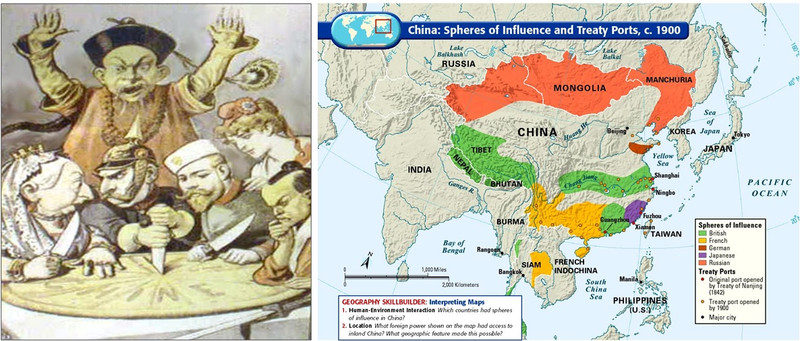
China: spheres of influence and treaty ports, c. 1900
The U.S. responded with the Open Door notes in 1899. They called for equal access for all foreign powers while keeping China formally intact. This protected American trade access. It did not end foreign pressure on China.
China and the Opium Wars
China is the clearest case of economic imperialism backed by military force.
Background
- Britain wanted Chinese tea, silk, and porcelain.
- China wanted little British manufactured goods.
- Britain lost silver in this trade.
- British merchants sold opium from India into China to reverse the silver flow.
Qing response and war
In 1839, Lin Zexu cracked down at Guangzhou and destroyed over 20,000 chests of opium. Britain answered with war.
- First Opium War (1839-1842)
Britain’s steam-powered navy defeated Qing forces.- Treaty of Nanjing (1842) gave Britain an indemnity, Hong Kong, five treaty ports including Shanghai and Guangzhou, and ended the Cohong system.
- Treaty of the Bogue (1843) added extraterritoriality and most-favored-nation status.
- Second Opium War (1856-1860)
Britain and France forced more concessions through the Treaties of Tianjin and Convention of Beijing. More ports opened, diplomats entered Beijing, missionary activity expanded, and opium was effectively legalized.
China stayed independent, but it lost major economic and legal sovereignty.
Commodity Trades and Investment That Favored Foreign Powers
- Opium produced in South Asia and the Middle East was exported to China through British trade networks, reversing silver outflows and helping trigger the Opium Wars. It shows colonial production, private trade, and military protection working together.
- Cotton grown in South Asia and Egypt was exported to Great Britain and other European countries to feed industrial mills. The high profits came from manufacturing cloth, not growing cotton. Egypt’s boom during the American Civil War shows dependence on outside demand.
- Palm oil from West Africa went to Europe for soap, candles, and lubricants. African producers worked in the trade, but Europeans increasingly controlled shipping and markets.
- Copper from Chile went to Europe and the U.S. Foreign firms often dominated finance, transport, and exports.
- Buenos Aires and British capital show informal empire well. The Puerto Madero project (1887-1897) modernized Argentina’s export system with British engineering and finance. Argentina benefited, but British investors gained major profits and influence.
Effects on the Global Economy
Economic imperialism helped create an integrated global capitalist economy. Regions specialized in exports, and industrial powers controlled the most profitable parts.
Benefits
- More trade, infrastructure, urban growth, and government revenue
- Local elites and landowners often profited too
Costs
- Dependence on foreign capital and demand
- Vulnerability to price drops, wars, and financial crises
- Uneven gains for laborers, peasants, and indigenous communities
- Reduced sovereignty through debt, treaties, and extraterritoriality
The chain to remember is simple. Industrialization raised demand for raw materials, markets, and investments. Foreign states and firms expanded into Asia and Latin America. They used treaties, loans, infrastructure, concessions, and force. Trade grew, but European and U.S. businesses gained the clear advantage.
Key Takeaways
Economic Imperialism
Use of unequal trade, investment, loans, concessions, or force to shape another society’s economy for the benefit of foreign states and businesses
Unequal Treaties
Agreements imposed on weaker states that granted foreign powers ports, low tariffs, legal privileges, or other one-sided commercial concessions
Commercial Concession
A government-granted foreign right to build infrastructure, operate mines, collect revenue, or exploit land and resources
Foreign Loans and Investment
Overseas capital that financed governments and infrastructure but allowed creditors to demand repayment guarantees, customs revenue, or favorable policies
Sphere of Influence
An area where one foreign state claimed privileged trading and investment rights without formally annexing the territory
Treaty Ports
Chinese ports opened by treaty to foreign residence and commerce under special commercial and legal privileges
Open Door Policy / Open Door Notes
The 1899 U.S. policy calling for equal foreign commercial access in China while formally preserving Chinese territorial integrity
Global Opium Trade
British networks carried opium, largely from India, into China to earn profits and reduce Britain’s silver outflow from purchases of Chinese goods
Lin Zexu
Qing commissioner who suppressed the opium trade at Guangzhou in 1839 and destroyed more than 20,000 chests of foreign-owned opium
First Opium War
The 1839–1842 war in which Britain defeated Qing China and forced it to accept expanded foreign trade and reduced economic sovereignty
Treaty of Nanjing
The 1842 treaty that ended the First Opium War, opened five Chinese ports, ceded Hong Kong, imposed an indemnity, and ended the Cohong system
Extraterritoriality
The privilege placing foreign nationals in China under their own consular courts rather than Chinese law in important legal cases
Second Opium War
The 1856–1860 British and French war against China that opened more ports and expanded foreign diplomatic, missionary, and commercial rights
Port of Buenos Aires / Puerto Madero
The British-backed port project built mainly from 1887 to 1897 that connected Argentina’s interior exports to Atlantic shipping and foreign markets
Global Cotton Trade
Cotton from South Asia and Egypt supplied European textile mills, while European firms captured greater profits through manufacturing, finance, shipping, and marketing
Global Palm Oil Trade
West African palm oil supplied European soap, candle, and lubricant industries while European merchants increasingly controlled shipping and industrial markets
Global Copper Trade
Chilean copper supplied European and U.S. industry while foreign firms often controlled its financing, transportation, purchasing, or processing
Formal Imperialism
Imperial control through annexation or direct political rule, often combined with economic domination, as in British India
Informal Empire
Foreign economic control or influence exercised through trade, investment, debt, or special privileges without direct political rule
Notes
Economic Imperialism
Use of unequal trade, investment, loans, concessions, or force to shape another society’s economy for the benefit of foreign states and businesses
Unequal Treaties
Agreements imposed on weaker states that granted foreign powers ports, low tariffs, legal privileges, or other one-sided commercial concessions
Commercial Concession
A government-granted foreign right to build infrastructure, operate mines, collect revenue, or exploit land and resources
Foreign Loans and Investment
Overseas capital that financed governments and infrastructure but allowed creditors to demand repayment guarantees, customs revenue, or favorable policies
Sphere of Influence
An area where one foreign state claimed privileged trading and investment rights without formally annexing the territory
Treaty Ports
Chinese ports opened by treaty to foreign residence and commerce under special commercial and legal privileges
Open Door Policy / Open Door Notes
The 1899 U.S. policy calling for equal foreign commercial access in China while formally preserving Chinese territorial integrity
Global Opium Trade
British networks carried opium, largely from India, into China to earn profits and reduce Britain’s silver outflow from purchases of Chinese goods
Lin Zexu
Qing commissioner who suppressed the opium trade at Guangzhou in 1839 and destroyed more than 20,000 chests of foreign-owned opium
First Opium War
The 1839–1842 war in which Britain defeated Qing China and forced it to accept expanded foreign trade and reduced economic sovereignty
Treaty of Nanjing
The 1842 treaty that ended the First Opium War, opened five Chinese ports, ceded Hong Kong, imposed an indemnity, and ended the Cohong system
Extraterritoriality
The privilege placing foreign nationals in China under their own consular courts rather than Chinese law in important legal cases
Second Opium War
The 1856–1860 British and French war against China that opened more ports and expanded foreign diplomatic, missionary, and commercial rights
Port of Buenos Aires / Puerto Madero
The British-backed port project built mainly from 1887 to 1897 that connected Argentina’s interior exports to Atlantic shipping and foreign markets
Global Cotton Trade
Cotton from South Asia and Egypt supplied European textile mills, while European firms captured greater profits through manufacturing, finance, shipping, and marketing
Global Palm Oil Trade
West African palm oil supplied European soap, candle, and lubricant industries while European merchants increasingly controlled shipping and industrial markets
Global Copper Trade
Chilean copper supplied European and U.S. industry while foreign firms often controlled its financing, transportation, purchasing, or processing
Formal Imperialism
Imperial control through annexation or direct political rule, often combined with economic domination, as in British India
Informal Empire
Foreign economic control or influence exercised through trade, investment, debt, or special privileges without direct political rule
