Topic 3.3 Notes – Empires: Belief Systems
Continuity and Change in Belief Systems from 1450 to 1750
Religion still shaped how people saw themselves and how rulers justified power. Christianity, Islam, and Hindu traditions did not fade away. They kept their sacred texts, clergy or religious specialists, rituals, and state backing.
What changed was the organization of religion more than religion itself.
- Old religions often split internally instead of disappearing.
- Contact between peoples could produce reform, conflict, or new traditions.
- Rulers kept using religion to unify subjects, justify rule, and attack rivals.
This is the AP pattern to remember: established religions stayed strong, but they became more divided, more political, and sometimes more widespread.
How Christianity Split and Expanded
Europe gives the clearest example of an old religion staying powerful while changing dramatically. This map helps you see the broad result by about 1600, with Catholic, Lutheran, Calvinist, Anglican, Orthodox, and Muslim regions spread across Europe.
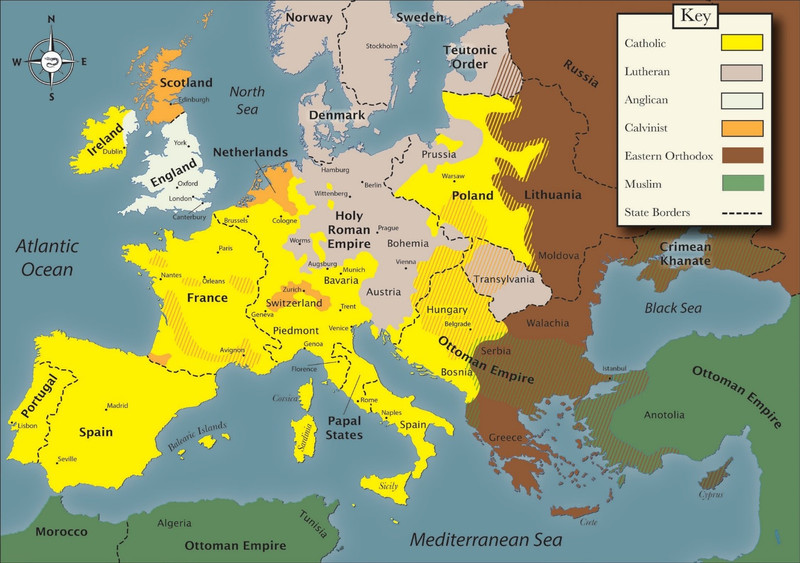
Religious divisions in Europe around 1600
Protestant Reformation
By 1500, the Catholic Church dominated western Europe, but many people criticized corruption, the sale of indulgences, the wealth of clergy, and too much papal power. Renaissance humanism pushed scholars back to original biblical texts, and the printing press spread ideas fast.
In 1517, Martin Luther published the Ninety-five Theses. His challenge widened into bigger arguments:
- Justification by faith meant salvation came through faith, not bought indulgences or church-controlled works.
- Scripture over pope meant the Bible had higher authority than papal rulings.
- His German Bible translation helped ordinary people access scripture.
At the Diet of Worms in 1521, Luther refused to recant. He survived because German princes protected him, which shows how political support helped religious reform succeed.
Main Protestant branches
- Lutheranism spread most in the German states and Scandinavia.
- Calvinism grew from John Calvin in Geneva. It stressed predestination and spread to the Netherlands, Scotland, parts of France, and the Holy Roman Empire. French Calvinists were Huguenots.
- Anglicanism began when Henry VIII broke from Rome through the Act of Supremacy in 1534. It started as a political break, then developed Protestant doctrine.
Catholic Reformation
The Catholic Church answered with reform of its own, often called the Catholic Reformation or Counter-Reformation.
- The Council of Trent (1545 to 1563) reformed abuses and improved clergy training.
- It also reaffirmed Catholic doctrine, including faith and works, seven sacraments, and church tradition.
- The Jesuits, founded by Ignatius of Loyola, opened schools, advised rulers, fought Protestantism, and spread Christianity through missions.
- Francis Xavier carried Christianity to India, Southeast Asia, and Japan.
- The Roman Inquisition and Index of Prohibited Books defended Catholic orthodoxy.
Results
- Western Christian unity ended.
- Religious conflict followed, including the French Wars of Religion and Thirty Years’ War.
- Christianity still expanded globally through both Catholic and Protestant missions.
The formula here is simple. Christianity stayed powerful, but it became more divided and more widespread.
How Ottoman-Safavid Rivalry Intensified the Sunni-Shi’a Split
The split between Sunni and Shi’a Muslims was already centuries old. It began after Muhammad’s death in 632 over who should lead the Muslim community.
- Sunni Muslims accepted the early caliphs and emphasized communal tradition.
- Shi’a Muslims believed leadership belonged to Ali and his descendants.
Both groups still shared core Islamic beliefs, the Quran, and Muhammad as prophet. The continuity matters.
The change came when empires turned that old split into a sharper political identity. This map helps you see the two rival states side by side.
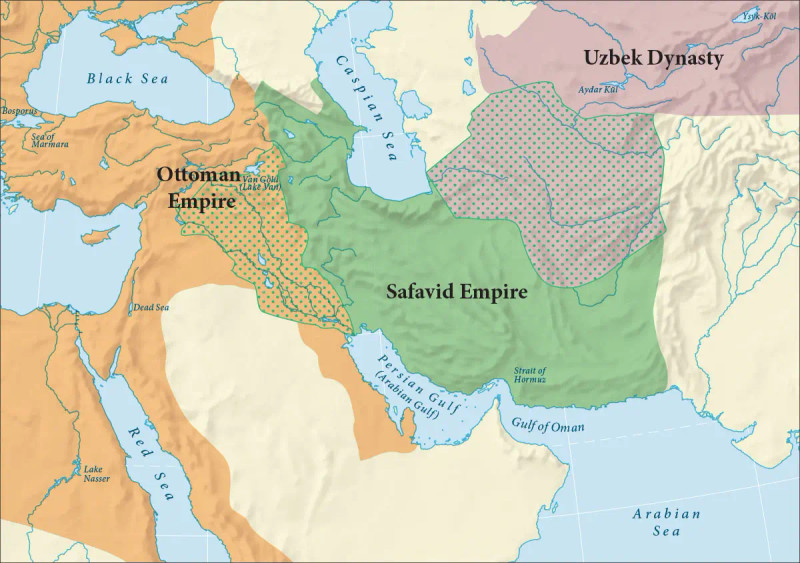
Ottoman, Safavid, and Uzbek states in Southwest and Central Asia
- The Ottoman Empire was mostly Sunni. After conquering Egypt in 1517, Ottoman sultans increasingly claimed caliphal authority and presented themselves as defenders of Sunni Islam.
- The Safavid Empire, founded by Shah Ismail in 1501, made Twelver Shi’ism the official religion of Iran and promoted Shi’a scholars while suppressing Sunni authority.
Their rivalry involved territory, trade routes, and imperial power, not religion alone. Religion made the conflict more intense and easier for rulers to use.
- At the Battle of Chaldiran in 1514, the Ottomans defeated the Safavids.
- That battle shows sectarian difference tied directly to military and political competition.
The formula here is that the Sunni-Shi’a division continued, but Ottoman-Safavid rivalry made it more political, territorial, and sectarian.
How Sikhism Emerged in South Asia
In Punjab, trade routes, migration, and empire brought Hindu and Muslim communities into long contact. The Mughal Empire ruled a mostly Hindu population, and both bhakti and Sufi traditions encouraged personal devotion across boundaries.
Guru Nanak
Guru Nanak (1469 to 1539) founded Sikhism. He taught:
- devotion to one God
- equality of people
- honest work and generosity
- rejection of empty ritual and caste inequality
Sikhism as syncretic but distinct
Sikhism developed through interaction between Hindu and Islamic traditions.
- Monotheism is often linked to Islamic influence.
- Karma and rebirth reflect South Asian influence.
But AP loves this distinction. Sikhism was not just a blend. It became its own religion.
Growth of the Sikh community
- A line of ten gurus led the community.
- Gurdwaras became places of worship.
- Langar, the communal meal, showed equality in practice.
- Guru Arjan compiled the Adi Granth.
- His execution by the Mughals in 1606 increased tension.
- In 1699, Guru Gobind Singh created the Khalsa.
- Authority later passed to the Guru Granth Sahib.
The formula here is that Hinduism and Islam remained, but their interaction helped create a new religion, Sikhism.
Key Takeaways
Protestant Reformation
Sixteenth-century movement that broke Western Christianity’s Catholic unity and created Protestant churches outside papal authority
Protestantism / Protestant
Christian churches and movements that separated from Roman Catholic authority during the Reformation
Martin Luther
German monk who challenged indulgences in 1517 and taught justification by faith and scripture’s supremacy over papal authority
Ninety-five Theses
Luther’s 1517 arguments against the preaching and sale of indulgences, conventionally marking the Reformation’s beginning
Indulgence
In Catholic practice, a remission of temporal punishment associated with sin; its sale and preaching provoked Luther’s protest
Justification by Faith
Lutheran teaching that salvation comes through faith and divine grace rather than purchased indulgences or accumulated works
Diet of Worms
1521 imperial assembly where Luther refused to recant his teachings after his excommunication
Lutheranism
Protestant tradition based on Luther’s teachings that became established in German territories and Scandinavia
John Calvin
Protestant reformer who established an influential Reformed tradition in Geneva emphasizing divine sovereignty and predestination
Calvinism / Reformed Christianity
Protestant tradition associated with John Calvin that emphasized divine sovereignty and predestination
Predestination
Calvinist teaching that God had already determined who would be saved
Huguenots
French Calvinists who faced persecution and participated in the French Wars of Religion
Henry VIII
English king whose marriage dispute with the pope led him to establish royal control over the Church of England
Act of Supremacy
1534 law recognizing the English monarch as head of the Church of England instead of the pope
Anglicanism / Church of England
English church under royal authority that adopted Protestant doctrines while retaining some Catholic forms and institutions
Catholic Reformation / Counter-Reformation
Catholic reform, renewal, and doctrinal defense that corrected abuses, resisted Protestantism, and expanded missionary work
Council of Trent
1545–1563 council that reformed clerical discipline while reaffirming Catholic tradition, faith and works, and seven sacraments
Society of Jesus / Jesuits
Catholic order that operated schools, advised rulers, opposed Protestantism, and conducted global missions
Ignatius of Loyola
Founder of the Society of Jesus, which received papal approval in 1540
French Wars of Religion
Sixteenth-century French conflicts involving Catholics and Huguenots as well as dynastic and political rivalries
Thirty Years’ War
1618–1648 European war combining Catholic-Protestant conflict with dynastic, territorial, and political rivalries
Sunni Islam vs. Shi’a Islam
Sunnis accepted the early caliphs and communal tradition; Shi’a traced legitimate leadership through Ali and Muhammad’s family
Sectarian
Describing division or conflict between branches of the same religion, such as Sunni and Shi’a Islam
Ottoman–Safavid Rivalry
Political and territorial competition between the Sunni Ottoman and Shi’a Safavid empires that intensified Islamic sectarian divisions
Shah Ismail I
Founder of Safavid rule in 1501 who made Twelver Shi’a Islam the empire’s official religion
Battle of Chaldiran
1514 battle in which Selim I’s Ottoman forces defeated Shah Ismail’s Safavids, illustrating the rivalry between Sunni and Shi’a imperial states
Caliph
Title associated with leadership of the Muslim community and increasingly claimed or emphasized by Ottoman sultans
Shah
Persian royal title used by Safavid rulers
Bhakti Movement
Hindu devotional tradition emphasizing personal devotion and sometimes challenging inherited status or elaborate ritual
Sufism
Islamic mystical tradition emphasizing devotion, spiritual discipline, and relationships between teachers and disciples
Syncretism
Development of beliefs or practices through sustained interaction among different religious or cultural traditions
Sikhism
Distinct monotheistic religion founded by Guru Nanak in Punjab amid Hindu-Islamic interaction and developed by later Sikh gurus
Guru Nanak
Founder and first Sikh guru who taught devotion to one God, honest work, generosity, and human equality
Guru
Spiritual teacher; Sikhism recognizes ten human gurus before authority passed to the Guru Granth Sahib
Guru Arjan
Fifth Sikh guru who compiled the Adi Granth and whose 1606 execution increased Sikh-Mughal tensions
Guru Gobind Singh
Tenth Sikh guru who founded the Khalsa in 1699 and strengthened Sikh collective identity
Khalsa
Disciplined community of initiated Sikhs founded by Guru Gobind Singh in 1699
Guru Granth Sahib
Sikh scripture that became the community’s enduring guru after the line of human gurus ended in 1708
Printing Press
Technology that rapidly circulated Luther’s writings, vernacular scripture, and other Reformation arguments to a wider public
Notes
Protestant Reformation
Sixteenth-century movement that broke Western Christianity’s Catholic unity and created Protestant churches outside papal authority
Protestantism / Protestant
Christian churches and movements that separated from Roman Catholic authority during the Reformation
Martin Luther
German monk who challenged indulgences in 1517 and taught justification by faith and scripture’s supremacy over papal authority
Ninety-five Theses
Luther’s 1517 arguments against the preaching and sale of indulgences, conventionally marking the Reformation’s beginning
Indulgence
In Catholic practice, a remission of temporal punishment associated with sin; its sale and preaching provoked Luther’s protest
Justification by Faith
Lutheran teaching that salvation comes through faith and divine grace rather than purchased indulgences or accumulated works
Diet of Worms
1521 imperial assembly where Luther refused to recant his teachings after his excommunication
Lutheranism
Protestant tradition based on Luther’s teachings that became established in German territories and Scandinavia
John Calvin
Protestant reformer who established an influential Reformed tradition in Geneva emphasizing divine sovereignty and predestination
Calvinism / Reformed Christianity
Protestant tradition associated with John Calvin that emphasized divine sovereignty and predestination
Predestination
Calvinist teaching that God had already determined who would be saved
Huguenots
French Calvinists who faced persecution and participated in the French Wars of Religion
Henry VIII
English king whose marriage dispute with the pope led him to establish royal control over the Church of England
Act of Supremacy
1534 law recognizing the English monarch as head of the Church of England instead of the pope
Anglicanism / Church of England
English church under royal authority that adopted Protestant doctrines while retaining some Catholic forms and institutions
Catholic Reformation / Counter-Reformation
Catholic reform, renewal, and doctrinal defense that corrected abuses, resisted Protestantism, and expanded missionary work
Council of Trent
1545–1563 council that reformed clerical discipline while reaffirming Catholic tradition, faith and works, and seven sacraments
Society of Jesus / Jesuits
Catholic order that operated schools, advised rulers, opposed Protestantism, and conducted global missions
Ignatius of Loyola
Founder of the Society of Jesus, which received papal approval in 1540
French Wars of Religion
Sixteenth-century French conflicts involving Catholics and Huguenots as well as dynastic and political rivalries
Thirty Years’ War
1618–1648 European war combining Catholic-Protestant conflict with dynastic, territorial, and political rivalries
Sunni Islam vs. Shi’a Islam
Sunnis accepted the early caliphs and communal tradition; Shi’a traced legitimate leadership through Ali and Muhammad’s family
Sectarian
Describing division or conflict between branches of the same religion, such as Sunni and Shi’a Islam
Ottoman–Safavid Rivalry
Political and territorial competition between the Sunni Ottoman and Shi’a Safavid empires that intensified Islamic sectarian divisions
Shah Ismail I
Founder of Safavid rule in 1501 who made Twelver Shi’a Islam the empire’s official religion
Battle of Chaldiran
1514 battle in which Selim I’s Ottoman forces defeated Shah Ismail’s Safavids, illustrating the rivalry between Sunni and Shi’a imperial states
Caliph
Title associated with leadership of the Muslim community and increasingly claimed or emphasized by Ottoman sultans
Shah
Persian royal title used by Safavid rulers
Bhakti Movement
Hindu devotional tradition emphasizing personal devotion and sometimes challenging inherited status or elaborate ritual
Sufism
Islamic mystical tradition emphasizing devotion, spiritual discipline, and relationships between teachers and disciples
Syncretism
Development of beliefs or practices through sustained interaction among different religious or cultural traditions
Sikhism
Distinct monotheistic religion founded by Guru Nanak in Punjab amid Hindu-Islamic interaction and developed by later Sikh gurus
Guru Nanak
Founder and first Sikh guru who taught devotion to one God, honest work, generosity, and human equality
Guru
Spiritual teacher; Sikhism recognizes ten human gurus before authority passed to the Guru Granth Sahib
Guru Arjan
Fifth Sikh guru who compiled the Adi Granth and whose 1606 execution increased Sikh-Mughal tensions
Guru Gobind Singh
Tenth Sikh guru who founded the Khalsa in 1699 and strengthened Sikh collective identity
Khalsa
Disciplined community of initiated Sikhs founded by Guru Gobind Singh in 1699
Guru Granth Sahib
Sikh scripture that became the community’s enduring guru after the line of human gurus ended in 1708
Printing Press
Technology that rapidly circulated Luther’s writings, vernacular scripture, and other Reformation arguments to a wider public
