Topic 8.5 Notes – Decolonization After 1900
What Decolonization Was
Decolonization means ending formal imperial control and gaining either autonomy or full sovereignty. Autonomy means self-government but still tied in some way to the imperial state. Sovereignty means a fully independent state.
Nationalism and self-determination had been growing before 1900, but World War II sped everything up. This 1945 world map is a good reminder that European empires still controlled huge dependent territories across Africa, Asia, and the Pacific even after the war. European empires came out weakened. Colonized peoples had served in the war and expected change. Japan’s victories over European powers in Asia shattered the myth of European invincibility. The United Nations talked about self-determination, anti-imperialism gained support, and the Cold War made both the US and USSR pressure empires at times.
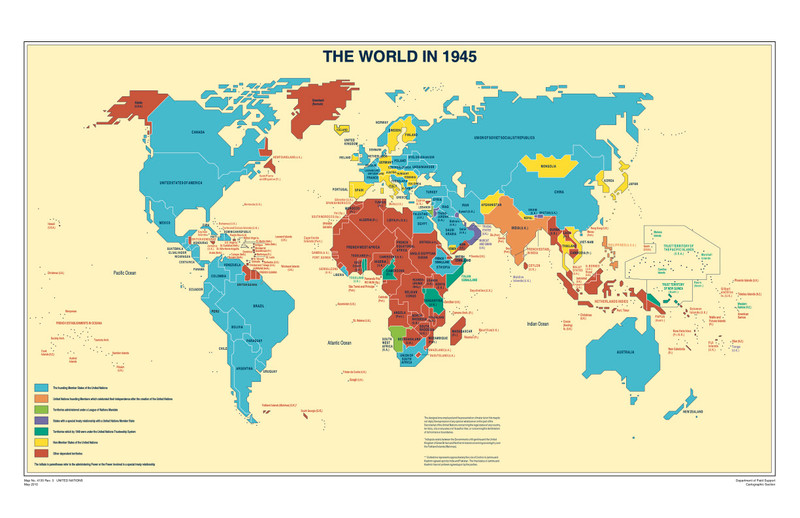
The world in 1945
Peoples pursued independence in three main ways:
- Negotiated independence through reforms, elections, and transfer of power
- Armed struggle through guerrilla war and insurgency
- Regional, religious, and ethnic movements that wanted autonomy or separation
That comparison matters a lot on the AP exam. These are patterns, not perfect boxes. Negotiated independence could still involve violence. Armed struggle usually still ended with diplomacy.
How Independence Was Won
Across cases, nationalist movements used a pretty similar toolbox:
- Political parties organized supporters, ran in elections, and pushed constitutional reform.
- Civil disobedience meant openly breaking unjust laws to expose imperial rule.
- Boycotts, strikes, and demonstrations made colonies harder and more expensive to govern.
- Guerrilla warfare let weaker forces wear down imperial armies.
- International appeals brought outside sympathy and embarrassed imperial powers.
The path differed because conditions differed:
- Britain was often more willing to negotiate than Portugal.
- France negotiated in some places but fought hard in Algeria and Vietnam.
- Large settler populations made compromise harder because settlers feared losing power.
- Nationalist unity, colonial repression, Cold War involvement, and the costs of empire all shaped outcomes.
Negotiated Independence
India
The Indian National Congress became the main nationalist party. Gandhi used satyagraha, or nonviolent resistance, through noncooperation, boycotts, civil disobedience, the Salt March, and Quit India.
Britain negotiated withdrawal after World War II, so India counts as negotiated independence. The key complication was the Muslim League under Muhammad Ali Jinnah, which first demanded protections for Muslims and then demanded Pakistan. Independence came in 1947, but partition into India and Pakistan caused massive communal violence.
Ghana
In the British Gold Coast, Kwame Nkrumah and the Convention People’s Party demanded “self-government now.” Positive Action included strikes, boycotts, and elections. Nkrumah was jailed, but the CPP won in 1951, which pushed Britain toward reform. Ghana became independent in 1957, the first sub-Saharan African colony to do so in the postwar wave.
French West Africa
This case was slower and more constitutional. The 1956 loi-cadre gave territories more authority. In 1958, France offered the French Community. Guinea, under Sékou Touré, rejected it and became immediately independent. Senegal and other territories became sovereign in 1960. Léopold Sédar Senghor is a key name here. This shows that political independence could come with continued French influence.
Egypt and Gamal Abdel Nasser
Egypt had been formally independent since 1922, but Britain kept troops around the Suez Canal. Gamal Abdel Nasser led the Free Officers who overthrew the monarchy in 1952, pushed British withdrawal, and nationalized the Suez Canal in 1956. The Suez Crisis showed that decolonization could mean ending foreign military and economic control, not just winning an independence day.
Independence Through Armed Struggle
Vietnam
Ho Chi Minh and the Viet Minh mixed nationalism with communism. France tried to return after 1945, which sparked the First Indochina War from 1946 to 1954. Viet Minh guerrilla tactics, Chinese communist aid after 1949, and US support for France all mattered. The turning point was Dien Bien Phu. The Geneva Accords ended French rule and temporarily divided Vietnam.
Algeria
The FLN revolted in 1954. France saw Algeria as part of France, and pieds-noirs settlers strongly resisted independence. The war included guerrilla fighting, bombings, the Battle of Algiers, and brutal French torture and repression. The war destabilized France, helped bring back Charles de Gaulle, and ended with the Evian Accords in 1962.
Angola
Portugal resisted decolonization longer than most. Armed struggle began in 1961. The MPLA, FNLA, and UNITA fought Portugal and also competed with each other. These wars helped cause Portugal’s Carnation Revolution in 1974. Angola became independent in 1975. This is a great example of colonial resistance plus crisis inside the imperial state.
Movements That Challenged Colonial Borders
Decolonization did not settle one huge question. Who counts as the nation?
- Muslim League in India argued Muslims were a separate nation. The Lahore Resolution pushed toward Pakistan and challenged both British rule and Congress’s united-India vision.
- Biafra in Nigeria was an Igbo-led secession attempt from 1967 to 1970. This happened after independence, which shows colonial borders stayed contested.
- Québécois separatism in Canada sought autonomy or sovereignty for French-speaking Quebec. The Parti Québécois used elections and referendums in 1980 and 1995, so this is self-determination through constitutional means, not war.
Key Takeaways
Decolonization
Process by which colonies and subordinated territories ended formal imperial rule and gained autonomy or political independence
Anticolonial Nationalism
Belief that a people under foreign imperial rule constituted a nation entitled to govern itself
National Self-Determination
Principle that a politically or culturally defined people should choose its own government and political status
Negotiated Independence vs. Independence Through Armed Struggle
Negotiated independence transferred sovereignty through agreements and constitutional reform; armed struggle used warfare to compel withdrawal, often followed by a settlement
Indian National Congress
Leading Indian nationalist organization that developed into a mass movement seeking self-government and negotiated independence from Britain
Mohandas Gandhi
Indian National Congress leader who used satyagraha, boycotts, marches, noncooperation, and civil disobedience against British rule
Satyagraha
Gandhi’s disciplined method of nonviolent moral resistance, often translated as “truth force.”
Salt March
Gandhi’s 1930 march to make salt illegally, defying Britain’s salt monopoly and mobilizing mass resistance to colonial rule
Quit India Movement
Congress campaign begun in 1942 demanding immediate British withdrawal; Britain responded by imprisoning its leaders
Muslim League
Party led by Muhammad Ali Jinnah that sought protections for Indian Muslims and ultimately demanded a separate Pakistan
Muhammad Ali Jinnah
Leader of the Muslim League who argued that South Asian Muslims required a separate Muslim-majority state
1940 Lahore Resolution
Muslim League resolution calling for separate states in Muslim-majority regions, marking its movement toward the demand for Pakistan
1947 Partition of British India
Negotiated British withdrawal that created Hindu-majority India and Muslim-majority Pakistan, accompanied by massacres and mass displacement
Kwame Nkrumah
Ghanaian nationalist who founded the Convention People’s Party, led “Positive Action,” and became independent Ghana’s first prime minister
Convention People’s Party
Nkrumah’s mass nationalist party, founded in 1949, that demanded “self-government now” and won elections in the Gold Coast
Positive Action
Convention People’s Party campaign using strikes, boycotts, and demonstrations to pressure Britain for immediate self-government
Gold Coast Independence / Ghanaian Independence
British Gold Coast gained negotiated independence as Ghana on March 6, 1957, after elections, protest, and constitutional reform
Pan-Africanism
Idea that African peoples and states shared interests created by colonialism and should cooperate politically
French West African Decolonization
Gradual constitutional transfer that brought Guinea immediate independence in 1958 and most other French West African territories sovereignty in 1960
Loi-Cadre (Framework Law)
French law of 1956 that transferred additional authority to elected territorial governments in French West Africa
French Community
Association offered in 1958 through which French African territories could gain self-government while retaining ties to France
Sékou Touré
Guinean nationalist leader who rejected membership in the French Community and led Guinea to immediate independence in 1958
Léopold Sédar Senghor
Senegalese nationalist leader prominent in the constitutional negotiations that led Senegal toward independence from France
Ho Chi Minh
Vietnamese communist and nationalist who founded the Viet Minh and declared an independent Democratic Republic of Vietnam in 1945
Viet Minh
Nationalist and communist organization founded by Ho Chi Minh that fought Japan and then defeated French colonial forces
First Indochina War
War from 1946 to 1954 in which the Viet Minh fought France’s attempt to restore colonial rule in Vietnam
Battle of Dien Bien Phu
Decisive 1954 Viet Minh victory that defeated the French colonial army and compelled France to leave Indochina
Geneva Agreements of 1954
Settlement ending French rule in Indochina and temporarily dividing Vietnam near the seventeenth parallel into North and South
Pieds-Noirs
European settlers in Algeria whose privileges and opposition to withdrawal made French compromise over Algerian independence more difficult
National Liberation Front (FLN)
Algerian nationalist organization that began a rebellion in 1954 and used guerrilla warfare, bombings, and political organizing against France
Algerian War of Independence
Violent 1954–1962 conflict in which the FLN’s insurgency and French repression ended with Algeria’s independence
Battle of Algiers
1956–1957 urban struggle marked by FLN bombings and systematic French counterinsurgency, detention, and torture
Charles de Gaulle
French leader restored to power during the Algerian crisis who eventually accepted that continued French rule was unsustainable
Évian Accords
1962 agreement establishing a cease-fire in Algeria and clearing the way for Algerian independence from France
Angolan War of Independence
Armed struggle beginning in 1961 in which the MPLA, FNLA, and UNITA fought Portuguese rule, helping produce Angola’s independence in 1975
Carnation Revolution
1974 military revolution that overthrew Portugal’s authoritarian government and led the new regime to end its African colonial wars
Gamal Abdel Nasser
Egyptian nationalist leader who helped overthrow King Farouk, secured British withdrawal from the Suez Canal zone, and nationalized the Suez Canal Company
Free Officers Movement
Egyptian military movement that overthrew King Farouk in 1952, abolished the monarchy, and challenged remaining British power
Suez Crisis
1956 conflict triggered by Nasser’s nationalization of the Suez Canal; international pressure forced Britain, France, and Israel to withdraw
Québécois Separatism
French-speaking Quebec movement seeking greater provincial autonomy or full sovereignty from Canada through constitutional and electoral politics
Quiet Revolution
1960s transformation in Quebec that expanded provincial government and encouraged a stronger secular Québécois nationalism
Parti Québécois
Quebec political party that pursued sovereignty through elections and promoted the unsuccessful 1980 and 1995 referendums
Autonomy
Substantial self-government within a larger state or political unit
Independence
Full sovereignty over domestic government and foreign relations without subordination to an imperial power
Secession
Withdrawal from an existing state to create a separate sovereign state or join another state
Biafran Secession
Southeastern Nigeria’s unsuccessful 1967 attempt to form an independent Biafra, defeated by federal forces in 1970 after a devastating war
Notes
Decolonization
Process by which colonies and subordinated territories ended formal imperial rule and gained autonomy or political independence
Anticolonial Nationalism
Belief that a people under foreign imperial rule constituted a nation entitled to govern itself
National Self-Determination
Principle that a politically or culturally defined people should choose its own government and political status
Negotiated Independence vs. Independence Through Armed Struggle
Negotiated independence transferred sovereignty through agreements and constitutional reform; armed struggle used warfare to compel withdrawal, often followed by a settlement
Indian National Congress
Leading Indian nationalist organization that developed into a mass movement seeking self-government and negotiated independence from Britain
Mohandas Gandhi
Indian National Congress leader who used satyagraha, boycotts, marches, noncooperation, and civil disobedience against British rule
Satyagraha
Gandhi’s disciplined method of nonviolent moral resistance, often translated as “truth force.”
Salt March
Gandhi’s 1930 march to make salt illegally, defying Britain’s salt monopoly and mobilizing mass resistance to colonial rule
Quit India Movement
Congress campaign begun in 1942 demanding immediate British withdrawal; Britain responded by imprisoning its leaders
Muslim League
Party led by Muhammad Ali Jinnah that sought protections for Indian Muslims and ultimately demanded a separate Pakistan
Muhammad Ali Jinnah
Leader of the Muslim League who argued that South Asian Muslims required a separate Muslim-majority state
1940 Lahore Resolution
Muslim League resolution calling for separate states in Muslim-majority regions, marking its movement toward the demand for Pakistan
1947 Partition of British India
Negotiated British withdrawal that created Hindu-majority India and Muslim-majority Pakistan, accompanied by massacres and mass displacement
Kwame Nkrumah
Ghanaian nationalist who founded the Convention People’s Party, led “Positive Action,” and became independent Ghana’s first prime minister
Convention People’s Party
Nkrumah’s mass nationalist party, founded in 1949, that demanded “self-government now” and won elections in the Gold Coast
Positive Action
Convention People’s Party campaign using strikes, boycotts, and demonstrations to pressure Britain for immediate self-government
Gold Coast Independence / Ghanaian Independence
British Gold Coast gained negotiated independence as Ghana on March 6, 1957, after elections, protest, and constitutional reform
Pan-Africanism
Idea that African peoples and states shared interests created by colonialism and should cooperate politically
French West African Decolonization
Gradual constitutional transfer that brought Guinea immediate independence in 1958 and most other French West African territories sovereignty in 1960
Loi-Cadre (Framework Law)
French law of 1956 that transferred additional authority to elected territorial governments in French West Africa
French Community
Association offered in 1958 through which French African territories could gain self-government while retaining ties to France
Sékou Touré
Guinean nationalist leader who rejected membership in the French Community and led Guinea to immediate independence in 1958
Léopold Sédar Senghor
Senegalese nationalist leader prominent in the constitutional negotiations that led Senegal toward independence from France
Ho Chi Minh
Vietnamese communist and nationalist who founded the Viet Minh and declared an independent Democratic Republic of Vietnam in 1945
Viet Minh
Nationalist and communist organization founded by Ho Chi Minh that fought Japan and then defeated French colonial forces
First Indochina War
War from 1946 to 1954 in which the Viet Minh fought France’s attempt to restore colonial rule in Vietnam
Battle of Dien Bien Phu
Decisive 1954 Viet Minh victory that defeated the French colonial army and compelled France to leave Indochina
Geneva Agreements of 1954
Settlement ending French rule in Indochina and temporarily dividing Vietnam near the seventeenth parallel into North and South
Pieds-Noirs
European settlers in Algeria whose privileges and opposition to withdrawal made French compromise over Algerian independence more difficult
National Liberation Front (FLN)
Algerian nationalist organization that began a rebellion in 1954 and used guerrilla warfare, bombings, and political organizing against France
Algerian War of Independence
Violent 1954–1962 conflict in which the FLN’s insurgency and French repression ended with Algeria’s independence
Battle of Algiers
1956–1957 urban struggle marked by FLN bombings and systematic French counterinsurgency, detention, and torture
Charles de Gaulle
French leader restored to power during the Algerian crisis who eventually accepted that continued French rule was unsustainable
Évian Accords
1962 agreement establishing a cease-fire in Algeria and clearing the way for Algerian independence from France
Angolan War of Independence
Armed struggle beginning in 1961 in which the MPLA, FNLA, and UNITA fought Portuguese rule, helping produce Angola’s independence in 1975
Carnation Revolution
1974 military revolution that overthrew Portugal’s authoritarian government and led the new regime to end its African colonial wars
Gamal Abdel Nasser
Egyptian nationalist leader who helped overthrow King Farouk, secured British withdrawal from the Suez Canal zone, and nationalized the Suez Canal Company
Free Officers Movement
Egyptian military movement that overthrew King Farouk in 1952, abolished the monarchy, and challenged remaining British power
Suez Crisis
1956 conflict triggered by Nasser’s nationalization of the Suez Canal; international pressure forced Britain, France, and Israel to withdraw
Québécois Separatism
French-speaking Quebec movement seeking greater provincial autonomy or full sovereignty from Canada through constitutional and electoral politics
Quiet Revolution
1960s transformation in Quebec that expanded provincial government and encouraged a stronger secular Québécois nationalism
Parti Québécois
Quebec political party that pursued sovereignty through elections and promoted the unsuccessful 1980 and 1995 referendums
Autonomy
Substantial self-government within a larger state or political unit
Independence
Full sovereignty over domestic government and foreign relations without subordination to an imperial power
Secession
Withdrawal from an existing state to create a separate sovereign state or join another state
Biafran Secession
Southeastern Nigeria’s unsuccessful 1967 attempt to form an independent Biafra, defeated by federal forces in 1970 after a devastating war
