Topic 8.1 Notes – Setting the Stage for the Cold War and Decolonization
How World War II Reshaped Global Power
After 1945, the old Europe-centered world order started to fall apart. Britain, France, and the Netherlands had dominated global politics for a long time, but WWII left them bombed, occupied, deeply in debt, and stuck paying huge reconstruction costs at home.
This 1945 map helps you see how much of the world was still under imperial control even as that old order was starting to weaken.
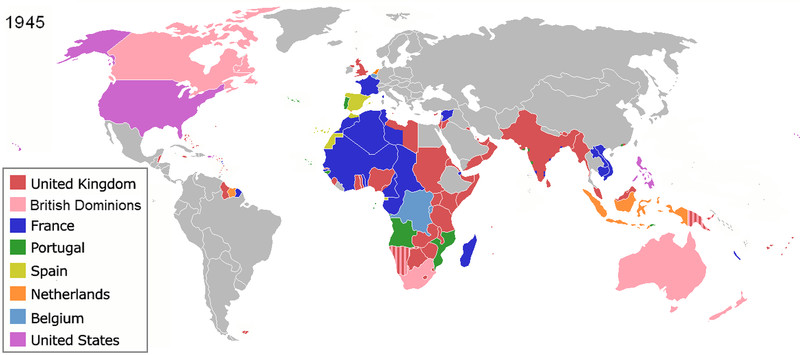
Colonial empires in 1945
The balance of power shifted to the United States and the Soviet Union. That created a bipolar world, which means two superpowers, not many equal great powers, shaped global politics.
One thing AP loves here. Anti-imperial nationalism and ideological conflict did not begin in 1945. Nationalists had already been resisting empire, and capitalism vs. communism already existed. WWII made both far more powerful and far more global. That is why this war is the turning point for both the Cold War and rapid decolonization.
Why Self-Determination Had Been Promised Before but Mostly Denied
World War I raised hopes without actually ending empire. The key idea was self-determination, the principle that peoples should choose their own government and political status. Woodrow Wilson connected it to his Fourteen Points, and colonized intellectuals grabbed onto that language fast.
The gap between rhetoric and reality
At the Paris Peace Conference in 1919, self-rule was applied very selectively, mostly in Europe. Race, strategy, and imperial interest shaped who got sovereignty and who did not. So the language sounded universal, but the practice was not.
The mandate system
The mandate system kept imperial control alive under League of Nations supervision.
- Britain received Iraq and Palestine
- France received Syria and Lebanon
In theory, mandates prepared people for self-government. In practice, they were colonial rule with a different label.
Nationalism between the wars
Anti-imperialism kept growing between WWI and WWII through parties, workers, students, veterans, and intellectuals.
- Korean March First Movement (1919) challenged Japanese rule.
- Indian protests pushed against British rule.
- Egyptian nationalism demanded more control and independence.
The key point is simple. Anti-imperialism existed before 1945. WWII changed the conditions so these movements could succeed more often.
Why European Empires Weakened After World War II
Several forces made empire much harder to maintain after 1945.
- Economic and military exhaustion meant Britain and France had fewer troops, less money, and damaged infrastructure. They could still fight to keep colonies, but doing so became much more expensive.
- Colonial participation mattered too. Colonized peoples served as soldiers and laborers, supplied raw materials, and came back with military experience and stronger demands for rights.
- Wartime mobilization also expanded cities, bureaucracies, and political networks in the colonies. That gave nationalist movements more organization.
Japanese victories in Asia
Japan shattered the myth that Europeans could not be beaten. The fall of Singapore in 1942 was especially humiliating for Britain, and images of British-led forces surrendering became a powerful symbol of declining imperial prestige in Asia.
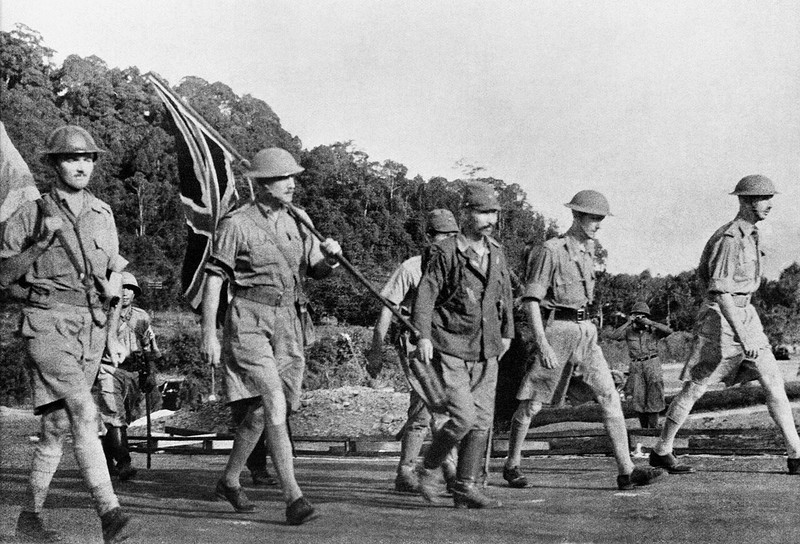
British surrender at Singapore, 1942
In Indonesia and Vietnam, nationalist leaders declared independence in 1945 before Europeans could fully return.
Legitimacy crisis of empire
Allied war language hurt empire too.
- The Atlantic Charter in 1941 talked about peoples choosing their government.
- The UN Charter in 1945 promoted equal rights and self-determination.
Imperial powers did not mean to free all colonies immediately, but colonized peoples used that language against them.
Why the United States and Soviet Union Became Superpowers
Both countries came out of WWII with unmatched influence, but for different reasons.
| Power | Why it rose |
|---|---|
| United States | Its mainland was not devastated, so it kept a huge industrial economy, financial power, navy, air power, and new technology like radar, aviation advances, communications, and atomic weapons. Hiroshima and Nagasaki showed unmatched military power. |
| Soviet Union | It suffered enormous losses, but the Red Army defeated Nazi Germany on the Eastern Front and occupied Eastern Europe. It had a huge military, centralized state power, industrial capacity, and scientific strength. Communist ideology also attracted some anti-fascist and anticolonial movements. |
Britain and France still mattered, but they no longer dominated world politics on their own. That is the meaning of superpower and bipolarity.
How the Cold War and Decolonization Became Linked
The U.S. and USSR cooperated during WWII because they shared an enemy. That alliance did not last.
The ideological divide ran deep.
- The U.S. was associated with capitalism and liberal democracy.
- The USSR was associated with communism, one-party rule, and state control of the economy.
Distrust went back to the Bolshevik Revolution of 1917, and after 1945 both sides also worried about security and influence. The USSR wanted buffer states in Eastern Europe. The U.S. saw Soviet expansion as a threat.
At the same time, anti-imperialism became more effective because empires were weaker, European prestige was damaged, nationalist groups were stronger, the UN gave new language for sovereignty, and superpowers became involved.
Independence did not always mean peace. India in 1947, Indonesia in 1949, and later African independence movements show that decolonization could bring new states, partition, border disputes, conflict, and continued economic dependence. Many new states became sites of Cold War competition, while others tried to stay nonaligned.
