Topic 7.6 Notes – Causes of World War II
How World War II Became Possible
World War II came from four connected causes. The Treaty of Versailles left anger and instability after World War I. The Great Depression wrecked economies and faith in democracy. Imperialist ambitions never disappeared. Fascist, totalitarian, and militarist regimes turned those problems into conquest.
This built through repeated crises, not one assassination like 1914. That matters on essays. You want to show that war was possible because of conditions, but it was not automatic. Leaders made choices, and Hitler’s Germany mattered most in Europe because Germany had the power to break the postwar balance.
The Four Main Causes
The Versailles Settlement and the Weak Peace
The Treaty of Versailles in 1919 punished Germany in ways nationalists never accepted.
- Article 231 blamed Germany for the war. That “war guilt” clause became a symbol of humiliation.
- Germany lost territory, had to pay reparations, faced military limits, and could not put troops in the Rhineland.
- Hitler and the Nazi Party used this resentment against the democratic Weimar Republic, claiming weak politicians had betrayed Germany.
- Self-determination was applied unevenly. New states were created, but many ethnic minorities were left inside them.
- Hitler later used Germans in Austria and the Sudetenland as excuses for expansion.
- Italy also felt cheated. Its “mutilated victory” helped Mussolini gain support.
The Great Depression and Political Radicalization
The global crash starting in 1929 shattered trade, loans, jobs, and production.
- Germany was hit especially hard because it depended on American loans.
- Moderate governments looked helpless. Extremists promised order, jobs, pride, and national revival.
- Hitler was appointed chancellor in 1933.
- Economic crisis pushed states toward protectionism and autarky, the idea of being self-sufficient. That made conquest look useful for raw materials and markets.
A common mistake is mixing up the Depression with German hyperinflation. Hyperinflation happened in 1923, earlier.
Fascism, Totalitarianism, and Militarism
These terms are related, but not identical.
| Term | What it means | Best examples |
|---|---|---|
| Fascism | authoritarian, ultranationalist, anti-liberal, glorifies violence and the leader | Mussolini’s Italy, Hitler’s Germany |
| Totalitarianism | state tries to control life through propaganda, censorship, surveillance, repression | Nazi Germany, Stalin’s USSR |
| Militarism | military values and conquest become normal policy | 1930s Japan, Nazi Germany |
Nazi Germany was fascist and strongly totalitarian. Stalin’s USSR was totalitarian, but not fascist. Japan is best described here as militarist and authoritarian.
Continued Imperialism
These powers did not reject empire. They wanted their own.
- Germany wanted empire in eastern Europe.
- Italy wanted empire in Africa and the Mediterranean.
- Japan wanted empire in East and Southeast Asia.
Imperialism tied together ideology, economics, and territorial expansion.
How Aggression Went Unchecked
The postwar system depended on the League of Nations, but the League had no army, no U.S. membership, and relied on Britain and France.
Japan’s expansion in East Asia is a good example of how weak that system turned out to be.
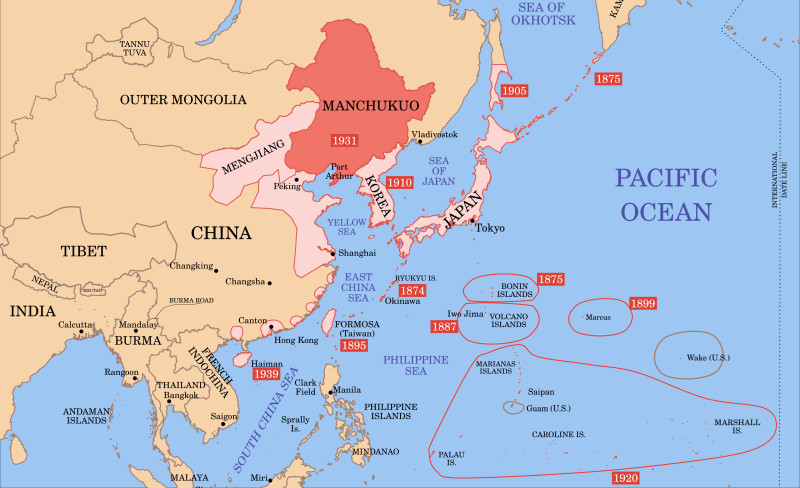
Japanese imperial expansion in East Asia
- Manchuria, 1931 to 1933
Japan used the Mukden Incident as a pretext, seized Manchuria, and made Manchukuo. The map highlights that takeover within Japan’s broader regional empire. The League condemned it, but did nothing effective. Japan left the League. - Ethiopia, 1935 to 1936
Mussolini invaded Ethiopia. League sanctions were weak and failed.
This set up appeasement. Britain and France made concessions because they feared another war, felt weak, faced Depression problems, feared communism, and thought some German complaints were reasonable. The Munich Agreement in 1938 let Hitler take the Sudetenland. Chamberlain called it “peace for our time.” Appeasement enabled aggression, but it was a failed response, not the deepest cause.
The Road to War in Europe and Asia
Hitler’s Expansion
Germany’s moves from 1935 to 1939 show how quickly Hitler pushed past the postwar settlement and turned revision into open conquest.
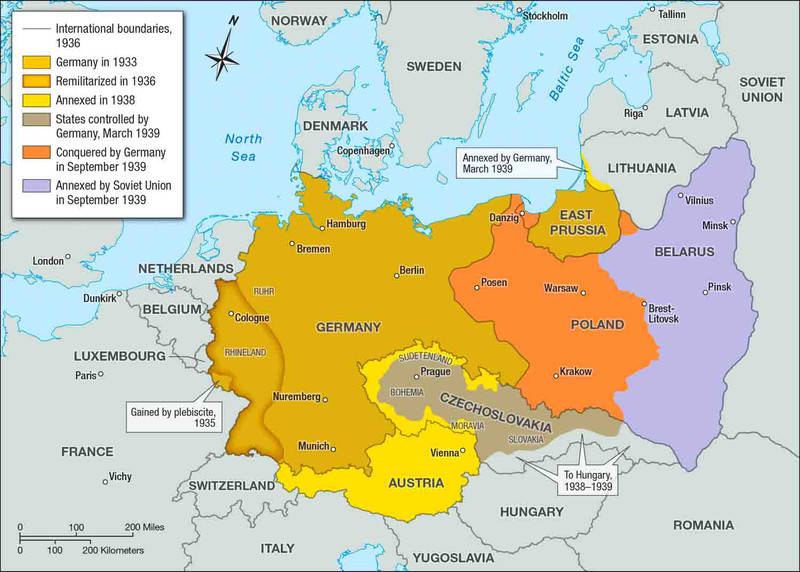
German expansion in Europe, 1933 to 1939
- 1935 Germany rearmed and brought back conscription.
- 1936 Hitler remilitarized the Rhineland.
- 1938 Germany annexed Austria in the Anschluss.
- 1938 Hitler got the Sudetenland through Munich.
- 1939 Germany occupied the rest of Czechoslovakia, proving this was about conquest, not just self-determination.
- August 1939 Germany signed the Nazi-Soviet Nonaggression Pact, with a secret plan to divide eastern Europe.
- September 1, 1939 Germany invaded Poland. Britain and France declared war on September 3.
Hitler’s goals included overturning Versailles, uniting Germans, gaining Lebensraum, destroying communism, and building a racial empire.
Italy and Japan as Parallel Expansionist Powers
Italy and Japan were following the same broader pattern of aggressive expansion.
- Italy invaded Ethiopia, helped Franco in the Spanish Civil War, and occupied Albania. Spain became a testing ground for weapons and ideologies.
- Japan seized Manchuria in 1931 and launched full-scale war against China in 1937 after the Marco Polo Bridge incident.
- Japan used the Greater East Asia Co-Prosperity Sphere as propaganda for Japanese rule.
In Europe, 1939 marks the general war. In Asia, 1937 or even 1931 can be the more meaningful starting point.
What to Say in a Strong AP Answer
A strong answer connects the causes. Versailles created grievances, the Depression destabilized states, fascist and militarist leaders chose conquest, and League weakness plus appeasement let aggression succeed. If you rank causes, Hitler’s aggressive militarism is the most immediate cause of war in Europe.
Compared with World War I, both wars involved nationalism, militarism, imperialism, and diplomatic failure. World War II also had the Depression, fascism, totalitarian rule, racial empire, and the drive to revise the post-1919 order. The immediate consequence you need here is the outbreak of general war in 1939, which later merged with the Asian conflict into global World War II.
Key Takeaways
Treaty of Versailles
1919 peace treaty that imposed German war responsibility, reparations, territorial losses, military limits, and a demilitarized Rhineland, fueling resentment later exploited by Hitler
Article 231 (War-Guilt Clause)
Versailles provision assigning Germany and its allies responsibility for wartime losses, becoming a major symbol of German humiliation
Collective Security
Principle that states should act together against an aggressor because aggression against one threatens the peace of all
League of Nations
Postwar organization weakened by the absence of the United States, lack of armed forces, and failure to stop Japanese and Italian aggression
Great Depression
Worldwide economic collapse beginning in 1929 that weakened democracies, increased extremist support, and intensified economic nationalism and expansionism
Fascism
Authoritarian, intensely nationalist ideology that rejected liberal democracy and glorified hierarchy, obedience, military strength, and violence under a powerful leader
Totalitarianism
System seeking extensive control over public and private life through centralized authority, ideology, propaganda, censorship, surveillance, and repression
Militarism
Glorification of military values and use of armed force as a normal instrument of national policy
Imperialism
Political and economic domination of other territories; Germany, Italy, and Japan sought new empires for land, resources, markets, and strategic power
Autarky
Economic self-sufficiency, which expansionist leaders claimed could be achieved by conquering territory containing resources, farmland, and protected markets
Nazi Party
German fascist movement led by Hitler that gained support during the Depression and established a racial dictatorship committed to rearmament and expansion
Adolf Hitler
Nazi dictator whose rearmament, treaty violations, annexations, racial imperialism, and invasion of Poland were the most decisive causes of general war in Europe
Lebensraum
Nazi goal of acquiring “living space” in eastern Europe for Germans through conquest and the subordination, displacement, or destruction of existing populations
Benito Mussolini
Italian fascist dictator who pursued imperial revival through aggression in Ethiopia and Albania and cooperation with Nazi Germany
Japanese Seizure of Manchuria
Japan occupied Manchuria in 1931 after the Mukden Incident, created the puppet state of Manchukuo, and exposed the League’s inability to reverse aggression
Italian Invasion of Ethiopia
Mussolini’s 1935–1936 conquest of a League member, which defeated limited sanctions and pushed Italy closer to Nazi Germany
Spanish Civil War
1936–1939 conflict in which Germany and Italy aided Franco’s Nationalists while the Soviet Union aided the Republicans, strengthening fascist cooperation and testing weapons
Francisco Franco
Leader of the Nationalists in the Spanish Civil War who received German and Italian aid and later ruled Spain as a dictator
Remilitarization of the Rhineland
Hitler’s March 1936 deployment of German forces into the demilitarized Rhineland, violating Versailles without provoking military resistance
Anschluss
Germany’s March 1938 annexation and union with Austria in violation of the postwar settlement
Appeasement
British and French policy of granting concessions to aggressors to avoid war; it postponed conflict but allowed Germany to grow stronger
Munich Agreement
September 1938 agreement allowing Germany to annex Czechoslovakia’s Sudetenland in exchange for Hitler’s promise of no further European territorial demands
Neville Chamberlain
British prime minister associated with appeasement who accepted the Munich Agreement and declared it offered “peace for our time.”
Second Sino-Japanese War
Full-scale war beginning in 1937 after fighting near the Marco Polo Bridge, creating a major Asian conflict before war began in Europe
Greater East Asia Co-Prosperity Sphere
Japanese claim that Asia would be liberated from Western imperialism under Japanese leadership, masking imperial domination and exploitation
Nazi-Soviet Nonaggression Pact
August 1939 German-Soviet agreement not to attack each other, with a secret protocol dividing parts of eastern Europe into spheres of influence
Joseph Stalin
Soviet totalitarian leader who accepted the Nazi-Soviet Pact to gain territory and time for military preparation
German Invasion of Poland
Germany attacked Poland on September 1, 1939; Britain and France declared war on Germany on September 3, beginning general war in Europe
Mukden Incident
1931 event used by Japan’s Kwantung Army as a pretext to occupy Manchuria
Manchukuo
Japanese-controlled puppet state established in Manchuria in 1932 after Japan seized the region
Sudetenland
German-speaking border region of Czechoslovakia annexed by Germany under the 1938 Munich Agreement
Marco Polo Bridge Incident
July 1937 fighting near Beijing that escalated into full-scale war between Japan and China
Mutilated Victory
Italian fascist claim that Italy had received too little territory after World War I despite fighting with the victorious Allies
Notes
Treaty of Versailles
1919 peace treaty that imposed German war responsibility, reparations, territorial losses, military limits, and a demilitarized Rhineland, fueling resentment later exploited by Hitler
Article 231 (War-Guilt Clause)
Versailles provision assigning Germany and its allies responsibility for wartime losses, becoming a major symbol of German humiliation
Collective Security
Principle that states should act together against an aggressor because aggression against one threatens the peace of all
League of Nations
Postwar organization weakened by the absence of the United States, lack of armed forces, and failure to stop Japanese and Italian aggression
Great Depression
Worldwide economic collapse beginning in 1929 that weakened democracies, increased extremist support, and intensified economic nationalism and expansionism
Fascism
Authoritarian, intensely nationalist ideology that rejected liberal democracy and glorified hierarchy, obedience, military strength, and violence under a powerful leader
Totalitarianism
System seeking extensive control over public and private life through centralized authority, ideology, propaganda, censorship, surveillance, and repression
Militarism
Glorification of military values and use of armed force as a normal instrument of national policy
Imperialism
Political and economic domination of other territories; Germany, Italy, and Japan sought new empires for land, resources, markets, and strategic power
Autarky
Economic self-sufficiency, which expansionist leaders claimed could be achieved by conquering territory containing resources, farmland, and protected markets
Nazi Party
German fascist movement led by Hitler that gained support during the Depression and established a racial dictatorship committed to rearmament and expansion
Adolf Hitler
Nazi dictator whose rearmament, treaty violations, annexations, racial imperialism, and invasion of Poland were the most decisive causes of general war in Europe
Lebensraum
Nazi goal of acquiring “living space” in eastern Europe for Germans through conquest and the subordination, displacement, or destruction of existing populations
Benito Mussolini
Italian fascist dictator who pursued imperial revival through aggression in Ethiopia and Albania and cooperation with Nazi Germany
Japanese Seizure of Manchuria
Japan occupied Manchuria in 1931 after the Mukden Incident, created the puppet state of Manchukuo, and exposed the League’s inability to reverse aggression
Italian Invasion of Ethiopia
Mussolini’s 1935–1936 conquest of a League member, which defeated limited sanctions and pushed Italy closer to Nazi Germany
Spanish Civil War
1936–1939 conflict in which Germany and Italy aided Franco’s Nationalists while the Soviet Union aided the Republicans, strengthening fascist cooperation and testing weapons
Francisco Franco
Leader of the Nationalists in the Spanish Civil War who received German and Italian aid and later ruled Spain as a dictator
Remilitarization of the Rhineland
Hitler’s March 1936 deployment of German forces into the demilitarized Rhineland, violating Versailles without provoking military resistance
Anschluss
Germany’s March 1938 annexation and union with Austria in violation of the postwar settlement
Appeasement
British and French policy of granting concessions to aggressors to avoid war; it postponed conflict but allowed Germany to grow stronger
Munich Agreement
September 1938 agreement allowing Germany to annex Czechoslovakia’s Sudetenland in exchange for Hitler’s promise of no further European territorial demands
Neville Chamberlain
British prime minister associated with appeasement who accepted the Munich Agreement and declared it offered “peace for our time.”
Second Sino-Japanese War
Full-scale war beginning in 1937 after fighting near the Marco Polo Bridge, creating a major Asian conflict before war began in Europe
Greater East Asia Co-Prosperity Sphere
Japanese claim that Asia would be liberated from Western imperialism under Japanese leadership, masking imperial domination and exploitation
Nazi-Soviet Nonaggression Pact
August 1939 German-Soviet agreement not to attack each other, with a secret protocol dividing parts of eastern Europe into spheres of influence
Joseph Stalin
Soviet totalitarian leader who accepted the Nazi-Soviet Pact to gain territory and time for military preparation
German Invasion of Poland
Germany attacked Poland on September 1, 1939; Britain and France declared war on Germany on September 3, beginning general war in Europe
Mukden Incident
1931 event used by Japan’s Kwantung Army as a pretext to occupy Manchuria
Manchukuo
Japanese-controlled puppet state established in Manchuria in 1932 after Japan seized the region
Sudetenland
German-speaking border region of Czechoslovakia annexed by Germany under the 1938 Munich Agreement
Marco Polo Bridge Incident
July 1937 fighting near Beijing that escalated into full-scale war between Japan and China
Mutilated Victory
Italian fascist claim that Italy had received too little territory after World War I despite fighting with the victorious Allies
