Topic 5.4 Notes – Industrialization Spreads in the Period from 1750 to 1900
How Industrialization Changed Production
Before industrialization, most goods were made in households, small workshops, or the putting-out system, where merchants gave raw materials to workers who produced goods at home. Skilled artisans usually controlled their own tools and much of the process.
Industrialization changed how goods were made.
- Factories brought workers and machines into one place. That let owners supervise work closely and keep production moving faster.
- Steam power and coal mattered because factories no longer had to rely mainly on people, animals, wind, or flowing water.
- Division of labor meant each worker handled one step instead of making the whole product. That raised efficiency and output.
- Mass production lowered the cost per item, so factories could make huge quantities more cheaply.
A textile mill like the one shown here captures the shift well. Instead of scattered household production, workers and machines were gathered in one shared factory space.
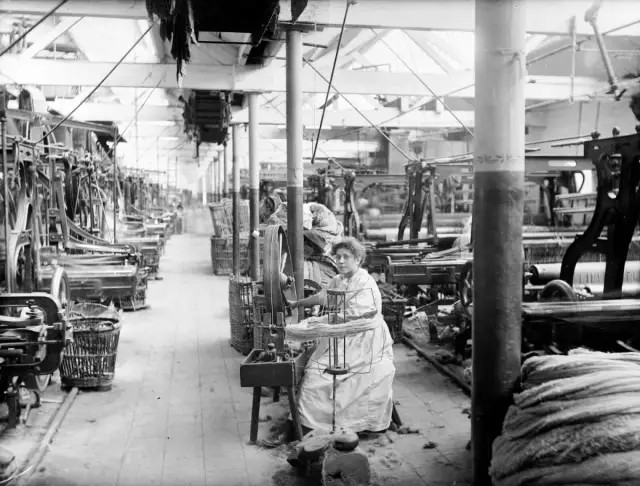
Early textile factory interior
One easy exam trap is thinking factories instantly replaced older work. They did not. Industrial and artisanal production coexisted for a long time. Another trap is assuming every society that made goods industrialized. Many still manufactured goods, but they did not all adopt the factory-based, steam-powered system.
Where Industrialization Spread
Britain went first. The new system then spread to Belgium, France, the German states, the United States, Russia, and Japan. It spread best where countries had some mix of coal, iron, capital, labor, transportation, markets, and technical knowledge.
Belgium
Belgium became the earliest major industrial center on the European continent. It had coal and iron, strong textile traditions, trade links, and it sat close to Britain. Its big sectors were coal mining, textiles, iron, and machinery.
France
France industrialized more slowly. Mechanized textile production grew, but small workshops and artisans stayed important, which makes France a great example of old and new production existing together.
German states
The German states grew faster in the 1800s. Railroads and commercial integration connected markets, and the Ruhr gave access to coal and iron for heavy industry. By the late 1800s, unified Germany was a major industrial power.
United States
Early U.S. industrialization centered in the Northeast, especially New England textiles. The Waltham-Lowell system in Massachusetts put several stages of cloth production into one mechanized factory, hired young women from farm families, and housed many in supervised boardinghouses. That system shows the move away from scattered household production. Later growth drew on natural resources, immigration, canals, and railroads.
Russia
Russia industrialized later and less completely. Factories grew near Moscow and St. Petersburg, with mining and metallurgy in the Urals and Donbas. The Trans-Siberian Railroad, begun in 1891, shows how much the state pushed industrial development. Russia relied heavily on government direction and foreign capital.
Japan
Japan became the strongest industrializer outside Europe and North America. After the Meiji Restoration in 1868, leaders imported Western machines and experts. Early industries included silk, cotton, shipyards, arsenals, and railroads. The first railway linked Tokyo and Yokohama in 1872. The government often built model industries first, then turned them over to private owners.
Why Industrialization Spread Unevenly
Industrialization moved across borders through machines, engineers, entrepreneurs, capital, and technical knowledge. Railroads and steam transport tied raw materials, factories, and markets together.
Still, diffusion was never automatic.
| More market-driven | More state-directed |
|---|---|
| Britain | Russia |
| United States | Japan |
Industrial growth also fed itself.
- More factory output lowered unit costs.
- Lower costs increased sales.
- More sales created capital for reinvestment.
- Reinvestment built more machines, railroads, and factories.
That is why industrialization clustered in cities, coalfields, ports, and transport corridors, not evenly across whole countries.
The Shift in Global Manufacturing Power
As industrial production spread, Europe and the United States sharply increased their share of world manufacturing during the 1800s. Many Asian and Middle Eastern regions still produced goods, but their relative share fell.
The graph below tracks that change over time. Focus on the broad pattern, not every category. Industrial powers expand their share across the 1800s, and older manufacturing regions take up less of the total.
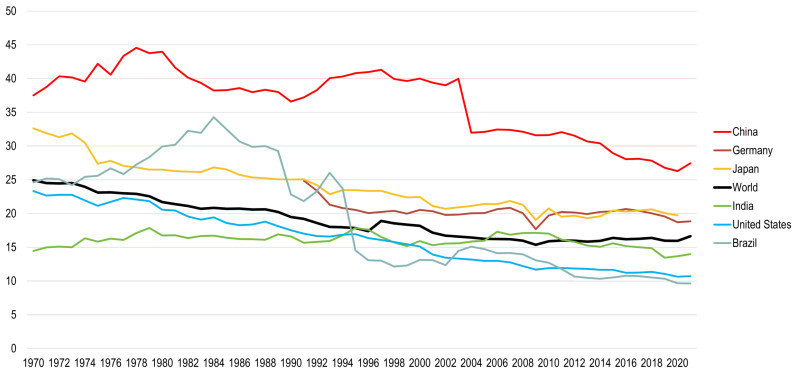
Changing shares of world manufacturing
The word relative matters. A falling share does not mean production totally stopped. It means industrial regions grew much faster.
- India kept producing textiles, iron, and ships, but British factory cloth undercut Indian handloom weaving. India increasingly exported raw cotton while Britain dominated finished cotton textiles. Shipyards at Bombay and Calcutta continued, but steam-powered iron and steel shipbuilding shifted advantage to Europe.
- Egypt under Muhammad Ali tried to build factories and a textile industry, but mechanized European competition was stronger. Egypt became more important as a raw cotton exporter.
- Southeast Asia kept shipbuilding and regional manufacturing traditions, but lost ground in the most advanced steamship sectors.
- Japan stands out as the major Asian exception because it built a substantial industrial base.
Uneven industrialization changed economic power first, then military power. That helps explain later imperialism and global inequality.
Key Takeaways
Belgian Industrialization
Europe’s earliest major industrialization outside Britain, based on coal, iron, textiles, machinery, and the adoption of British methods
French Industrialization
Gradual, geographically dispersed industrial growth in which mechanized production developed alongside enduring small workshops and artisanal manufacturing
German Industrialization
Rapid nineteenth-century industrial growth aided by commercial integration, railroads, and Ruhr coal and iron, making unified Germany a leading industrial power
Waltham-Lowell System
Massachusetts textile system that combined production stages in mechanized mills and employed young women housed in supervised boardinghouses
Industrialization in the United States
Factory production began chiefly in northeastern textiles and expanded through abundant resources, investment, immigration, transportation, and a growing national market
Industrialization in Russia
Late, regionally concentrated industrialization driven heavily by the state, foreign capital, railroads, and growth in coal, iron, textiles, and factories
Trans-Siberian Railroad
Russian railroad begun in 1891 to connect European Russia with Siberia and the Pacific, linking distant resources and industrial centers
Meiji Restoration
The 1868 political transformation after which Japanese leaders accelerated industrialization to strengthen Japan against Western pressure
Industrialization in Japan
Selective, state-supported adoption of Western machinery and expertise that developed textiles, railroads, shipyards, arsenals, and factories during the Meiji Era
Relative Decline in Manufacturing Share
A region produced a smaller percentage of growing world output because industrial economies expanded faster, even when its own manufacturing continued
Shipbuilding in India and Southeast Asia
Skilled wooden shipbuilding continued, but the industry lost relative position as steam-powered metal ships favored capital-intensive European and American yards
Indian Iron Production
Skilled small-scale ironworking persisted but was overshadowed by cheaper, high-volume European metal made with coal power, large furnaces, and factory systems
Indian Textile Production
A major hand-produced textile industry lost markets and global share to inexpensive British machine-made cloth, although specialized handloom weaving survived
Egyptian Textile Production
Egypt attempted factory production but struggled against mechanized European textiles and increasingly exported raw cotton rather than manufactured cloth
Putting-Out System
Merchants distributed raw materials to workers who completed production tasks in their homes
Factory System
Machinery and wage workers were concentrated under centralized supervision, with production divided into specialized tasks
Notes
Belgian Industrialization
Europe’s earliest major industrialization outside Britain, based on coal, iron, textiles, machinery, and the adoption of British methods
French Industrialization
Gradual, geographically dispersed industrial growth in which mechanized production developed alongside enduring small workshops and artisanal manufacturing
German Industrialization
Rapid nineteenth-century industrial growth aided by commercial integration, railroads, and Ruhr coal and iron, making unified Germany a leading industrial power
Waltham-Lowell System
Massachusetts textile system that combined production stages in mechanized mills and employed young women housed in supervised boardinghouses
Industrialization in the United States
Factory production began chiefly in northeastern textiles and expanded through abundant resources, investment, immigration, transportation, and a growing national market
Industrialization in Russia
Late, regionally concentrated industrialization driven heavily by the state, foreign capital, railroads, and growth in coal, iron, textiles, and factories
Trans-Siberian Railroad
Russian railroad begun in 1891 to connect European Russia with Siberia and the Pacific, linking distant resources and industrial centers
Meiji Restoration
The 1868 political transformation after which Japanese leaders accelerated industrialization to strengthen Japan against Western pressure
Industrialization in Japan
Selective, state-supported adoption of Western machinery and expertise that developed textiles, railroads, shipyards, arsenals, and factories during the Meiji Era
Relative Decline in Manufacturing Share
A region produced a smaller percentage of growing world output because industrial economies expanded faster, even when its own manufacturing continued
Shipbuilding in India and Southeast Asia
Skilled wooden shipbuilding continued, but the industry lost relative position as steam-powered metal ships favored capital-intensive European and American yards
Indian Iron Production
Skilled small-scale ironworking persisted but was overshadowed by cheaper, high-volume European metal made with coal power, large furnaces, and factory systems
Indian Textile Production
A major hand-produced textile industry lost markets and global share to inexpensive British machine-made cloth, although specialized handloom weaving survived
Egyptian Textile Production
Egypt attempted factory production but struggled against mechanized European textiles and increasingly exported raw cotton rather than manufactured cloth
Putting-Out System
Merchants distributed raw materials to workers who completed production tasks in their homes
Factory System
Machinery and wage workers were concentrated under centralized supervision, with production divided into specialized tasks
