Topic 1.2 Notes – Developments in Dar al-Islam from c. 1200 to c. 1450
What Dar al-Islam Was from c. 1200 to c. 1450
Dar al-Islam means the broader world shaped by Islam. By this period, it stretched across parts of North Africa, Southwest Asia, Central Asia, and into South Asia. You should picture a civilization zone, not a single state.
This map helps you see that spread and the trade routes that kept the Islamic world connected across many regions.
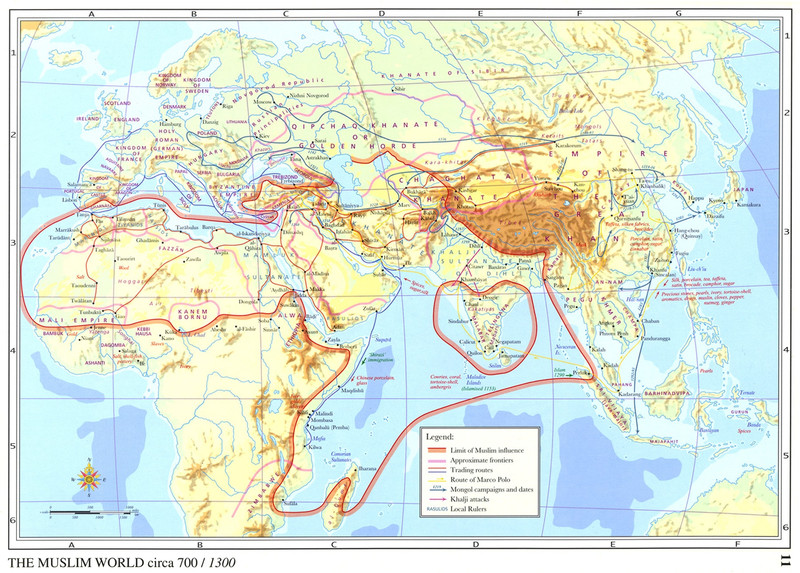
Dar al-Islam and major trade routes, c. 1200-1300
The biggest pattern is political fragmentation plus cultural unity. Abbasid power had weakened before 1200, and the Mongols destroyed Baghdad in 1258, ending Abbasid rule there. Even so, the Islamic world stayed connected through shared beliefs and institutions.
What held it together:
- Umma meant the worldwide community of believers.
- Quran and hadith gave the basis for belief and practice.
- The Five Pillars shaped daily life
- Shahada = declaration of faith
- Salat = prayer
- Zakat = charity
- Sawm = fasting during Ramadan
- Hajj = pilgrimage to Mecca
- Sharia was Islamic law as interpreted by scholars, so it was not one single law code everywhere.
- Ulama taught and interpreted religion, qadis served as judges, madrasas trained scholars, mosques anchored community life, and waqfs funded religious and public institutions.
Language also shows the mix of unity and diversity:
- Arabic was the language of scripture and major scholarship.
- Persian mattered in literature and administration.
- Turkic peoples became politically powerful as rulers and soldiers.
Islam shaped society through law, education, charity, pilgrimage, and rulership. A ruler gained legitimacy by presenting himself as a defender of Islam.
Women had recognized rights in Islamic law, including property ownership, inheritance, marriage contracts, and divorce in some cases. Actual practice still varied because these were patriarchal societies.
Diversity inside Islam
Islam was never completely uniform.
- Sunni and Shi'a Muslims split over who should lead the community after Muhammad.
- Sufism emphasized personal devotion and closeness to God through spiritual practice.
Sufism mattered a lot because it helped spread Islam through local relationships.
- Sufi orders formed around spiritual teachers.
- Sufi lodges gave people places for worship and teaching.
- Dhikr means devotional remembrance of God.
- Rumi is the classic example of a Sufi writer from this period.
Jews and Christians under Muslim rule
Jews and Christians were seen as People of the Book. Many lived as dhimmis, protected but subordinate non-Muslim communities who paid the jizya tax.
In Iberia, convivencia meant coexistence among Muslims, Christians, and Jews, but with limits. It was not full equality.
How Islamic States Changed after Abbasid Decline
As Abbasid power faded, new regional states rose. This happened because the empire was too large to control directly, provincial elites grew stronger, taxes and armies became regional, and Turkic military forces became central.
A major shift followed. The caliph kept symbolic religious importance, but the sultan usually held real political and military power.
There was both continuity and change:
| Continuity | Innovation |
|---|---|
| Islamic legitimacy | Turkic military elites |
| Sharia and taxation | Slave-soldier systems |
| Urban bureaucracy | Regional diversity in rule |
| Mosques and madrasas | Strong sultans over caliphs |
The Seljuks, Mamluks, and Delhi Sultanates
Seljuk states
The Seljuks were Sunni Turkic rulers who controlled Persia, Iraq, and nearby regions. They ruled in the Abbasid caliph's name but exercised actual power themselves as sultans. They used Persian bureaucrats and backed Sunni scholarship.
The Sultanate of Rum in Anatolia spread Muslim rule and Turkic settlement into former Byzantine lands. The Seljuks became a model for later states because they combined Turkic military power, Persian administration, and Islamic legitimacy.
Mamluk Sultanate
The Mamluks ruled Egypt and Syria from 1250 to 1517. Their elite came from mamluks, originally enslaved soldiers trained for military service and rule.
At the Battle of Ain Jalut in 1260, they stopped Mongol expansion into Egypt. After Baghdad fell, Cairo became a major political, trade, and intellectual center.
They also patronized mosques, madrasas, hospitals, and scholarship.
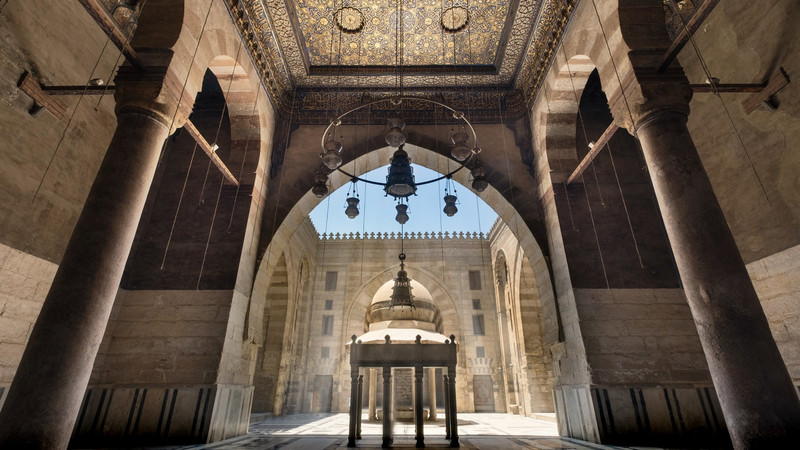
Mamluk religious complex in Cairo
Delhi Sultanates
The Delhi Sultanates were a series of Muslim dynasties ruling much of northern India from 1206 to 1526. They used cavalry, taxes, Persian administration, and fortified cities.
They ruled a Hindu-majority population, so Muslim rule did not produce instant mass conversion. Policies varied. Some rulers imposed jizya and destroyed temples in conquest, while others worked with Hindu officials and landholders.
This produced Indo-Islamic culture in language, architecture, and government.
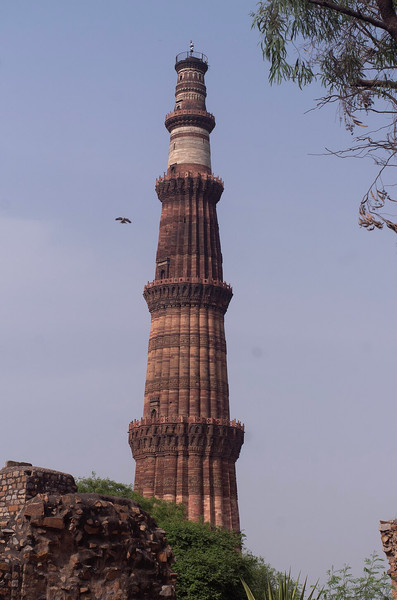
Qutb Minar, Delhi
How Islam Spread and How Ideas Moved
Islam spread through more than conquest. Muslim states expanded by war, but merchants, scholars, missionaries, and especially Sufis also spread the faith through trade, teaching, intermarriage, and community ties. This distinction shows up on tests all the time. Political control did not automatically mean conversion.
Dar al-Islam was also a learning network. Courts, libraries, madrasas, hospitals, observatories, and waqfs supported scholarship, and scholars traveled widely.
Important examples:
- House of Wisdom in Baghdad represents the earlier translation movement that preserved and commented on Greek science, philosophy, and medicine.
- Toledo in Muslim and Christian Spain became a major translation center from Arabic into Latin.
- Nasir al-Din al-Tusi at the Maragha observatory advanced math and astronomy, including the Tusi couple.
- Ibn al-Nafis described pulmonary circulation, correcting earlier medical ideas.
- Rumi shows devotional and literary creativity in this period.
- A'ishah al-Ba'uniyyah is a useful later example of that literary tradition, though she is slightly beyond this topic's main time frame.
The big effect is easy to miss. Dar al-Islam did not just preserve old knowledge. It combined, improved, and spread ideas across Afro-Eurasia.
Key Takeaways
Dar al-Islam
The “abode of Islam”: regions where Muslims ruled or Islamic institutions substantially shaped public life, not a single empire
Umma
The transregional community of Muslim believers, united by Islam despite living under different rulers
Five Pillars of Islam
Shahada, profession of faith; salat, five daily prayers; zakat, charitable giving; sawm, fasting during Ramadan; and hajj, pilgrimage to Mecca when able
Quran
Islam’s sacred scripture and a primary foundation of Muslim teaching and law
Hadith
Traditions recording Muhammad’s words and actions, used with the Quran as a foundation for teaching and law
Sharia
The ideal body of Islamic moral and legal principles interpreted from the Quran and hadith by legal scholars
Ulama
Learned Islamic scholars who interpreted religious law, taught, advised rulers, and sometimes served as judges
Qadi
A judge who applied Islamic legal principles to contracts, inheritance, marriage, and disputes
Madrasa
An institution of advanced learning, especially for Islamic law and related religious subjects
Waqf
A charitable endowment whose continuing revenue supported institutions such as mosques, madrasas, hospitals, and fountains
Sunni–Shiʿa Division
The division originating in disagreement over legitimate leadership after Muhammad, with continuing religious and political importance
Sufism
Islam’s mystical and devotional tradition, emphasizing closeness to God and helping spread Islam through adaptable teaching and Sufi communities
Tariqa
An organized Sufi order or spiritual path formed around a teacher and a chain of spiritual authority
Jalal al-Din Rumi
Thirteenth-century Sufi poet in Anatolia whose Persian works explored divine love, longing, and union with God
People of the Book
The Islamic designation for Jews and Christians as followers of earlier monotheistic scriptures
Dhimmi
A Jew or Christian granted protected but subordinate status under Muslim rule while retaining communal religious institutions
Jizya
A tax generally imposed on adult non-Muslim men in exchange for protected status under Muslim government
Convivencia
The limited coexistence and shared culture of Muslims, Christians, and Jews in medieval Iberia, without continuous equality or tolerance
Abbasid Caliphate
The Baghdad-based caliphate whose political authority fragmented into regional states while its caliphs retained symbolic prestige
Caliph vs. Sultan
A caliph claimed leadership of the Muslim community, while a sultan held practical political and military power
Mongol Sack of Baghdad
The Mongol capture and destruction of Baghdad in 1258, ending the Abbasid caliphate there but not Islamic civilization
Seljuk States
Sunni Turkic states that used Persian administrators, supported madrasas, and left practical authority to sultans while honoring the Abbasid caliph
Seljuk Sultanate of Rum
A Seljuk successor state in Anatolia that encouraged Muslim rule and Turkic settlement in former Byzantine lands
Mamluk
A military slave, commonly of Turkic or Circassian origin, converted and trained as an elite Muslim soldier and often later manumitted
Mamluk Sultanate
The military-elite state that ruled Egypt and Syria from 1250 to 1517 and made Cairo a major Islamic center
Battle of Ain Jalut
The Mamluk victory over a Mongol force in Palestine in 1260, checking expansion toward Egypt and strengthening Mamluk legitimacy
Delhi Sultanates
Successive Muslim dynasties that ruled much of northern India from 1206 to 1526 using military expansion and Persian administrative practices
Indo-Islamic Culture
The synthesis of Islamic and South Asian traditions in language, architecture, literature, administration, and religion, exemplified by the Qutb Minar complex
Nasir al-Din al-Tusi
Persian mathematician and astronomer who directed the Maragha observatory, advanced trigonometry, and devised the Tusi couple
Tusi Couple
Al-Tusi’s geometric model using one rotating circle inside another to generate linear motion from circular movements
Bimaristan
An Islamic hospital that could include wards, pharmacies, medical teaching, and charitable care, often supported by a waqf
Ibn al-Nafis
Physician who described pulmonary circulation and rejected Galen’s claim that blood passed through invisible pores between the heart’s ventricles
ʿAʾishah al-Baʿuniyyah
Highly educated Arab woman and Sufi author whose late fifteenth- and early sixteenth-century poetry and prose explored mystical love and devotion
Scholarly and Cultural Transfers in Muslim and Christian Spain
Multilingual translation in Iberia transmitted Arabic versions of Greek works and original Muslim and Jewish scholarship to Latin-reading Europe
Notes
Dar al-Islam
The “abode of Islam”: regions where Muslims ruled or Islamic institutions substantially shaped public life, not a single empire
Umma
The transregional community of Muslim believers, united by Islam despite living under different rulers
Five Pillars of Islam
Shahada, profession of faith; salat, five daily prayers; zakat, charitable giving; sawm, fasting during Ramadan; and hajj, pilgrimage to Mecca when able
Quran
Islam’s sacred scripture and a primary foundation of Muslim teaching and law
Hadith
Traditions recording Muhammad’s words and actions, used with the Quran as a foundation for teaching and law
Sharia
The ideal body of Islamic moral and legal principles interpreted from the Quran and hadith by legal scholars
Ulama
Learned Islamic scholars who interpreted religious law, taught, advised rulers, and sometimes served as judges
Qadi
A judge who applied Islamic legal principles to contracts, inheritance, marriage, and disputes
Madrasa
An institution of advanced learning, especially for Islamic law and related religious subjects
Waqf
A charitable endowment whose continuing revenue supported institutions such as mosques, madrasas, hospitals, and fountains
Sunni–Shiʿa Division
The division originating in disagreement over legitimate leadership after Muhammad, with continuing religious and political importance
Sufism
Islam’s mystical and devotional tradition, emphasizing closeness to God and helping spread Islam through adaptable teaching and Sufi communities
Tariqa
An organized Sufi order or spiritual path formed around a teacher and a chain of spiritual authority
Jalal al-Din Rumi
Thirteenth-century Sufi poet in Anatolia whose Persian works explored divine love, longing, and union with God
People of the Book
The Islamic designation for Jews and Christians as followers of earlier monotheistic scriptures
Dhimmi
A Jew or Christian granted protected but subordinate status under Muslim rule while retaining communal religious institutions
Jizya
A tax generally imposed on adult non-Muslim men in exchange for protected status under Muslim government
Convivencia
The limited coexistence and shared culture of Muslims, Christians, and Jews in medieval Iberia, without continuous equality or tolerance
Abbasid Caliphate
The Baghdad-based caliphate whose political authority fragmented into regional states while its caliphs retained symbolic prestige
Caliph vs. Sultan
A caliph claimed leadership of the Muslim community, while a sultan held practical political and military power
Mongol Sack of Baghdad
The Mongol capture and destruction of Baghdad in 1258, ending the Abbasid caliphate there but not Islamic civilization
Seljuk States
Sunni Turkic states that used Persian administrators, supported madrasas, and left practical authority to sultans while honoring the Abbasid caliph
Seljuk Sultanate of Rum
A Seljuk successor state in Anatolia that encouraged Muslim rule and Turkic settlement in former Byzantine lands
Mamluk
A military slave, commonly of Turkic or Circassian origin, converted and trained as an elite Muslim soldier and often later manumitted
Mamluk Sultanate
The military-elite state that ruled Egypt and Syria from 1250 to 1517 and made Cairo a major Islamic center
Battle of Ain Jalut
The Mamluk victory over a Mongol force in Palestine in 1260, checking expansion toward Egypt and strengthening Mamluk legitimacy
Delhi Sultanates
Successive Muslim dynasties that ruled much of northern India from 1206 to 1526 using military expansion and Persian administrative practices
Indo-Islamic Culture
The synthesis of Islamic and South Asian traditions in language, architecture, literature, administration, and religion, exemplified by the Qutb Minar complex
Nasir al-Din al-Tusi
Persian mathematician and astronomer who directed the Maragha observatory, advanced trigonometry, and devised the Tusi couple
Tusi Couple
Al-Tusi’s geometric model using one rotating circle inside another to generate linear motion from circular movements
Bimaristan
An Islamic hospital that could include wards, pharmacies, medical teaching, and charitable care, often supported by a waqf
Ibn al-Nafis
Physician who described pulmonary circulation and rejected Galen’s claim that blood passed through invisible pores between the heart’s ventricles
ʿAʾishah al-Baʿuniyyah
Highly educated Arab woman and Sufi author whose late fifteenth- and early sixteenth-century poetry and prose explored mystical love and devotion
Scholarly and Cultural Transfers in Muslim and Christian Spain
Multilingual translation in Iberia transmitted Arabic versions of Greek works and original Muslim and Jewish scholarship to Latin-reading Europe
