Topic 9.6 Notes – Globalized Culture After 1900
What Globalized Culture Was After 1900
Cultural globalization means the rapid cross-border spread of art, entertainment, information, sports, brands, and consumer habits. The main change was not that exchange suddenly began. Exchange had existed for centuries. The change was speed, scale, mass audiences, and commercial distribution.
A few forces worked together:
- Radio, records, and film let the same songs and stories reach huge audiences.
- Television and satellites carried news and entertainment across borders.
- Air travel and container shipping moved performers, products, and media quickly.
- Multinational corporations and global advertising sold similar goods and lifestyles in many countries.
- Internet, cell phones, and social media made cultural exchange instant and interactive.
The timeline matters:
- Early to mid-1900s: cinema, radio, recorded music, and print created mass culture.
- After 1945: television, commercial aviation, and growing trade widened global reach.
- Late 1900s to early 2000s: internet, social media, and digital commerce sped everything up.
One AP trap here is thinking globalization made everyone the same. It created shared reference points, but people still adapted global culture to local tastes. That mix is called hybridity.
How Political and Social Change Reshaped the Arts
The violence and upheaval of the 20th century changed both what artists made and how they made it. World wars, revolutions, decolonization, migration, urbanization, industrialization, and struggles over race, gender, and national identity pushed artists away from simple realism and heroic praise of rulers.
Guernica
Pablo Picasso’s Guernica shows this shift clearly.
- Painted in 1937 after the bombing of Guernica during the Spanish Civil War
- Uses distorted, broken figures to show terror and suffering
- Became an international antiwar symbol
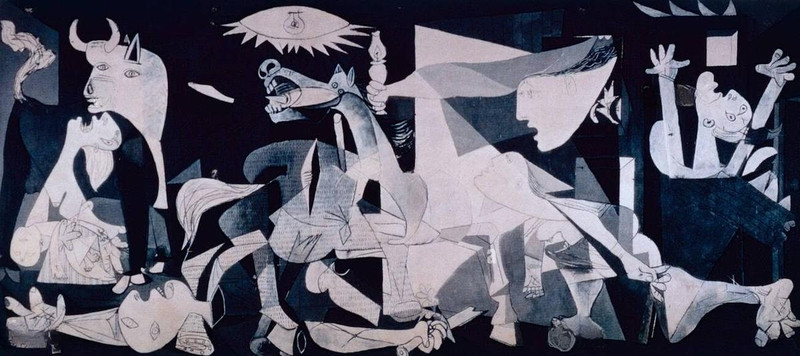
Picasso, Guernica (1937)
In the painting, the fractured human and animal figures turn a specific wartime attack into a broader image of chaos, pain, and destruction.
You should recognize movement names like Cubism, Dadaism, and Abstract Expressionism, but the bigger point is that modern art often used experimentation, fragmentation, and critique to respond to crisis.
Decolonization and migration also widened global audiences. African, Asian, Caribbean, Latin American, and Indigenous cultural forms reached more people. During the Cold War, governments used culture as soft power through broadcasts, tours, arts funding, and sports prestige.
Forms of Global Popular Culture
Popular culture became global through media networks, migration, and mass audiences.
Music
Reggae is the key example.
- Developed in Jamaica in the late 1960s
- Connected to poverty, colonialism, independence, racial identity, and Rastafari
- Bob Marley became its best-known global figure
- Spread through records, radio, migration, touring, and music companies
Reggae matters because it shows culture also moved outward from the Caribbean, not just from Western powers.
Film and broadcasting
Bollywood is the Hindi-language commercial film industry centered in Mumbai.
- Reached South Asia, diaspora communities, the Middle East, Africa, and beyond
- Mixed local languages, music, dance, and family themes with global film technology
- Proves globalization was multidirectional, not just Hollywood taking over
BBC broadcasting spread shared news and entertainment across borders, but it also projected British influence.
Social media and sports
Facebook and Twitter made communication many-to-many. Users themselves spread images, trends, music, commentary, and products in real time. They also tied culture closely to advertising.
World Cup soccer and the Olympics became global spectacles. Broadcasts, sponsorships, tourism, and merchandise built huge audiences, yet these events also strengthened national identity.
Global Consumer Culture
Consumer culture means people express identity, status, and lifestyle through buying things. After 1900, branding, trade, and advertising made this global.
| Example | Why it matters |
|---|---|
| Toyota | Japanese global brand; shows consumerism was not only American or European |
| Coca-Cola | Symbol of American commercial reach, but marketed in local languages and settings |
| Alibaba | Chinese e-commerce giant linking buyers and sellers across borders |
| eBay | Online marketplace making global buying and selling easier |
Products carried meanings beyond use:
- Toyota could signal reliability and middle-class modern life.
- Coca-Cola could signal youth, leisure, or American-style branding.
- Alibaba and eBay turned digital trends into actual purchases through payment systems, shipping, and supply chains.
What Globalization Changed and What Stayed Different
Culture after 1900 crossed borders more quickly, reached larger audiences, and became more commercialized. That is the big change.
The continuity is that local, national, religious, and linguistic identities stayed powerful. Globalization sometimes caused homogenization, but AP World usually pushes harder on adaptation and hybridity.
The best examples of multidirectional exchange are reggae, Bollywood, and Toyota. They show global culture was interconnected, but it was not simply Westernization.
Key Takeaways
Cultural Globalization
The increasingly rapid, large-scale movement of art, entertainment, information, lifestyles, and consumer practices across national and regional boundaries
Soft Power
Influence gained through cultural attraction and prestige rather than military force or economic coercion
Reggae
Jamaican music originating in the late 1960s that spread globally through records, radio, migration, touring, and performers such as Bob Marley
Bollywood
The Hindi-language commercial film industry centered in Mumbai, combining South Asian conventions with global cinema technology and distribution
British Broadcasting Corporation (BBC)
A major British broadcaster whose international radio and television services carried news, entertainment, and cultural programming across national borders
Social Media
Digital platforms enabling participatory, many-to-many communication in which users circulate content and cultural trends across borders
A social media platform that enabled users to form networks and circulate images, videos, products, and cultural trends internationally
Twitter (X)
A social media platform, renamed X in 2023, that enabled users to discuss events and circulate content and trends across borders in real time
FIFA World Cup
A global soccer tournament first held in 1930 that combines mass broadcasting, national identity, international audiences, sponsorship, tourism, and merchandise
Modern Olympic Games
International games begun in 1896 that became globally televised competition among state representatives and displays of national prestige
Global Consumer Culture
A transnational environment in which widely recognized products, brands, advertisements, and purchases express identity, status, taste, and lifestyle
Toyota
A Japanese automobile manufacturer whose worldwide sales and production networks made it a global brand associated with reliability and modern consumer life
Coca-Cola
A globally recognizable American beverage brand spread through bottling, advertising, sponsorships, distribution networks, and locally adapted marketing
Online Commerce (E-Commerce)
The advertising, ordering, and payment for goods and services through digital networks, linking distant consumers and sellers
eBay
A United States–founded digital marketplace connecting buyers and sellers, including individuals and small businesses, across local and national boundaries
Alibaba
A company founded in China that developed online platforms linking consumers, retailers, producers, and wholesalers
Cultural Convergence
The growth of shared cultural reference points as people in distant societies recognize many of the same brands, athletes, media, and performers
Cultural Homogenization
The apparent reduction of cultural differences as similar products, media, and practices spread among societies
Cultural Hybridity
The combination of imported and local cultural forms, such as global production methods joined with local languages, traditions, or tastes
Pablo Picasso
Modern artist who used experimental forms to respond to political violence, most notably in Guernica
Guernica
Picasso’s 1937 painting using distorted figures to convey the suffering and terror caused by the bombing of Guernica
Popular Culture
Entertainment, styles, practices, and cultural products consumed by broad publics rather than only by social elites
Mass Culture
Cultural material made available to very large audiences through industrial production and mass media
Notes
Cultural Globalization
The increasingly rapid, large-scale movement of art, entertainment, information, lifestyles, and consumer practices across national and regional boundaries
Soft Power
Influence gained through cultural attraction and prestige rather than military force or economic coercion
Reggae
Jamaican music originating in the late 1960s that spread globally through records, radio, migration, touring, and performers such as Bob Marley
Bollywood
The Hindi-language commercial film industry centered in Mumbai, combining South Asian conventions with global cinema technology and distribution
British Broadcasting Corporation (BBC)
A major British broadcaster whose international radio and television services carried news, entertainment, and cultural programming across national borders
Social Media
Digital platforms enabling participatory, many-to-many communication in which users circulate content and cultural trends across borders
A social media platform that enabled users to form networks and circulate images, videos, products, and cultural trends internationally
Twitter (X)
A social media platform, renamed X in 2023, that enabled users to discuss events and circulate content and trends across borders in real time
FIFA World Cup
A global soccer tournament first held in 1930 that combines mass broadcasting, national identity, international audiences, sponsorship, tourism, and merchandise
Modern Olympic Games
International games begun in 1896 that became globally televised competition among state representatives and displays of national prestige
Global Consumer Culture
A transnational environment in which widely recognized products, brands, advertisements, and purchases express identity, status, taste, and lifestyle
Toyota
A Japanese automobile manufacturer whose worldwide sales and production networks made it a global brand associated with reliability and modern consumer life
Coca-Cola
A globally recognizable American beverage brand spread through bottling, advertising, sponsorships, distribution networks, and locally adapted marketing
Online Commerce (E-Commerce)
The advertising, ordering, and payment for goods and services through digital networks, linking distant consumers and sellers
eBay
A United States–founded digital marketplace connecting buyers and sellers, including individuals and small businesses, across local and national boundaries
Alibaba
A company founded in China that developed online platforms linking consumers, retailers, producers, and wholesalers
Cultural Convergence
The growth of shared cultural reference points as people in distant societies recognize many of the same brands, athletes, media, and performers
Cultural Homogenization
The apparent reduction of cultural differences as similar products, media, and practices spread among societies
Cultural Hybridity
The combination of imported and local cultural forms, such as global production methods joined with local languages, traditions, or tastes
Pablo Picasso
Modern artist who used experimental forms to respond to political violence, most notably in Guernica
Guernica
Picasso’s 1937 painting using distorted figures to convey the suffering and terror caused by the bombing of Guernica
Popular Culture
Entertainment, styles, practices, and cultural products consumed by broad publics rather than only by social elites
Mass Culture
Cultural material made available to very large audiences through industrial production and mass media
