Topic 2.2 Notes – The Mongol Empire and the Making of the Modern World
How the Mongols Built an Empire
The Mongols came from the Inner Asian steppe, where life centered on herding, horses, and mobility. That mattered because steppe warfare rewarded speed, endurance, and horseback archery. Mongol riders used composite bows, could travel long distances fast, and often brought multiple horses.
At its height, that steppe empire stretched across much of Eurasia, linking East Asia, Central Asia, the Middle East, and parts of eastern Europe.
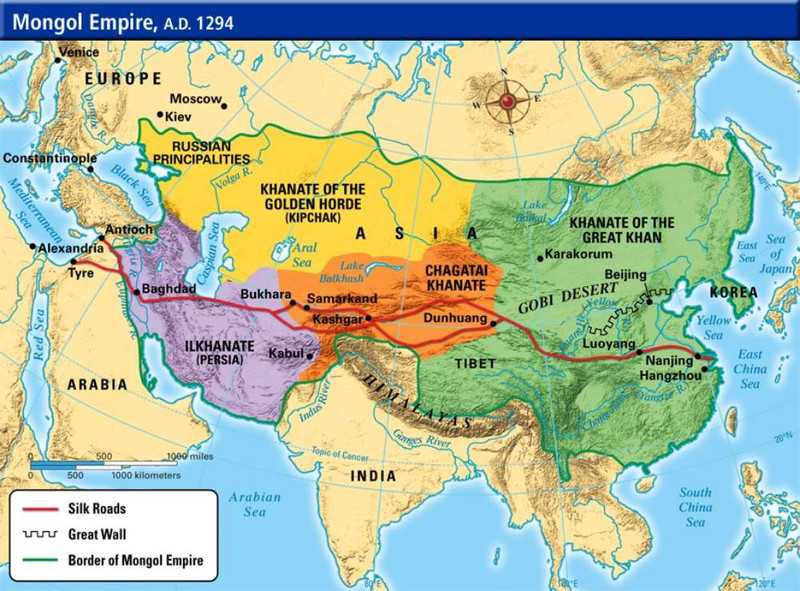
Mongol Empire across Eurasia, c. 1294
Temujin turned this military potential into a state. In 1206, a kurultai recognized him as Chinggis Khan. He broke old clan loyalties and rewarded loyalty and military skill, so people rose by merit, not just family rank.
The decimal system organized both the army and the empire:
- 10
- 100
- 1,000
- tümen = 10,000
This mixed tribes together and made soldiers answer to commanders loyal to the khan.
Conquest methods
Mongol conquest worked in a pretty clear sequence:
- Scout and gather intelligence so they knew enemy numbers, terrain, and weak points.
- Attack fast with cavalry, often from several directions.
- Use feigned retreat to lure enemies into disorder.
- Bring in Chinese, Persian, and Central Asian engineers for siege warfare against cities.
- Offer a choice: surrender and pay tribute or resist and face massacre and destruction.
The Yassa was their body of rulings about discipline, loyalty, and order. Think of it less as one neat law code and more as shared rules that helped unify the empire.
Key conquests replaced older states:
- Jin state in northern China
- Khwarazmian Empire in Central Asia and Persia
- Rus’ principalities under Batu Khan
- Baghdad destroyed by Hülegü in 1258, ending Abbasid power there
- Song China conquered by Kublai Khan in 1279
Mongol expansion had limits. The Mamluks stopped them at ʿAyn Jalut in 1260, and invasions of Japan failed in 1274 and 1281.
The Four Khanates
After Chinggis Khan, one empire split into four major khanates. Same Mongol roots, different local styles of rule.
| Khanate | Region | Key features | Decline |
|---|---|---|---|
| Yuan dynasty | China | Kublai Khan founded it in 1271; used Chinese institutions but kept Mongol privilege; welcomed foreign merchants and officials | Factionalism, inflation, disasters, epidemics, rebellion; overthrown by Zhu Yuanzhang in 1368 |
| Ilkhanate | Persia and Iraq | Founded by Hülegü; used Persian bureaucrats; Ghazan converted to Islam in 1295; Rashid al-Din wrote a universal history | Broke apart after Abu Saʿid died in 1335 |
| Golden Horde | Steppe north of Black and Caspian Seas | Ruled the Rus’ indirectly through tribute; protected the Russian Orthodox Church; Moscow gained power as tribute collector | Fragmented; Muscovy ended regular submission in 1480 |
| Chagatai Khanate | Central Asia | Sat on major overland trade routes; kept steppe traditions longer; gradual Turkic influence and Islamization | Weakened by internal division and succession conflict |
How Mongol Rule Expanded Trade and Communication
The Pax Mongolica means relative security across much of Eurasia. It does not mean constant peace. Wars still happened, but trade became easier because related Mongol states controlled so much territory.
The Mongols promoted trade for practical reasons:
- luxury goods for courts
- taxes and customs revenue
- supplies for the empire
They supported exchange by protecting roads, punishing banditry, maintaining bridges and stations, giving merchants privileges, backing ortogh partnerships between merchants and Mongol elites, and using translators and diplomats.
The yam relay system
The yam was a relay network with stations that provided fresh horses, food, and lodging. It carried orders, intelligence, and official travelers quickly across long distances. Built for government, it also helped merchants and envoys.
The key continuity-and-change idea is this: the Mongols did not create the Silk Roads. They made existing routes safer, more connected, and busier.
Cultural Transfers and Why the Mongols Matter
Conquest moved people across Eurasia. Merchants, envoys, artisans, engineers, physicians, astronomers, and scribes all traveled under Mongol rule.
The Uyghur script shows how conquest drove borrowing. The Mongols adopted and adapted Uyghur writing for administration and diplomacy.
Important transfers you should know:
- Greco-Islamic medical knowledge reached western Europe through wider Eurasian contact. Names to know are Hippocrates, Galen, Ibn Sina (Avicenna), and the Canon of Medicine.
- Numbering systems spread further into Europe. Know Hindu-Arabic numerals, zero, and Fibonacci’s Liber Abaci.
- Other examples include astronomy, cartography, papermaking, printing knowledge, and gunpowder technologies.
The empire declined because of succession disputes, huge distances, local adaptation, wars among khanates, rebellions, fiscal problems, and the Black Death. On tests, remember the Black Death was a factor, not the only cause.
Key Takeaways
Pastoral Nomadism
Mobile herding lifestyle of the Mongolian steppe that produced skilled horsemen and supported fast-moving armies
Temujin / Chinggis Khan / Genghis Khan
Leader who unified the Mongol tribes, took the title Chinggis Khan in 1206, and founded the Mongol Empire
Kurultai
Assembly of Mongol leaders that selected khans, including Temujin as Chinggis Khan in 1206
Mongol Decimal Military System
Organization of warriors into units of 10, 100, 1,000, and tümen of about 10,000, mixing tribes under disciplined commanders
Yassa / Yasa
Commands and customary rulings associated with Chinggis Khan that promoted discipline and common obligations, not a surviving complete written code
Mongol Empire
Largest contiguous land empire in history, founded in 1206 and expanded across Eurasia before dividing into khanates
Fall of Baghdad
Hülegü’s 1258 capture of Baghdad, which ended the Abbasid caliphate there as a functioning territorial government
Battle of ʿAyn Jalut
1260 Mamluk victory over a Mongol army in Palestine that checked Mongol expansion toward Egypt
Khanate
Territory ruled by a khan; the Mongol Empire divided into four major khanates during the later thirteenth century
Yuan Dynasty
Mongol dynasty founded by Kublai Khan that ruled China from 1271 until its overthrow by the Ming in 1368
Kublai Khan
Grandson of Chinggis Khan who founded the Yuan dynasty and completed the Mongol conquest of Song China in 1279
Zhu Yuanzhang
Rebel leader who captured the Yuan capital in 1368, founded the Ming dynasty, and ended Yuan rule over China
Ming Dynasty
Chinese dynasty founded by Zhu Yuanzhang in 1368 after the overthrow of the Mongol Yuan dynasty
Ilkhanate
Mongol khanate in Persia and Iraq that used Persian administrators and gradually adopted Persian culture and Islam
Hülegü
Grandson of Chinggis Khan who conquered Baghdad in 1258 and established Mongol rule in Persia and Iraq
Ghazan
Ilkhan who converted to Islam in 1295, illustrating Mongol adaptation to the culture of their Persian subjects
Golden Horde
Mongol khanate that dominated the Rus’ principalities through indirect rule, tribute, and confirmation of local princes
Batu Khan
Grandson of Chinggis Khan whose conquests in Russia and eastern Europe created the basis of the Golden Horde
Chagatai Khanate
Central Asian Mongol khanate that controlled important overland routes and later divided amid succession and nomadic-settled tensions
Mongol Religious Tolerance
Pragmatic protection and patronage of multiple religions to reduce resistance and recruit useful officials and specialists
Pax Mongolica
“Mongol Peace,” the relative security and political integration that encouraged Eurasian trade and travel in the thirteenth and early fourteenth centuries
Ortogh Partnerships
Merchant associations in which Mongol elites financed long-distance traders and shared in their profits
Yam
Mongol imperial relay system whose stations supplied authorized messengers with fresh horses, food, and lodging
Uyghur Script
Central Asian writing system adapted vertically for Mongolian to record decrees, diplomacy, administration, and political traditions
Greco-Islamic Medical Knowledge
Greek medicine preserved and expanded by Islamic scholars whose wider circulation was reinforced, but not begun, by Mongol-era contacts
Hindu-Arabic Numerals
Indian decimal place-value numerals, including zero, spread through Islamic and European networks whose circulation Mongol-era integration reinforced
Fragmentation of the Mongol Empire
Gradual division caused by succession disputes, vast distances, regional adaptation, rival khanates, rebellions, fiscal problems, and disease
Black Death
Fourteenth-century pandemic that weakened Mongol states by reducing populations and revenue and disrupting commerce and political stability
Mongol Invasions of Japan
Failed Mongol invasions in 1274 and 1281 that demonstrated the limits of Mongol warfare in difficult maritime conditions
Notes
Pastoral Nomadism
Mobile herding lifestyle of the Mongolian steppe that produced skilled horsemen and supported fast-moving armies
Temujin / Chinggis Khan / Genghis Khan
Leader who unified the Mongol tribes, took the title Chinggis Khan in 1206, and founded the Mongol Empire
Kurultai
Assembly of Mongol leaders that selected khans, including Temujin as Chinggis Khan in 1206
Mongol Decimal Military System
Organization of warriors into units of 10, 100, 1,000, and tümen of about 10,000, mixing tribes under disciplined commanders
Yassa / Yasa
Commands and customary rulings associated with Chinggis Khan that promoted discipline and common obligations, not a surviving complete written code
Mongol Empire
Largest contiguous land empire in history, founded in 1206 and expanded across Eurasia before dividing into khanates
Fall of Baghdad
Hülegü’s 1258 capture of Baghdad, which ended the Abbasid caliphate there as a functioning territorial government
Battle of ʿAyn Jalut
1260 Mamluk victory over a Mongol army in Palestine that checked Mongol expansion toward Egypt
Khanate
Territory ruled by a khan; the Mongol Empire divided into four major khanates during the later thirteenth century
Yuan Dynasty
Mongol dynasty founded by Kublai Khan that ruled China from 1271 until its overthrow by the Ming in 1368
Kublai Khan
Grandson of Chinggis Khan who founded the Yuan dynasty and completed the Mongol conquest of Song China in 1279
Zhu Yuanzhang
Rebel leader who captured the Yuan capital in 1368, founded the Ming dynasty, and ended Yuan rule over China
Ming Dynasty
Chinese dynasty founded by Zhu Yuanzhang in 1368 after the overthrow of the Mongol Yuan dynasty
Ilkhanate
Mongol khanate in Persia and Iraq that used Persian administrators and gradually adopted Persian culture and Islam
Hülegü
Grandson of Chinggis Khan who conquered Baghdad in 1258 and established Mongol rule in Persia and Iraq
Ghazan
Ilkhan who converted to Islam in 1295, illustrating Mongol adaptation to the culture of their Persian subjects
Golden Horde
Mongol khanate that dominated the Rus’ principalities through indirect rule, tribute, and confirmation of local princes
Batu Khan
Grandson of Chinggis Khan whose conquests in Russia and eastern Europe created the basis of the Golden Horde
Chagatai Khanate
Central Asian Mongol khanate that controlled important overland routes and later divided amid succession and nomadic-settled tensions
Mongol Religious Tolerance
Pragmatic protection and patronage of multiple religions to reduce resistance and recruit useful officials and specialists
Pax Mongolica
“Mongol Peace,” the relative security and political integration that encouraged Eurasian trade and travel in the thirteenth and early fourteenth centuries
Ortogh Partnerships
Merchant associations in which Mongol elites financed long-distance traders and shared in their profits
Yam
Mongol imperial relay system whose stations supplied authorized messengers with fresh horses, food, and lodging
Uyghur Script
Central Asian writing system adapted vertically for Mongolian to record decrees, diplomacy, administration, and political traditions
Greco-Islamic Medical Knowledge
Greek medicine preserved and expanded by Islamic scholars whose wider circulation was reinforced, but not begun, by Mongol-era contacts
Hindu-Arabic Numerals
Indian decimal place-value numerals, including zero, spread through Islamic and European networks whose circulation Mongol-era integration reinforced
Fragmentation of the Mongol Empire
Gradual division caused by succession disputes, vast distances, regional adaptation, rival khanates, rebellions, fiscal problems, and disease
Black Death
Fourteenth-century pandemic that weakened Mongol states by reducing populations and revenue and disrupting commerce and political stability
Mongol Invasions of Japan
Failed Mongol invasions in 1274 and 1281 that demonstrated the limits of Mongol warfare in difficult maritime conditions
