Topic 5.10 Notes – Continuity and Change in the Industrial Age
What Changed and What Stayed the Same from 1750 to 1900
To judge change, you need the 1750 baseline. Most people lived in villages, farmed for a living, and relied on human labor, animal power, wood, wind, and water. Manufacturing usually happened through artisans, household production, or the putting-out system, where merchants gave raw materials to rural families who made goods at home.
Industrialization did not appear out of nowhere. Industrial capitalism grew from older commercial capitalism, which already had merchants, banks, overseas trade, and investment.
The best overall argument is this:
- Major changes happened in production, energy, transportation, communication, and political ideas.
- Major continuities remained in inequality, patriarchy, empire, and the importance of rural agriculture.
- The strongest thesis wording is “extensive but uneven change” or “change layered onto continuity.”
How Industrialization Reshaped Production and Daily Life
Industrialization changed how goods were made and how people worked every day. A textile mill like this one captures several of the biggest shifts at once, including mechanized production, centralized workplaces, and closely supervised wage labor.
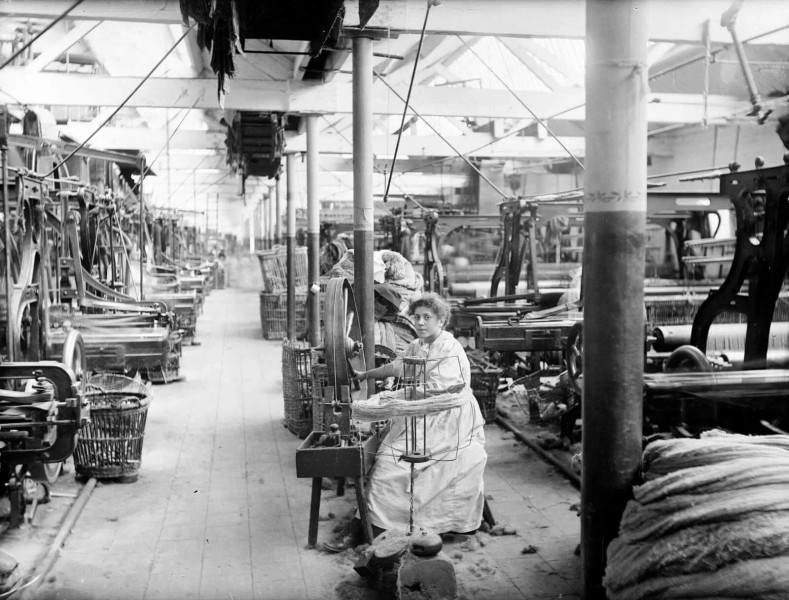
Nineteenth-century textile mill interior
Transformation of production
- The factory system brought workers and machines into one place under centralized management. That meant stricter schedules, close supervision, and less independence than artisan work.
- Wage labor became more important because workers were paid for their labor instead of owning the tools or product.
- Mechanized textile production is the classic example. Spinning and weaving cloth moved from homes and small workshops into mills.
- Manchester became the standard example of an industrial city built on textile factories.
Transformation of energy
- The huge shift was from biological energy to fossil fuels, especially coal powering steam engines.
- Later in the 1800s, industry added oil, steel, chemicals, electricity, and the internal combustion engine.
Industrial capitalism
- It combined private ownership, investment, profit motive, wage labor, and mechanized production.
- Limited-liability corporations and bigger financial institutions pooled capital and lowered investor risk, which helped businesses grow much larger.
Standards of living and limits
- Machine-made goods became more available and cheaper. Textiles, metal goods, and household items reached wider markets.
- The middle class benefited most clearly.
- Workers often faced long hours, low wages, dangerous conditions, child labor, slums, and pollution.
- Total wealth grew, but it was not distributed equally.
- Artisans, small producers, and agriculture still survived beside factories.
How Railroads, Steamships, and Telegraphs Connected the World
These technologies made distance matter less and helped states and empires reach farther. This kind of world map helps you see how rail lines, steamship routes, and telegraph cables tied continents together into a tighter global network.
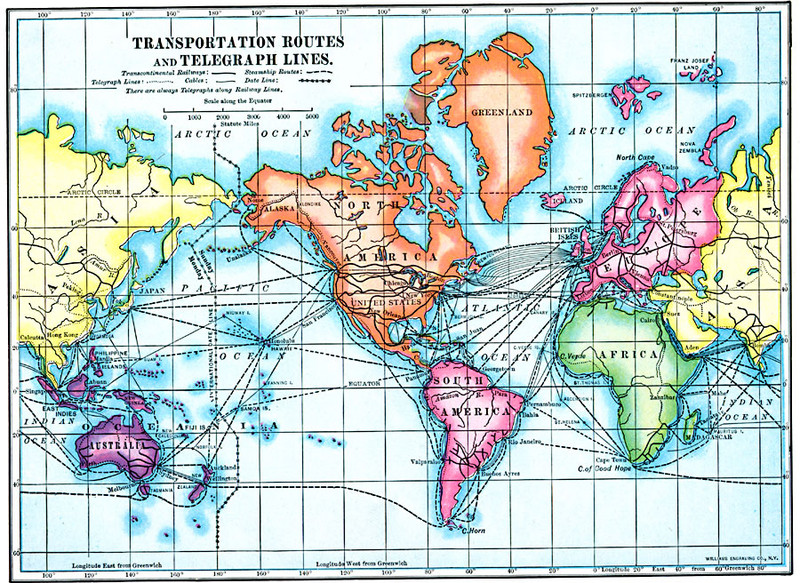
Global transportation routes and telegraph lines
- Railroads moved people and goods faster and more reliably. They linked mines, farms, plantations, factories, cities, and ports. In British India, railroads connected interior producers to port cities and also helped colonial extraction.
- Steamships made river and ocean travel faster and more regular, reduced transport costs, and increased migration and trade.
- The telegraph was a major turning point because communication could move faster than transportation for the first time. Governments, merchants, and military leaders could coordinate across long distances. Submarine cables linked global markets.
Major effects:
- more trade, migration, and settlement
- stronger state control of interior regions
- stronger empires
Continuities stayed too. Geography still mattered, infrastructure was expensive and uneven, and older local transport methods continued.
New Social Classes, Old Inequalities
Industrialization created new classes, but old hierarchies did not disappear.
- The middle class grew and included industrialists, managers, professionals, engineers, and merchants.
- The proletariat was the industrial working class dependent on wages.
- In Marxist language, this is bourgeoisie vs proletariat.
Responses to industrial society
- Workers formed labor unions, mutual-aid societies, reform movements, and socialist parties.
- Karl Marx argued that history moves through class conflict and that capitalism pits owners against workers.
Urbanization and gender
Cities grew rapidly around factory jobs, which brought overcrowding, disease, and poor sanitation. Later governments passed reforms such as sanitation projects, housing rules, and labor laws.
Women and children often worked for wages. Middle-class families promoted the idea of separate spheres, where men belonged in public work and women in the home. Patriarchy stayed strong.
Key feminist challenges you should know:
- Mary Wollstonecraft
- Olympe de Gouges
- Seneca Falls Convention (1848)
Social mobility increased for some, but class inequality and patriarchy remained deeply rooted.
Enlightenment, Revolutions, Nationalism, and the Limits of Political Change
Political change reshaped ideas of government, even though older power systems survived.
Enlightenment ideas
Thinkers used reason, empiricism, natural rights, and the social contract to challenge old authority.
Key names:
- John Locke
- Jean-Jacques Rousseau
- Montesquieu
Atlantic revolutions and new states
- American Revolution
- French Revolution
- Haitian Revolution
- Latin American independence movements with Simón Bolívar
Political legitimacy became tied more to citizens, constitutions, and popular sovereignty. Delacroix's famous image of revolution captures the way these movements presented liberty and popular action as powerful political ideals.
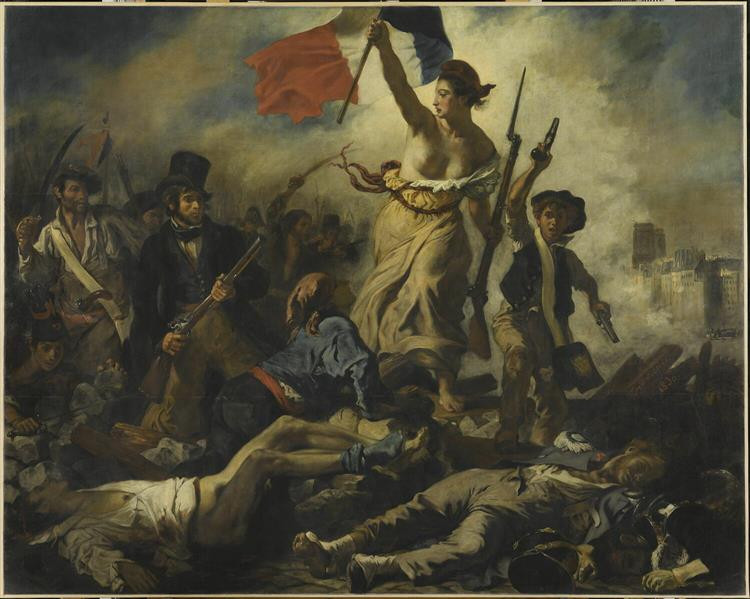
Delacroix, Liberty Leading the People (1830)
Nationalism and its limits
Nationalism said people sharing culture, language, history, or territory should form a political community. It helped drive German unification and Italian unification. It could also challenge empires.
These ideas were not simply caused by industrialization. Enlightenment thought and early revolutions began before full industrial transformation. Industrialization later helped spread them through print culture, transportation, urbanization, and stronger states. Meiji Japan shows how state-led industrialization could strengthen national power.
Still, monarchies and empires survived, suffrage stayed limited, and slavery, racial hierarchy, colonial rule, and exclusion of women continued.
