Topic 8.9 Notes – Causation in the Age of the Cold War and Decolonization
How to Explain Causation in the Cold War and Decolonization
This topic is about extent. You’re judging how similar the effects were across both hemispheres, not proving they were identical.
- Eastern and Western Hemispheres are geographic regions. They do not mean communist East vs capitalist West.
- Eastern Hemisphere = Europe, Africa, most of Asia
- Western Hemisphere = North America, Latin America, Caribbean
In both hemispheres, the Cold War brought similar kinds of effects:
- ideological rivalry
- intervention by superpowers
- militarization
- repression
- economic competition
- resistance movements
What changes is scale and method.
Causation
Good causation separates:
- long-term causes such as nationalism, inequality, religion, ethnic division, and colonial borders
- immediate triggers such as invasions, coups, or independence declarations
- consequences such as civil war, migration, repression, or superpower involvement
The Cold War often intensified local conflicts instead of creating them from nothing. Angola is a great example. Rival nationalist groups already existed, then Cold War support made the war bigger and longer.
Best thesis move: the effects were similar in kind, but different in scale and method.
Political and Military Effects in Both Hemispheres
The Cold War turned local struggles into global ones.
Global alliance system
- NATO formed in 1949. It tied the US, Canada, and Western Europe together.
- Warsaw Pact formed in 1955. It tied the USSR to Eastern European satellite states.
- Superpowers also sent money, weapons, training, and diplomatic backing around the world.
By the early 1960s, those alignments reached far beyond Europe, with countries across Latin America, Africa, Asia, and the Middle East pulled toward one bloc or the other.
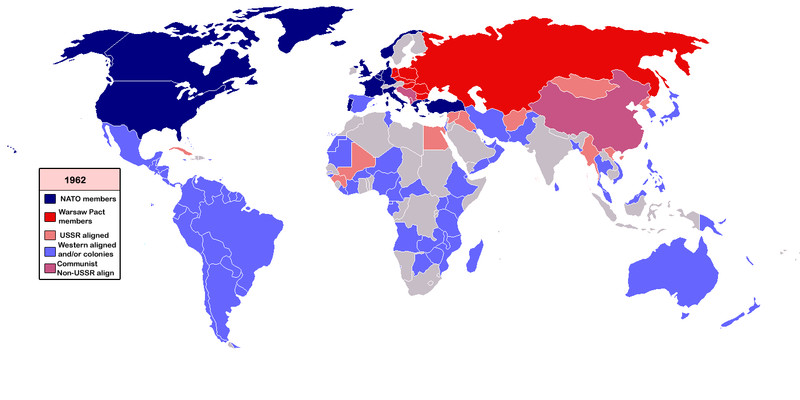
Cold War alignments, 1962
Proxy wars and militarization
- Korea was split at the 38th parallel after WWII. War lasted from 1950 to 1953. North Korea had Soviet and Chinese backing; South Korea had US and UN backing. It ended in an armistice, so the war technically never got a peace treaty.
- Vietnam mixed anticolonial nationalism with communism. Ho Chi Minh fought the French, defeated them at Dien Bien Phu in 1954, and later the US backed South Vietnam.
- Afghanistan saw a Soviet invasion in 1979. Afghan resistance was backed by the US, Pakistan, and Saudi Arabia.
- Angola became a proxy war after Portuguese rule ended. MPLA got Soviet and Cuban support; rivals got US and apartheid South African support.
- Nicaragua saw the Sandinistas overthrow Somoza in 1979, and the US backed the Contras against them.
Intervention and repression
- The USSR crushed reform in Hungary in 1956 and the Prague Spring in 1968 under Alexander Dubček.
- In Cuba, Fidel Castro overthrew Batista in 1959. Then came the Bay of Pigs in 1961 and the Cuban Missile Crisis in 1962.
- In Chile, Salvador Allende was overthrown in 1973, and Augusto Pinochet fit US anticommunist goals.
A shared result in both hemispheres was bigger armies, stronger intelligence agencies, and fear driven by the nuclear arms race and the military-industrial complex.
Decolonization and New States in the Eastern Hemisphere
Most decolonization happened in the Eastern Hemisphere because that’s where most colonies still were after WWII.
Why empires weakened after World War II
- Britain and France were weakened by two world wars.
- Colonial soldiers and workers demanded rights after wartime service.
- Nationalism had been building for decades.
- Japan’s victories in Asia shattered the myth that Europeans could not be beaten.
- The UN and the idea of self-determination made independence claims more legitimate.
Different paths to independence
| Path | Examples |
|---|---|
| Negotiated | India (1947) under Gandhi and Congress; Ghana (1957) under Kwame Nkrumah; much of French West Africa around 1960 |
| Violent | Algeria under the FLN, independence in 1962; Vietnam against France; Angola after Portuguese withdrawal in 1975 |
In the Western Hemisphere, decolonization was smaller in scale and mostly Caribbean:
- Jamaica and Trinidad and Tobago in 1962
- Guyana in 1966
Borders, partition, and displacement
- India and Pakistan were partitioned in 1947. That caused mass migration, communal violence, and later Bangladesh broke from Pakistan in 1971.
- Israel was created in 1948. Many Palestinians were displaced, and Arab-Israeli conflict kept returning.
- Nigeria faced the Biafra civil war.
Empire ended, but new states often inherited unstable borders and conflict.
Nonalignment, Development, and Resistance
New states did not just pick a side automatically.
Nonalignment
- Bandung Conference in 1955
- Non-Aligned Movement in 1961
- Key leaders included Nehru, Nasser, Sukarno, Nkrumah, and Tito
Their goal was independence from both superpowers, even if they still took aid when useful.
Competing and mixed economic models
- Soviet model = command economy and COMECON
- US-backed model = capitalism, Marshall Plan, IMF, World Bank
- Many postcolonial states used state-led development
- Nasser nationalized the Suez Canal and built the Aswan High Dam
- Nyerere used ujamaa in Tanzania
- Indira Gandhi used planning in India
- Bandaranaike expanded state control in Sri Lanka
- land reform appeared in Vietnam, Ethiopia under Mengistu, Kerala, and Iran’s White Revolution
Resistance to power structures
- Gandhi used nonviolence against empire.
- Martin Luther King Jr. adapted nonviolence in the US.
- Nelson Mandela and the ANC fought apartheid.
- Some resistance or repression was more violent, including Shining Path in Peru, Idi Amin in Uganda, Franco in Spain, and Pinochet in Chile.
Across both hemispheres, states expanded control over society and often treated dissent as ideological treason.
How the Cold War Ended and the Big Comparison
The Soviet system weakened from inside and outside pressure.
- weak command economy and shortages
- huge military costs
- the Soviet war in Afghanistan
- Gorbachev’s reforms of glasnost and perestroika
- rising nationalism in Eastern Europe and the USSR
- communist governments fell in 1989
- the Berlin Wall opened in 1989
- the USSR dissolved in 1991
The biggest immediate effects were in the Eastern Hemisphere because that’s where the Soviet empire and satellite states actually were. The Western Hemisphere changed too. The US had less Cold War justification for intervention, and Cuba lost Soviet support.
