Topic 1.3 Notes – Developments in South and Southeast Asia from c. 1200 to c. 1450
How Religion Shaped Society and Rule in South and Southeast Asia
This region never had one single religion or one single political model. You need to picture a mix of Hindu, Buddhist, and Muslim communities, with rulers using religion as part of government.
- Religion shaped more than worship. It organized social rank, education, charity, temple and monastery life, and ideas about what made a ruler legitimate.
- In land-based states, power often rested on rice agriculture, taxes, and support from temples or monasteries that tied rulers to local communities.
- In maritime states, rulers depended more on ports, trade, and cooperation among people of different religions because commerce brought in merchants from many places.
- In South Asia, Hinduism remained strongest overall, Islam expanded politically under the Delhi Sultanate, and Buddhism stayed important in Sri Lanka.
- In Southeast Asia, rulers borrowed Indian religious ideas but blended them with local customs. This is adaptation, not simple copying.
Belief Systems and Religious Practices
Hinduism
Hinduism stayed central in South Asia and influenced many Southeast Asian courts.
- Dharma meant duty and proper conduct.
- Karma meant actions had consequences across lifetimes.
- Reincarnation meant rebirth after death.
- Moksha meant escape from the cycle of rebirth.
The caste system continued. The broad varna categories mattered as ideals, but daily life worked through many local jatis, or birth groups. Brahmins served as priests, scholars, and advisers, and temples were major landholders, employers, ritual centers, and local administration hubs. Sanskrit kept prestige, but regional languages became more important. The Ramayana and Mahabharata spread ideas about kingship, duty, and morality.
Bhakti movement
Bhakti stressed personal devotion to a deity such as Vishnu, Shiva, or Krishna.
- It used poetry, song, pilgrimage, and vernacular languages.
- It opened devotion to people outside Sanskrit-educated elites.
- It sometimes challenged caste exclusiveness and expanded participation for women and lower-status groups.
The usual trap is saying Bhakti ended caste. It did not. It questioned hierarchy in some spaces, but caste survived.
Islam and Sufism
Islam grew politically in South Asia under Muslim rulers, especially the Delhi Sultanate, even though most subjects were still Hindu.
- Islam centered on one God, Muhammad, the Quran, and the umma, the Muslim community.
- Persian became a major language of administration.
- Mosques, madrasas, courts, and charitable institutions spread.
Sufism helped Islam spread beyond royal courts.
- Sufis emphasized mystical devotion, saints, shrines, and close teacher-disciple ties.
- Khanqahs offered charity, hospitality, and instruction.
- Sufis often used local languages and personal relationships.
A common comparison is worth knowing. Bhakti and Sufism both emphasized personal devotion and broader access, but they came from different religions.
Buddhism and monasticism
Buddhism remained strongest in Sri Lanka and much of Southeast Asia.
- Its goal was to end suffering and escape rebirth through disciplined practice leading to nirvana.
- The sangha, the monastic community, preserved texts, taught monks, and received donations from laypeople seeking merit.
- Theravada Buddhism was especially important in Sri Lanka and mainland Southeast Asia.
- Mahayana Buddhism remained important in places like Srivijaya and earlier Khmer courts.
Monasteries were not just spiritual centers. They were economic and political institutions too.
How States Built and Maintained Power
Rulers across the region used similar tools, even though their states looked different.
- military force and fortified capitals
- agricultural taxes in land-based kingdoms
- port taxes, tolls, and naval power in maritime states
- alliances with chiefs, warrior elites, and local officials
- patronage of temples, monasteries, Brahmins, and scholars
- monumental building projects, reservoirs, canals, roads, and cities
In many Southeast Asian mandala states, power spread outward from a strong center. Borders were loose, and tribute often mattered more than direct control.
Major States and What Made Each One Distinct
| State | Distinctive features |
|---|---|
| Rajput kingdoms | Regional Hindu warrior states; Kshatriya identity, forts, cavalry, marriage alliances, temple patronage |
| Vijayanagara | Founded 1336 in south India; major Hindu state with Hampi capital, canals, markets, temple complexes |
| Sinhala dynasties | Theravada Buddhist kingship in Sri Lanka; legitimacy tied to protecting the sangha and the Tooth Relic |
| Khmer Empire | Angkor-based rice kingdom; sacred kingship, tribute, labor, huge building projects |
| Sukhothai | Thai kingdom using Theravada Buddhist dharmaraja rule; later absorbed by Ayutthaya |
| Srivijaya | Buddhist trading state on Sumatra controlling the Strait of Malacca; declined in this period |
| Majapahit | Founded 1293 on Java; Hindu-Buddhist maritime power mixing agriculture, trade, and tribute |
| Samudra-Pasai and Malacca | Muslim port states where Islam spread mainly by trade, Sufis, intermarriage, and ruler conversion |
Monumental Architecture and the Big Patterns
Monuments showed that rulers could command labor, wealth, and sacred legitimacy.
Angkor Wat is the classic example. Its moat, causeway, concentric layout, and towers representing Mount Meru showed cosmic order and divine kingship, while its huge scale showed state power.
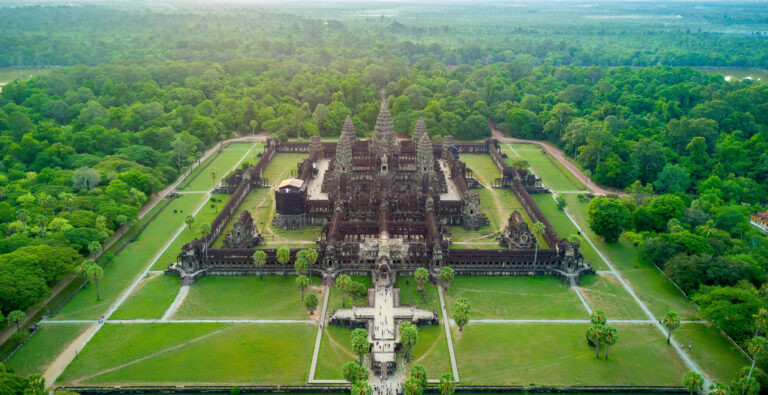
Angkor Wat, Cambodia
From this aerial view, you can see the symmetry and massive scale that made such monuments both religious spaces and political tools. Temples, monasteries, stupas, mosques, and capitals all worked in that double role.
Key Takeaways
Hinduism
Diverse South Asian tradition centered on dharma, karma, reincarnation, and moksha that shaped caste, kingship, temples, and social duties
Dharma
Religious and social duty in Hindu tradition
Karma
The consequences of a person’s actions, which influence the conditions of future rebirths
Reincarnation
Rebirth into another life after death, with the form of rebirth influenced by karma
Moksha
Liberation from the cycle of death and rebirth in Hindu tradition
Caste System (Varna and Jati)
South Asian hierarchy in which broad varnas defined ideal status while numerous local jatis organized occupation, marriage, and social interaction
Brahmins
The priestly varna whose members served as ritual specialists, scholars, and royal advisers and legitimized Hindu rulers
Bhakti Movement
Hindu devotional movement emphasizing personal love of a deity through vernacular poetry, song, pilgrimage, and worship open to broader participation
Islam
Monotheistic faith based on one God, Muhammad’s prophethood, the Quran, and membership in the Muslim community
Umma
The worldwide community of Muslims united by their shared faith
Sufism
Mystical Islamic traditions seeking personal experience of God through spiritual discipline, divine love, teachers, and communities of disciples
Buddhism
Tradition teaching that desire causes suffering and that disciplined practice can end rebirth and lead to nirvana
Nirvana
Buddhist liberation from suffering and the cycle of rebirth
Buddhist Monasticism (Sangha)
The organized community of monks and monasteries that preserved texts, taught, performed rituals, and allowed laypeople to gain merit through donations
Theravada Buddhism
Buddhist tradition stressing teachings associated with the historical Buddha and the Pali canon, especially influential in Sri Lanka and mainland Southeast Asia
Mahayana Buddhism
Buddhist tradition emphasizing bodhisattvas and multiple forms of assistance toward enlightenment, influential in Srivijaya and the Khmer court
Indianization
Selective Southeast Asian adaptation of Indian religions, Sanskrit titles, epics, architecture, and political ideas to local purposes
Mandala State
Political system in which authority radiated from a central court and weakened with distance, leaving tributary local rulers considerable autonomy
Rajput Kingdoms
Competing Hindu warrior states of northern and northwestern India that relied on forts, cavalry, marriage alliances, and temple patronage
Vijayanagara Empire
Hindu empire founded in southern India in 1336 that used armies, agricultural revenue, trade, subordinate chiefs, and temple patronage to maintain power
Sinhala Dynasties
Sri Lankan ruling houses that legitimized fragmented regional rule by protecting Theravada Buddhism, monasteries, Pali learning, and the Buddha’s tooth relic
Khmer Empire
Angkor-centered mainland Southeast Asian empire supported by rice agriculture, tribute, military power, waterworks, and Hindu-Buddhist royal patronage
Angkor Wat
Monumental Khmer temple originally dedicated to Vishnu whose Mount Meru design, scale, and cosmic layout proclaimed sacred royal authority
Jayavarman VII
Khmer king and Mahayana Buddhist patron who built Angkor Thom, the Bayon, roads, rest houses, and hospitals
Sukhothai Kingdom
Thirteenth-century Thai state that used rice wealth, local alliances, and Theravada Buddhist righteous kingship as Khmer influence weakened
Dharmaraja
A righteous Buddhist king who governs morally, protects the sangha, dispenses justice, and gains merit through patronage
Srivijaya
Sumatra-centered Mahayana Buddhist maritime state that profited from its location near the Strait of Malacca through naval power, port alliances, tribute, and trade-related taxes
Majapahit
Hindu-Buddhist state founded on Java in 1293 that combined agricultural wealth with naval force, tribute, alliances, and commercial influence
Samudra-Pasai
Muslim trading state established in northern Sumatra by the late thirteenth century and linked to Indian Ocean commercial networks
Malacca Sultanate
Port founded around 1400 that became a Muslim sultanate and major commercial center on the strategically important Strait of Malacca
Notes
Hinduism
Diverse South Asian tradition centered on dharma, karma, reincarnation, and moksha that shaped caste, kingship, temples, and social duties
Dharma
Religious and social duty in Hindu tradition
Karma
The consequences of a person’s actions, which influence the conditions of future rebirths
Reincarnation
Rebirth into another life after death, with the form of rebirth influenced by karma
Moksha
Liberation from the cycle of death and rebirth in Hindu tradition
Caste System (Varna and Jati)
South Asian hierarchy in which broad varnas defined ideal status while numerous local jatis organized occupation, marriage, and social interaction
Brahmins
The priestly varna whose members served as ritual specialists, scholars, and royal advisers and legitimized Hindu rulers
Bhakti Movement
Hindu devotional movement emphasizing personal love of a deity through vernacular poetry, song, pilgrimage, and worship open to broader participation
Islam
Monotheistic faith based on one God, Muhammad’s prophethood, the Quran, and membership in the Muslim community
Umma
The worldwide community of Muslims united by their shared faith
Sufism
Mystical Islamic traditions seeking personal experience of God through spiritual discipline, divine love, teachers, and communities of disciples
Buddhism
Tradition teaching that desire causes suffering and that disciplined practice can end rebirth and lead to nirvana
Nirvana
Buddhist liberation from suffering and the cycle of rebirth
Buddhist Monasticism (Sangha)
The organized community of monks and monasteries that preserved texts, taught, performed rituals, and allowed laypeople to gain merit through donations
Theravada Buddhism
Buddhist tradition stressing teachings associated with the historical Buddha and the Pali canon, especially influential in Sri Lanka and mainland Southeast Asia
Mahayana Buddhism
Buddhist tradition emphasizing bodhisattvas and multiple forms of assistance toward enlightenment, influential in Srivijaya and the Khmer court
Indianization
Selective Southeast Asian adaptation of Indian religions, Sanskrit titles, epics, architecture, and political ideas to local purposes
Mandala State
Political system in which authority radiated from a central court and weakened with distance, leaving tributary local rulers considerable autonomy
Rajput Kingdoms
Competing Hindu warrior states of northern and northwestern India that relied on forts, cavalry, marriage alliances, and temple patronage
Vijayanagara Empire
Hindu empire founded in southern India in 1336 that used armies, agricultural revenue, trade, subordinate chiefs, and temple patronage to maintain power
Sinhala Dynasties
Sri Lankan ruling houses that legitimized fragmented regional rule by protecting Theravada Buddhism, monasteries, Pali learning, and the Buddha’s tooth relic
Khmer Empire
Angkor-centered mainland Southeast Asian empire supported by rice agriculture, tribute, military power, waterworks, and Hindu-Buddhist royal patronage
Angkor Wat
Monumental Khmer temple originally dedicated to Vishnu whose Mount Meru design, scale, and cosmic layout proclaimed sacred royal authority
Jayavarman VII
Khmer king and Mahayana Buddhist patron who built Angkor Thom, the Bayon, roads, rest houses, and hospitals
Sukhothai Kingdom
Thirteenth-century Thai state that used rice wealth, local alliances, and Theravada Buddhist righteous kingship as Khmer influence weakened
Dharmaraja
A righteous Buddhist king who governs morally, protects the sangha, dispenses justice, and gains merit through patronage
Srivijaya
Sumatra-centered Mahayana Buddhist maritime state that profited from its location near the Strait of Malacca through naval power, port alliances, tribute, and trade-related taxes
Majapahit
Hindu-Buddhist state founded on Java in 1293 that combined agricultural wealth with naval force, tribute, alliances, and commercial influence
Samudra-Pasai
Muslim trading state established in northern Sumatra by the late thirteenth century and linked to Indian Ocean commercial networks
Malacca Sultanate
Port founded around 1400 that became a Muslim sultanate and major commercial center on the strategically important Strait of Malacca
