Topic 6.2 Notes – State Expansion from 1750 to 1900
How States Expanded Their Power from 1750 to 1900
Imperialism means a state extends its power over other peoples and territories. Colonialism is one form of that, where a state formally rules land beyond its original borders.
Industrialization made this easier. Steamships, railroads, telegraphs, modern rifles, and stronger bureaucracies let states conquer faster, communicate farther, and govern more tightly.
States expanded in several ways:
- Annexation meant taking territory and making it part of the state.
- Colonies were lands under the direct sovereignty of an outside power.
- Protectorates kept local rulers on the throne, but the imperial state controlled the real decisions.
- Direct rule used imperial officials sent from the metropole.
- Indirect rule used local elites under imperial supervision.
- Settler colonialism sent permanent migrants who seized land and built political institutions for themselves.
- Some places shifted from private control to state control, which matters a lot in this topic.
The comparison point teachers love is that state power did not shift in just one direction. It moved:
- from indigenous rulers to imperial governments
- from companies or individuals to national states
- from Spain and Portugal to newer industrial powers
War and diplomacy usually worked together. A treaty often came after military pressure, and conquest usually needed legal recognition to stick.
When States Tightened Control over Colonies They Already Had
Some empires did not just gain new land. They grabbed tighter control over land they already influenced.
British India
Before 1858, much of India was ruled by the British East India Company, not the British government itself. The Sepoy Rebellion of 1857 showed how unstable company rule could be. The Government of India Act of 1858 transferred control to the British Crown. That created the British Raj, run by a viceroy in India and a secretary of state in Britain. Princely states stayed in place, but under British paramountcy, which meant Britain held final authority.
Dutch East Indies
The VOC dissolved in 1799, and the Dutch state took control in 1800. The big shift here is company empire turning into state empire, followed by more systematic Dutch rule.
Congo
The Congo shows a different transfer. On the map, the Congo appears as the large central territory labeled Belgium, which reflects the later shift from personal rule to direct state rule.
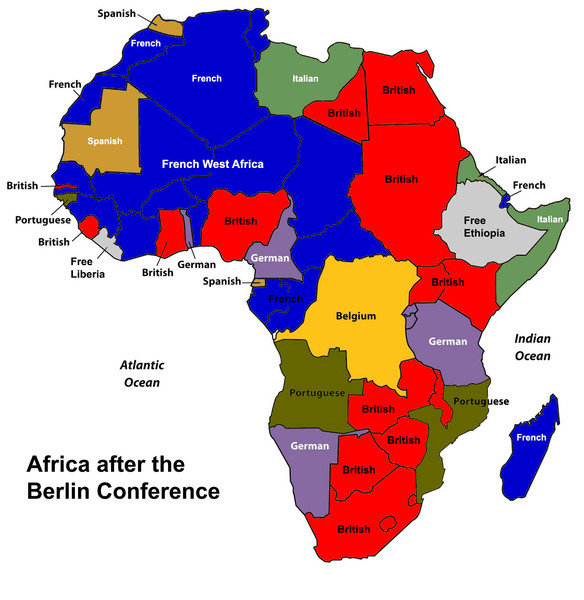
Africa after the Berlin Conference
King Leopold II personally controlled the Congo Free State, recognized at the Berlin Conference. His regime used forced labor for rubber and ivory and became infamous for mutilation and mass killing. International outrage pushed Belgium to annex it in 1908 as the Belgian Congo. Same territory, different holder of power.
Expansion in Asia, the Pacific, and Africa
Asia and the Pacific
Imperial expansion in Asia and the Pacific created a patchwork of colonies, protectorates, and naval bases across islands and coastlines.
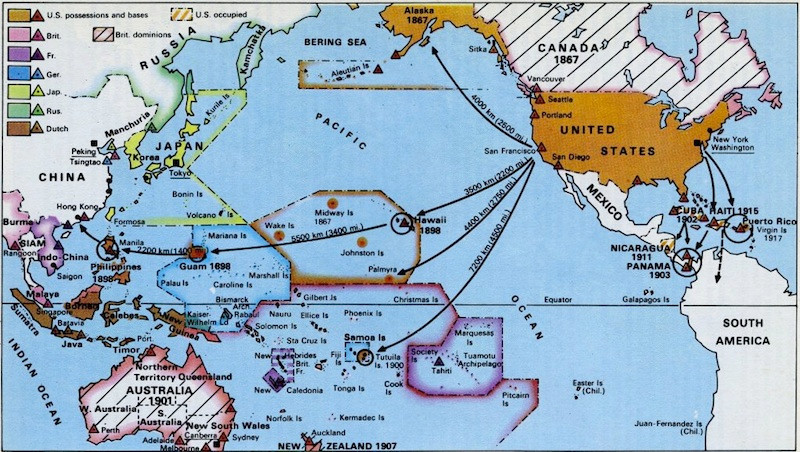
Imperial possessions in Asia and the Pacific
- Britain conquered Burma through three Anglo-Burmese Wars and annexed it in 1885.
- France built French Indochina through conquest and treaties in Vietnam, Cambodia, and Laos.
- The United States became an overseas empire. It annexed Hawaii in 1898 after the 1893 overthrow of Queen Liliʻuokalani. The Treaty of Paris after the Spanish-American War gave the U.S. Puerto Rico, Guam, and the Philippines.
- Japan, after the Meiji Restoration, annexed Okinawa in 1879 and gained Taiwan and the Penghu Islands in the Treaty of Shimonoseki after the First Sino-Japanese War.
Africa
The Scramble for Africa rapidly redrew control by 1900. The Berlin Conference set rules for claims, especially effective occupation, and Africans were not represented.
European powers used:
- treaties with African rulers
- protectorates
- diplomacy with rival Europeans
- military conquest
Britain in West Africa
- Lagos was annexed in 1861.
- The Gold Coast became a Crown colony in 1874.
- Nigeria expanded through protectorates and the Royal Niger Company.
France in West Africa
- France expanded inland from Senegal.
- It created French West Africa in 1895.
Diplomacy gave the claim legal cover. War made it enforceable.
Settler Colonies and Expansion into Neighboring Lands
Settler colonies involved permanent migration, land seizure, and governments dominated by settlers.
New Zealand
The Treaty of Waitangi in 1840 was signed by Britain and Māori chiefs, but the English and Māori versions differed, especially on sovereignty. Disputes helped cause the New Zealand Wars, and the colonial government confiscated Māori land. Responsible government in the 1850s gave settlers local political power.
Other settler examples include Australia, Canada, Algeria, southern Africa, and the western United States.
The United States also expanded into neighboring lands:
- Louisiana Purchase in 1803
- Texas annexation in 1845
- Mexican-American War
- Treaty of Guadalupe Hidalgo in 1848
- Alaska purchase in 1867
Railroads, settlers, and Native American displacement made those claims real on the ground.
Russia expanded into the Caucasus and Central Asia, captured Tashkent in 1865, made Bukhara and Khiva protectorates, and gained land from Qing China through the Treaty of Aigun and Convention of Beijing. Vladivostok was founded in 1860.
Japan tightened control of Hokkaido, displacing the Ainu. That nearby expansion blended into overseas empire.
The Big Comparison Patterns
Here’s the pattern tying everything together. States used the same basic tools, but in different geographic forms.
| Shared methods | Main users |
|---|---|
| conquest | all major expanding powers |
| treaties and diplomacy | Europe, U.S., Japan, Russia |
| protectorates and annexation | especially in Africa and Asia |
| stronger bureaucratic rule | Britain, France, Netherlands, Belgium |
| settlement | settler colonies, U.S., Russia, Japan |
The big differences:
- Overseas empires included Britain, France, Belgium
- Contiguous land empire fits Russia
- Mixed continental and overseas expansion fits the United States and Japan
Spain and Portugal declined in relative power. Latin American independence weakened both, and Spain’s 1898 defeat marked a major collapse of its old empire.
Key Takeaways
Imperialism
The extension of a state’s power over other territories and peoples through political, military, or economic control
Colonialism
The establishment and maintenance of political control over territory outside a state’s original borders
Annexation
The formal incorporation of a territory into an expanding state or empire
Colony
A territory placed under an outside state’s sovereignty and governed by officials responsible to that state
Protectorate
A territory retaining a local government in form while an imperial power controls major policies such as diplomacy or defense
Direct Rule vs. Indirect Rule
Direct rule used imperial officials and institutions; indirect rule governed through supervised local rulers or existing institutions
Settler Colony
A colony receiving substantial permanent migration whose settlers claimed land, built institutions, and displaced or subordinated indigenous peoples
Non-State Empire
An imperial possession governed by an individual or private company rather than directly by a national government
British East India Company
Private company that ruled much of British-controlled India with armies and taxation powers until the Crown ended company rule in 1858
British Raj
British Crown rule in India after 1858, replacing East India Company government while princely states remained under British paramountcy
Dutch East India Company (VOC)
Private Dutch company whose Asian possessions passed to the Dutch state after the company was dissolved in 1799
Dutch East Indies
The Dutch state’s colonial empire in the Indonesian archipelago, consolidated after it assumed the VOC’s possessions in 1800
King Leopold II
Belgian king who personally controlled the Congo Free State and used coercive labor systems to extract ivory and rubber
Congo Free State
Leopold II’s personal Congo empire, recognized in 1884–1885 and notorious for forced labor before Belgium took control in 1908
Anglo-Burmese Wars
Three wars from 1824 to 1885 through which Britain conquered Burma and annexed it to British India
French Indochina
French colonial union established in 1887 from conquered or subordinated territories in Vietnam and Cambodia, later including Laos
Annexation of Hawaii
The United States annexed Hawaii in 1898 after American settlers and business interests helped overthrow Queen Liliʻuokalani in 1893
Spanish-American War
The 1898 war in which the United States defeated Spain and gained major territories in the Caribbean and Pacific
Treaty of Paris of 1898
Treaty ending the Spanish-American War that gave Puerto Rico, Guam, and the Philippines to the United States and ended Spanish rule in Cuba
Meiji Restoration
The 1868 political transformation that created a centralized, industrializing Japanese state capable of imperial expansion
Annexation of the Ryukyu Kingdom
Japan abolished the Ryukyu Kingdom and incorporated it as Okinawa Prefecture in 1879
First Sino-Japanese War
The 1894–1895 war in which Japan defeated Qing China and gained Taiwan and the Penghu Islands through the Treaty of Shimonoseki
Treaty of Shimonoseki
The 1895 treaty ending the First Sino-Japanese War and transferring Taiwan and the Penghu Islands to Japan
Decline of Spanish and Portuguese Influence
Their relative imperial power fell as American colonies became independent and industrializing states gained dominance; Spain lost major colonies in 1898
Scramble for Africa
The rapid late-nineteenth-century European conquest and partition of nearly all Africa through warfare, treaties, and colonial administration
Berlin Conference
The 1884–1885 meeting that set rules for European African claims, promoted effective occupation, and recognized Leopold’s Congo; Africans were excluded
French West Africa
Federation created in 1895 to consolidate France’s separately conquered West African territories under centralized colonial authority
Treaty of Waitangi
The disputed 1840 agreement through which Britain claimed sovereignty over New Zealand despite differing English and Māori understandings
New Zealand Wars
Nineteenth-century conflicts over land and sovereignty that accompanied British settlement and resulted in extensive confiscation of Māori land
Louisiana Purchase
The 1803 purchase of French territory that roughly doubled the land claimed by the United States
Annexation of Texas
The United States incorporated Texas in 1845, contributing to tensions that led to war with Mexico
Mexican-American War
The 1846–1848 war in which the United States defeated Mexico and obtained vast western territories
Treaty of Guadalupe Hidalgo
The 1848 treaty ending the Mexican-American War and ceding California and a vast southwestern region to the United States
Alaska Purchase
The United States purchased Alaska from Russia in 1867
Russian Imperial Expansion
Russia conquered and settled adjoining lands in the Caucasus, Central Asia, and Far East while subordinating diverse peoples and local governments
Russification
Russian policies promoting Russian language and culture among the empire’s culturally diverse subject peoples
Colonization of Hokkaido
Meiji Japan intensified settlement and administration in Hokkaido while displacing and assimilating the indigenous Ainu
British Expansion in West Africa
Britain used companies, treaties, military campaigns, and state administration to expand coastal holdings into colonies and protectorates in the Gold Coast and Nigeria
Treaty of Aigun
The 1858 agreement by which Qing China transferred Far Eastern territory to Russia, strengthening Russian control along its Pacific frontier
Convention of Beijing
The 1860 agreement that transferred additional Qing territory to Russia and helped enable Russia to establish Vladivostok
Indian Rebellion of 1857
Uprising against East India Company rule that prompted Britain to abolish company government and transfer India to Crown rule in 1858
British Settler Colonialism in New Zealand
Permanent British migration brought Crown claims to sovereignty, Māori land loss and warfare, and settler-dominated self-government
Notes
Imperialism
The extension of a state’s power over other territories and peoples through political, military, or economic control
Colonialism
The establishment and maintenance of political control over territory outside a state’s original borders
Annexation
The formal incorporation of a territory into an expanding state or empire
Colony
A territory placed under an outside state’s sovereignty and governed by officials responsible to that state
Protectorate
A territory retaining a local government in form while an imperial power controls major policies such as diplomacy or defense
Direct Rule vs. Indirect Rule
Direct rule used imperial officials and institutions; indirect rule governed through supervised local rulers or existing institutions
Settler Colony
A colony receiving substantial permanent migration whose settlers claimed land, built institutions, and displaced or subordinated indigenous peoples
Non-State Empire
An imperial possession governed by an individual or private company rather than directly by a national government
British East India Company
Private company that ruled much of British-controlled India with armies and taxation powers until the Crown ended company rule in 1858
British Raj
British Crown rule in India after 1858, replacing East India Company government while princely states remained under British paramountcy
Dutch East India Company (VOC)
Private Dutch company whose Asian possessions passed to the Dutch state after the company was dissolved in 1799
Dutch East Indies
The Dutch state’s colonial empire in the Indonesian archipelago, consolidated after it assumed the VOC’s possessions in 1800
King Leopold II
Belgian king who personally controlled the Congo Free State and used coercive labor systems to extract ivory and rubber
Congo Free State
Leopold II’s personal Congo empire, recognized in 1884–1885 and notorious for forced labor before Belgium took control in 1908
Anglo-Burmese Wars
Three wars from 1824 to 1885 through which Britain conquered Burma and annexed it to British India
French Indochina
French colonial union established in 1887 from conquered or subordinated territories in Vietnam and Cambodia, later including Laos
Annexation of Hawaii
The United States annexed Hawaii in 1898 after American settlers and business interests helped overthrow Queen Liliʻuokalani in 1893
Spanish-American War
The 1898 war in which the United States defeated Spain and gained major territories in the Caribbean and Pacific
Treaty of Paris of 1898
Treaty ending the Spanish-American War that gave Puerto Rico, Guam, and the Philippines to the United States and ended Spanish rule in Cuba
Meiji Restoration
The 1868 political transformation that created a centralized, industrializing Japanese state capable of imperial expansion
Annexation of the Ryukyu Kingdom
Japan abolished the Ryukyu Kingdom and incorporated it as Okinawa Prefecture in 1879
First Sino-Japanese War
The 1894–1895 war in which Japan defeated Qing China and gained Taiwan and the Penghu Islands through the Treaty of Shimonoseki
Treaty of Shimonoseki
The 1895 treaty ending the First Sino-Japanese War and transferring Taiwan and the Penghu Islands to Japan
Decline of Spanish and Portuguese Influence
Their relative imperial power fell as American colonies became independent and industrializing states gained dominance; Spain lost major colonies in 1898
Scramble for Africa
The rapid late-nineteenth-century European conquest and partition of nearly all Africa through warfare, treaties, and colonial administration
Berlin Conference
The 1884–1885 meeting that set rules for European African claims, promoted effective occupation, and recognized Leopold’s Congo; Africans were excluded
French West Africa
Federation created in 1895 to consolidate France’s separately conquered West African territories under centralized colonial authority
Treaty of Waitangi
The disputed 1840 agreement through which Britain claimed sovereignty over New Zealand despite differing English and Māori understandings
New Zealand Wars
Nineteenth-century conflicts over land and sovereignty that accompanied British settlement and resulted in extensive confiscation of Māori land
Louisiana Purchase
The 1803 purchase of French territory that roughly doubled the land claimed by the United States
Annexation of Texas
The United States incorporated Texas in 1845, contributing to tensions that led to war with Mexico
Mexican-American War
The 1846–1848 war in which the United States defeated Mexico and obtained vast western territories
Treaty of Guadalupe Hidalgo
The 1848 treaty ending the Mexican-American War and ceding California and a vast southwestern region to the United States
Alaska Purchase
The United States purchased Alaska from Russia in 1867
Russian Imperial Expansion
Russia conquered and settled adjoining lands in the Caucasus, Central Asia, and Far East while subordinating diverse peoples and local governments
Russification
Russian policies promoting Russian language and culture among the empire’s culturally diverse subject peoples
Colonization of Hokkaido
Meiji Japan intensified settlement and administration in Hokkaido while displacing and assimilating the indigenous Ainu
British Expansion in West Africa
Britain used companies, treaties, military campaigns, and state administration to expand coastal holdings into colonies and protectorates in the Gold Coast and Nigeria
Treaty of Aigun
The 1858 agreement by which Qing China transferred Far Eastern territory to Russia, strengthening Russian control along its Pacific frontier
Convention of Beijing
The 1860 agreement that transferred additional Qing territory to Russia and helped enable Russia to establish Vladivostok
Indian Rebellion of 1857
Uprising against East India Company rule that prompted Britain to abolish company government and transfer India to Crown rule in 1858
British Settler Colonialism in New Zealand
Permanent British migration brought Crown claims to sovereignty, Māori land loss and warfare, and settler-dominated self-government
