AP®︎ World History: Topic 4.4 Practice Test
Prepare for your quiz, test, or the AP exam with focused practice questions on Topic 4.4 of AP World History – Maritime Empires Established.
Questions List
Topic 4.4
Question 1 Easy
Engraving of Elmina Castle on the West African coast, late 16th century
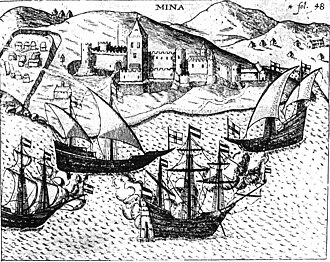
Unknown artist, c. 1596. Wikimedia Commons.
The type of fortified structure shown in the image most directly contributed to which later development?
What You’re Being Tested On:
Explore the learning objectives taken directly from the College Board’s AP® World History: Modern Curriculum. Ensure you’re prepared for the exact topics covered on the AP® exam, in-class tests, and quizzes, and gain confidence in your mastery of the material.

Topic 4.4: Maritime Empires Established
Thematic Focus: GovernanceGOV
A variety of internal and external factors contribute to state formation, expansion, and decline. Governments maintain order through a variety of administrative institutions, policies, and procedures, and governments obtain, retain, and exercise power in different ways and for different purposes.
Learning Objective: Unit 4: Learning Objective E
Explain the process of state building and expansion among various empires and states in the period from 1450 to 1750.
Historical Developments: KC-4.3.II.A.i
Europeans established new trading posts in Africa and Asia, which proved profitable for the rulers and merchants involved in new global trade networks. Some Asian states sought to limit the disruptive economic and cultural effects of European-dominated long-distance trade by adopting restrictive or isolationist trade policies.
Historical Developments: KC-4.3.II.C
Driven largely by political, religious, and economic rivalries, European states established new maritime empires, including the Portuguese, Spanish, Dutch, French, and British.
Historical Developments: KC-4.3.II.A.ii
The expansion of maritime trading networks fostered the growth of states in Africa, including the Asante and the Kingdom of the Kongo, whose participation in trading networks led to an increase in their influence.
Thematic Focus: Economic SystemsECN
As societies develop, they affect and are affected by the ways that they produce, exchange, and consume goods and services.
Learning Objective: Unit 4: Learning Objective F
Explain the continuities and changes in economic systems and labor systems from 1450 to 1750.
Historical Developments: KC-4.3.II.A.iii
Despite some disruption and restructuring due to the arrival of Portuguese, Spanish, and Dutch merchants, existing trade networks in the Indian Ocean continued to flourish and included intra-Asian trade and Asian merchants.
Historical Developments: KC-4.2.II.D
Newly developed colonial economies in the Americas largely depended on agriculture, utilized existing labor systems, including the Incan mit’a, and introduced new labor systems including chattel slavery, indentured servitude, and encomienda and hacienda systems.
Thematic Focus: Social Interactions and OrganizationSIO
The process by which societies group their members and the norms that govern the interactions between these groups and between individuals influence political, economic, and cultural institutions and organization.
Learning Objective: Unit 4: Learning Objective G
Explain changes and continuities in systems of slavery in the period from 1450 to 1750.
Historical Developments: KC-4.2.II.B
Enslavement in Africa continued in its traditional forms, including incorporation of enslaved persons into households and the export of enslaved persons to the Mediterranean and the Indian Ocean regions.
Historical Developments: KC-4.2.II.C
The growth of the plantation economy increased the demand for enslaved labor in the Americas, leading to significant demographic, social, and cultural changes.
Illustrative Examples specific knowledge students should know & demonstrate
- Ming China
- Tokugawa Japan
- Swahili Arabs
- Omanis
- Gujaratis
- Javanese
- Transoceanic Interconnections
