AP®︎ Precalculus: Topic 3.13 Practice Test
Prepare for your quiz, test, or the AP exam with focused practice questions on Topic 3.13 of AP Precalculus – Trigonometry and Polar Coordinates.
Questions List
Topic 3.13
Question 1 Easy
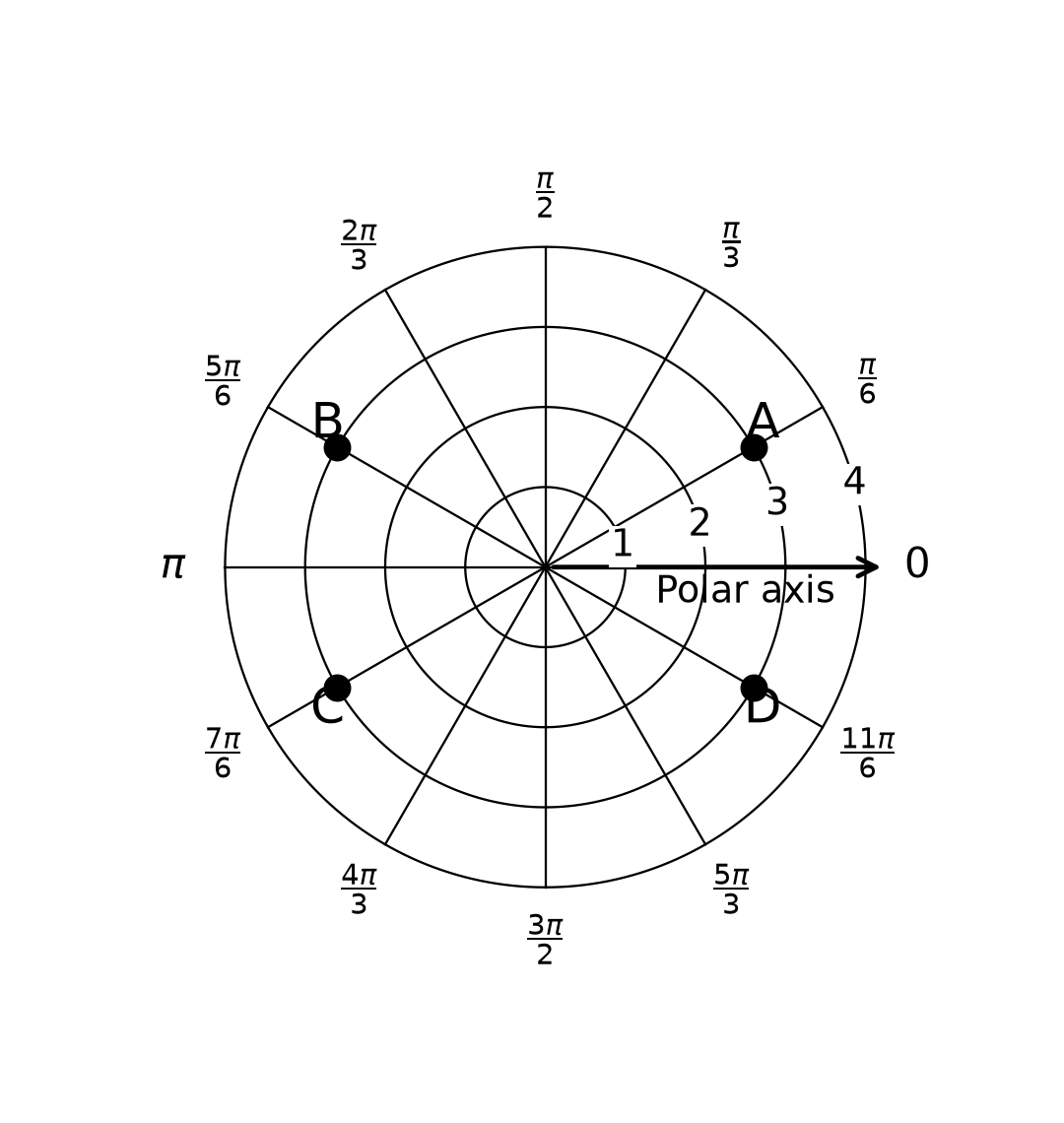
Which labeled point has polar coordinates ?
What You’re Being Tested On:
Explore the learning objectives taken directly from the College Board’s AP® Precalculus Curriculum. Ensure you’re prepared for the exact topics covered on the AP® exam, in-class tests, and quizzes, and gain confidence in your mastery of the material.

Topic 3.13: Trigonometry and Polar Coordinates
Learning Objective: 3.13.A
Determine the location of a point in the plane using both rectangular and polar coordinates.
Essential Knowledge: 3.13.A.1
The polar coordinate system is based on a grid of circles centered at the origin and on lines through the origin. The positive -axis is called the polar axis. Polar coordinates of a point are defined as an ordered pair, . The value of is given by the measure of an angle in standard position whose terminal ray lies in a line that passes through the point, and is the radial displacement of the point from the origin. Positive values of indicate radial displacement from the origin along the terminal ray of the angle . Negative values of indicate radial displacement from the origin along the line containing the terminal ray of the angle —but in the opposite direction of the terminal ray of the angle . In the polar coordinate system, the same point can be represented many ways with combinations of positive and negative values of and .
Essential Knowledge: 3.13.A.2
The coordinates of a point in the polar coordinate system, , can be converted to coordinates in the rectangular coordinate system, , using and .
Essential Knowledge: 3.13.A.3
The coordinates of a point in the rectangular coordinate system, , can be converted to coordinates in the polar coordinate system, , using and for or for .
Essential Knowledge: 3.13.A.4
A complex number can be understood as a point in the complex plane and can be determined by its corresponding rectangular or polar coordinates. When the complex number has the rectangular coordinates , it can be expressed as . When the complex number has polar coordinates , it can be expressed as .
