AP®︎ Precalculus: Topic 3.8 Practice Test
Prepare for your quiz, test, or the AP exam with focused practice questions on Topic 3.8 of AP Precalculus – The Tangent Function.
Questions List
Topic 3.8
Question 1 Easy
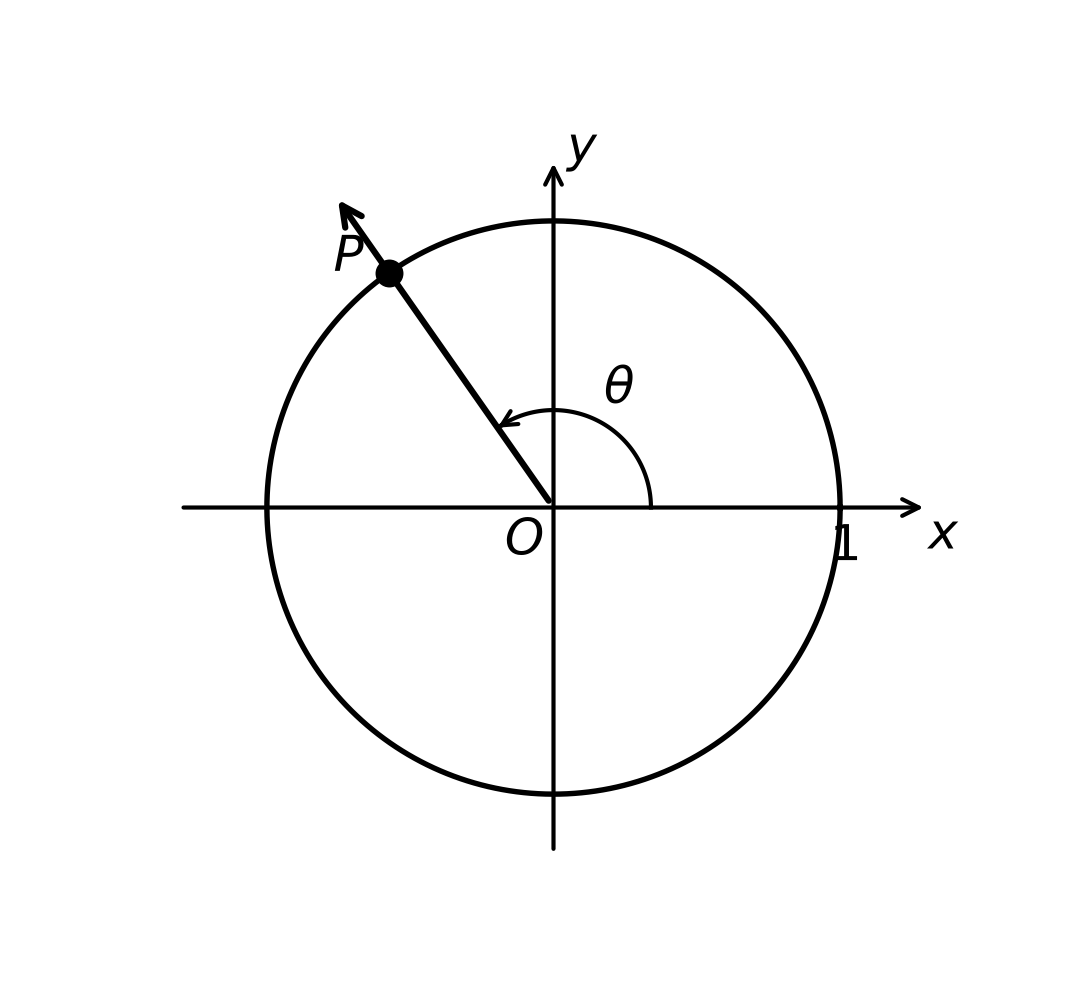
The figure shows a unit circle centered at the origin and an angle in standard position. Its terminal ray meets the circle at .
What does give?
What You’re Being Tested On:
Explore the learning objectives taken directly from the College Board’s AP® Precalculus Curriculum. Ensure you’re prepared for the exact topics covered on the AP® exam, in-class tests, and quizzes, and gain confidence in your mastery of the material.

Topic 3.8: The Tangent Function
Learning Objective: 3.8.A
Construct representations of the tangent function using the unit circle.
Essential Knowledge: 3.8.A.1
Given an angle of measure in standard position and a unit circle centered at the origin, there is a point, , where the terminal ray intersects the circle. The tangent function, , gives the slope of the terminal ray.
Essential Knowledge: 3.8.A.2
Because the slope of the terminal ray is the ratio of the change in the -values to the change in the -values between any two points on the ray, the tangent function is also the ratio of the sine function to the cosine function. Therefore, , where .
Learning Objective: 3.8.B
Describe key characteristics of the tangent function.
Essential Knowledge: 3.8.B.1
Because the slope values of the terminal ray repeat every one-half revolution of the circle, the tangent function has a period of .
Essential Knowledge: 3.8.B.2
The tangent function demonstrates periodic asymptotic behavior at input values , for integer values of , because at those values.
Essential Knowledge: 3.8.B.3
The tangent function increases and its graph changes from concave down to concave up between consecutive asymptotes.
Learning Objective: 3.8.C
Describe additive and multiplicative transformations involving the tangent function.
Essential Knowledge: 3.8.C.1
The graph of the additive transformation of the tangent function is a vertical translation of the graph of and the line containing its points of inflection by units.
Essential Knowledge: 3.8.C.2
The graph of the additive transformation of the tangent function is a horizontal translation, or phase shift, of the graph of by units.
Essential Knowledge: 3.8.C.3
The graph of the multiplicative transformation of the tangent function is a vertical dilation of the graph of by a factor of . If , the transformation involves a reflection over the -axis.
Essential Knowledge: 3.8.C.4
The graph of the multiplicative transformation of the tangent function is a horizontal dilation of the graph of and differs in period by a factor of . If , the transformation involves a reflection over the -axis.
Essential Knowledge: 3.8.C.5
The graph of is a vertical dilation of the graph of by a factor of , has a period of units, is a vertical shift of the line containing the points of inflection of the graph of by units, and is a phase shift of units.
