5m left·0%
Reading Time: 5 min
Last Updated: August 19, 2026
Main Ideas: 5
Reading Time: 5 min
Last Updated: August 19, 2026
Main Ideas: 5

Topic 3.8 Notes – The Tangent Function

Verified for 2027 AP® Precalculus Exam
Read aloud
Tangent connects angle measure to slope. On the unit circle, it tells you the slope of the terminal ray, which is why its graph looks so different from sine and cosine. This topic is about what tangent means, how its graph behaves, and how to read and sketch transformed tangent functions.

What Tangent Is

For an angle θ\theta in standard position, the terminal ray hits the unit circle at
P=(cos⁡θ,sin⁡θ)P=(\cos\theta,\sin\theta).

That point gives tangent a clean meaning. The slope from the origin to PP is

tan⁡θ=sin⁡θcos⁡θ,cos⁡θ≠0 \tan\theta=\frac{\sin\theta}{\cos\theta}, \qquad \cos\theta\ne 0

So tangent is the slope of the terminal ray.
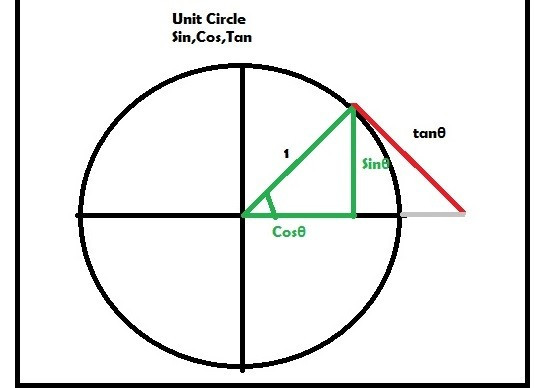
Study guide illustration

Tangent on the unit circle

In the diagram, the green right triangle shows why tan⁡θ=sin⁡θcos⁡θ\tan\theta=\dfrac{\sin\theta}{\cos\theta}. The red segment is another common unit-circle picture for tangent.

A few things come straight from that definition:

  • If cos⁡θ=0\cos\theta=0, the run is 00, so the ray is vertical and tangent is undefined.
  • The sign comes from the signs of sine and cosine:
    • Quadrant I: + ⁣/ ⁣+=++\!/\!+=+
    • Quadrant II: + ⁣/ ⁣−=−+\!/\!-= -
    • Quadrant III: − ⁣/ ⁣−=+-\!/\!-=+
    • Quadrant IV: − ⁣/ ⁣+=−-\!/\!+=-
  • The right-triangle memory aid opposite over adjacent still works, but the unit-circle definition works in all four quadrants.

The Parent Tangent Graph

The parent function is y=tan⁡θy=\tan\theta.

Three anchor values are worth knowing cold:

  • tan⁡(−π4)=−1\tan\left(-\frac{\pi}{4}\right)=-1
  • tan⁡(0)=0\tan(0)=0
  • tan⁡(π4)=1\tan\left(\frac{\pi}{4}\right)=1

One basic branch lives on (−π2,π2)\left(-\frac{\pi}{2},\frac{\pi}{2}\right). As θ\theta moves left to right there, the graph rises from very negative to very positive. The full graph just repeats that pattern every π\pi, and these three anchor points show up in the center branch.
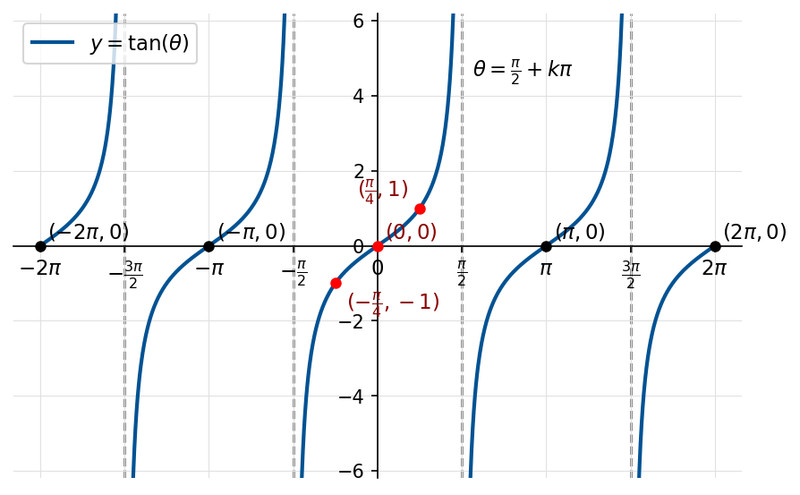
Key facts that get tested a lot:

  • Vertical asymptotes at θ=π2+kπ\theta=\frac{\pi}{2}+k\pi
  • Period is π\pi, not 2π2\pi
  • Domain excludes θ=π2+kπ\theta=\frac{\pi}{2}+k\pi
  • Range is all real numbers
  • Zeros at θ=kπ\theta=k\pi, so intercepts are (kπ,0)(k\pi,0)
  • Odd symmetry: tan⁡(−θ)=−tan⁡θ\tan(-\theta)=-\tan\theta
  • Increasing on each interval between consecutive asymptotes
  • Concavity
    • down on (−π2+kπ,kπ)\left(-\frac{\pi}{2}+k\pi,k\pi\right)
    • up on (kπ,π2+kπ)\left(k\pi,\frac{\pi}{2}+k\pi\right)
  • Inflection points at (kπ,0)(k\pi,0)
  • No amplitude, no maximum, no minimum

Transformations of Tangent

The general form is

y=atan⁡(b(θ+c))+d y=a\tan(b(\theta+c))+d

Each parameter changes a different feature:

  • aa changes vertical stretch/compression by factor ∣a∣|a|
    • if a<0a<0, reflect across the xx-axis
    • ∣a∣|a| is not amplitude
  • bb changes horizontal stretch/compression by factor 1∣b∣\frac{1}{|b|}
    • new period is π∣b∣\frac{\pi}{|b|}
    • if b<0b<0, reflect across the yy-axis
  • cc gives phase shift of −c-c
    • positive cc means left
    • negative cc means right
  • dd shifts the graph up or down
    • the inflection-point line becomes y=dy=d

That line y=dy=d matters, but it is not an asymptote and it is not a sine/cosine midline.

Graphing and Reading y=atan⁡(b(θ+c))+dy=a\tan(b(\theta+c))+d

Use the inner input u=b(θ+c)u=b(\theta+c). Parent tangent is built around these key inputs:

  1. u=−π2u=-\frac{\pi}{2} and u=π2u=\frac{\pi}{2} give vertical asymptotes
  2. u=0u=0 gives the inflection point
  3. u=±π4u=\pm\frac{\pi}{4} give anchor points with outputs d−ad-a and d+ad+a

Then solve each equation for θ\theta to place the features.

Important formulas:

  • Asymptotes from b(θ+c)=π2+kπb(\theta+c)=\frac{\pi}{2}+k\pi
  • Inflection points at (−c+kπb, d)\left(-c+\frac{k\pi}{b},\,d\right)

Branch behavior:

  • If ab>0ab>0, each branch is increasing
  • If ab<0ab<0, each branch is decreasing
  • If b<0b<0, the parent key-input order reverses left to right

Common Exam Mistakes

  • Using 2π2\pi as the period instead of π\pi
  • Saying tangent has amplitude or a midline
  • Forgetting tangent is undefined where cos⁡θ=0\cos\theta=0
  • Treating an asymptote as part of the graph or saying tangent “equals infinity”
  • Reading phase shift from an unfactored input like tan⁡(2θ−π/3)\tan(2\theta-\pi/3) instead of rewriting it as tan⁡(2(θ−π/6))\tan\left(2\left(\theta-\pi/6\right)\right)
  • Saying the graph decreases across an asymptote instead of analyzing one branch at a time

Key Takeaways

Tangent is the slope of the terminal ray, so tan⁡θ=sin⁡θcos⁡θ\tan\theta=\frac{\sin\theta}{\cos\theta} when cos⁡θ≠0\cos\theta\ne 0.
Tangent repeats every π\pi, which is why its period is π\pi for the parent function.
Vertical asymptotes happen where cos⁡θ=0\cos\theta=0, at θ=π2+kπ\theta=\frac{\pi}{2}+k\pi.
The zeros of tangent are at θ=kπ\theta=k\pi, and those are also the parent inflection points.
For y=atan⁡(b(θ+c))+dy=a\tan(b(\theta+c))+d, the period is π∣b∣\frac{\pi}{|b|}, not 2π∣b∣\frac{2\pi}{|b|}.
The line y=dy=d contains the inflection points, but it is not an asymptote and not an amplitude-based midline.
If the inside is not factored, you cannot read the phase shift correctly until you rewrite it.

AP® is a trademark registered by the College Board, which is not affiliated with, and does not endorse this website.

Notes

1 credit used · 5/5 remaining