5m left·0%
Reading Time: 5 min
Last Updated: August 20, 2026
Main Ideas: 5
Reading Time: 5 min
Last Updated: August 20, 2026
Main Ideas: 5

Topic 3.12 Notes – Equivalent Representations of Trigonometric Functions

Verified for 2027 AP® Precalculus Exam
Read aloud
Equivalent trigonometric forms are expressions that look different but give the same value wherever both are defined. In this topic, you use a small set of core identities to rewrite trig expressions so you can simplify, evaluate exact values, verify identities, or solve equations and inequalities more cleanly.

What Equivalent Trigonometric Forms Are

Two trig expressions are equivalent when they match on their common domain. That domain part matters. Some rewrites introduce restrictions.

The whole point of rewriting is to make something easier to see, like:

  • a constant, such as sin⁡2θ+cos⁡2θ=1\sin^2\theta+\cos^2\theta=1
  • one trig function instead of two
  • a factorable or quadratic form
  • exact values at awkward angles
  • amplitude or range

The main source identities are

sin⁡2θ+cos⁡2θ=1 \sin^2\theta+\cos^2\theta=1

sin⁡(α+β)=sin⁡αcos⁡β+cos⁡αsin⁡β \sin(\alpha+\beta)=\sin\alpha\cos\beta+\cos\alpha\sin\beta

cos⁡(α+β)=cos⁡αcos⁡β−sin⁡αsin⁡β \cos(\alpha+\beta)=\cos\alpha\cos\beta-\sin\alpha\sin\beta

A quick notation reminder. sin⁡2θ\sin^2\theta means (sin⁡θ)2(\sin\theta)^2, not sin⁡(θ2)\sin(\theta^2).

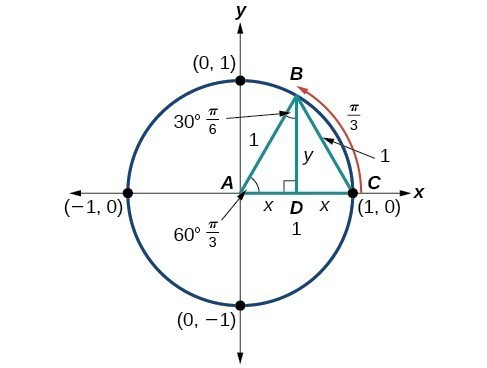
On the unit circle, a point (x,y)(x,y) gives cos⁡θ=x\cos\theta=x and sin⁡θ=y\sin\theta=y, so the right triangle in the diagram leads directly to the Pythagorean identity.
Study guide illustration

Unit circle triangle and Pythagorean identity

The difference and double-angle identities come from the sum identities, so this is one connected system, not a random formula list.

Identities You Should Be Ready to Generate and Use

From the Pythagorean identity, you should be able to swap mixed squares for 11, or isolate one square:

  • sin⁡2θ=1−cos⁡2θ\sin^2\theta=1-\cos^2\theta
  • cos⁡2θ=1−sin⁡2θ\cos^2\theta=1-\sin^2\theta
  • tan⁡2θ+1=sec⁡2θ\tan^2\theta+1=\sec^2\theta when cos⁡θ≠0\cos\theta\ne0
  • 1+cot⁡2θ=csc⁡2θ1+\cot^2\theta=\csc^2\theta when sin⁡θ≠0\sin\theta\ne0

If sin⁡θ=x\sin\theta=x, then

cos⁡θ=±1−x2 \cos\theta=\pm\sqrt{1-x^2}

The sign depends on the quadrant or given interval.

From the sum identities, you get:

  • Difference identities
    • sin⁡(α−β)=sin⁡αcos⁡β−cos⁡αsin⁡β\sin(\alpha-\beta)=\sin\alpha\cos\beta-\cos\alpha\sin\beta
    • cos⁡(α−β)=cos⁡αcos⁡β+sin⁡αsin⁡β\cos(\alpha-\beta)=\cos\alpha\cos\beta+\sin\alpha\sin\beta
    • sin⁡(π2−θ)=cos⁡θ\sin\left(\frac{\pi}{2}-\theta\right)=\cos\theta, cos⁡(π2−θ)=sin⁡θ\cos\left(\frac{\pi}{2}-\theta\right)=\sin\theta
  • Double-angle identities
    • sin⁡(2α)=2sin⁡αcos⁡α\sin(2\alpha)=2\sin\alpha\cos\alpha
    • cos⁡(2α)=cos⁡2α−sin⁡2α=1−2sin⁡2α=2cos⁡2α−1\cos(2\alpha)=\cos^2\alpha-\sin^2\alpha=1-2\sin^2\alpha=2\cos^2\alpha-1
  • Power-reduction identities
    • sin⁡2α=1−cos⁡(2α)2\sin^2\alpha=\dfrac{1-\cos(2\alpha)}{2}
    • cos⁡2α=1+cos⁡(2α)2\cos^2\alpha=\dfrac{1+\cos(2\alpha)}{2}

Exact-value example. Since 75∘=45∘+30∘75^\circ=45^\circ+30^\circ,

sin⁡75∘=6+24 \sin 75^\circ=\frac{\sqrt6+\sqrt2}{4}

and the same idea works for 5π/12=π/4+π/65\pi/12=\pi/4+\pi/6.

A derived identity you may see is the tangent sum identity:

tan⁡(α+β)=tan⁡α+tan⁡β1−tan⁡αtan⁡β \tan(\alpha+\beta)=\frac{\tan\alpha+\tan\beta}{1-\tan\alpha\tan\beta}

Also know how to combine Asin⁡θ+Bcos⁡θA\sin\theta+B\cos\theta into one sinusoid:

Asin⁡θ+Bcos⁡θ=Rsin⁡(θ+ϕ),R=A2+B2 A\sin\theta+B\cos\theta=R\sin(\theta+\phi), \quad R=\sqrt{A^2+B^2}

This is great for reading amplitude and range quickly.

Choosing the Best Rewrite

Ask what form makes the goal easiest.

  • If you see sin⁡2θ+cos⁡2θ\sin^2\theta+\cos^2\theta, turn it into 11.
  • If everything else is in sine, use cos⁡(2θ)=1−2sin⁡2θ\cos(2\theta)=1-2\sin^2\theta.
  • If everything else is in cosine, use cos⁡(2θ)=2cos⁡2θ−1\cos(2\theta)=2\cos^2\theta-1.
  • If the angle is weird like 75∘75^\circ, use sum or difference identities.
  • If you have Asin⁡θ+Bcos⁡θA\sin\theta+B\cos\theta, combine into one sinusoid with R=A2+B2R=\sqrt{A^2+B^2}.

A good rewrite can reveal zeros, extrema, range, or a solvable quadratic.

Verifying Identities and Solving Equations

Verifying identities

Work from one side only, usually the messier side, until it becomes the other side.

Useful moves:

  1. rewrite everything in sine and cosine
  2. use Pythagorean or double-angle identities
  3. factor or get common denominators
  4. keep domain restrictions in mind

Solving equations and inequalities

Rewrite first, then solve the easier form.

For cos⁡(2θ)=sin⁡θ\cos(2\theta)=\sin\theta on 0≤θ<2π0\le\theta<2\pi:

1−2sin⁡2θ=sin⁡θ 1-2\sin^2\theta=\sin\theta

2sin⁡2θ+sin⁡θ−1=0 2\sin^2\theta+\sin\theta-1=0

(2sin⁡θ−1)(sin⁡θ+1)=0 (2\sin\theta-1)(\sin\theta+1)=0

So sin⁡θ=12\sin\theta=\frac12 or sin⁡θ=−1\sin\theta=-1, giving

θ=π6, 5π6, 3π2 \theta=\frac{\pi}{6},\ \frac{5\pi}{6},\ \frac{3\pi}{2}

For cos⁡(2θ)≤0\cos(2\theta)\le0 on 0≤θ<2π0\le\theta<2\pi, use the unit circle or cosine graph to get

θ∈[π4,3π4]∪[5π4,7π4] \theta\in\left[\frac{\pi}{4},\frac{3\pi}{4}\right]\cup\left[\frac{5\pi}{4},\frac{7\pi}{4}\right]

Common Mistakes and Domain Traps

  • sin⁡(α+β)≠sin⁡α+sin⁡β\sin(\alpha+\beta)\ne\sin\alpha+\sin\beta and cos⁡(α+β)≠cos⁡α+cos⁡β\cos(\alpha+\beta)\ne\cos\alpha+\cos\beta
  • Square roots need ±\pm, unless the interval fixes the sign.
  • tan⁡,sec⁡\tan,\sec need cos⁡θ≠0\cos\theta\ne0. cot⁡,csc⁡\cot,\csc need sin⁡θ≠0\sin\theta\ne0.
  • Canceling a factor that could be zero can lose solutions.
  • Squaring or multiplying can create extraneous solutions, so check in the original equation.
  • Two expressions may agree only on a restricted common domain.
  • Exact-value work falls apart if you mix degrees and radians.

Key Takeaways

The identity sin⁡2θ+cos⁡2θ=1\sin^2\theta+\cos^2\theta=1 comes from the unit circle point (cos⁡θ,sin⁡θ)(\cos\theta,\sin\theta).
The best form of cos⁡(2θ)\cos(2\theta) depends on what else is in the problem.
If you recover cos⁡θ\cos\theta from sin⁡θ\sin\theta, use cos⁡θ=±1−sin⁡2θ\cos\theta=\pm\sqrt{1-\sin^2\theta} and choose the sign from the quadrant.
Verifying an identity means rewriting one side into the other on their common domain.
Asin⁡θ+Bcos⁡θA\sin\theta+B\cos\theta can be rewritten as one sinusoid using R=A2+B2R=\sqrt{A^2+B^2}, which makes amplitude and range easy to see.
Domain restrictions matter anytime you divide, cancel, use reciprocal trig functions, or work with inverse trig.

AP® is a trademark registered by the College Board, which is not affiliated with, and does not endorse this website.

Notes

1 credit used · 5/5 remaining