6m left·0%
Reading Time: 6 min
Last Updated: September 7, 2026
Main Ideas: 5
Reading Time: 6 min
Last Updated: September 7, 2026
Main Ideas: 5

Topic 4.10 Notes – Matrices

Verified for 2027 AP® Precalculus Exam
Read aloud
Matrices are rectangular arrays of numbers, and this topic is about one main job they do: multiplying to combine information. The heart of it is knowing when a product is defined, how the row-by-column process works, and why the order of multiplication changes everything.

What Matrices Are

A matrix is a rectangular array of values arranged in rows and columns. If a matrix has 2 rows and 3 columns, its dimensions are 2×32\times 3. Rows come first.

A=[4−16203] A=\begin{bmatrix} 4 & -1 & 6\\ 2 & 0 & 3 \end{bmatrix}

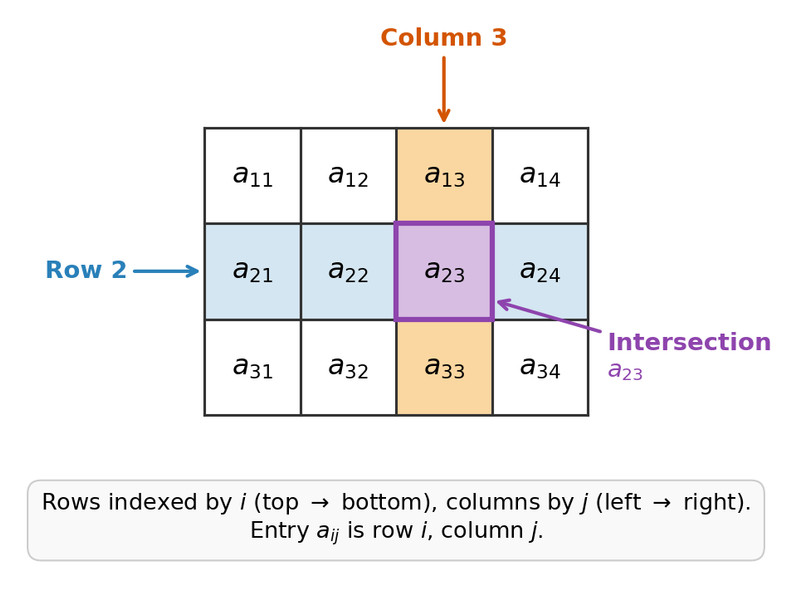
Here, AA is 2×32\times 3. An entry is named by position. In aija_{ij}, ii is the row and jj is the column, so a12=−1a_{12}=-1 and a23=3a_{23}=3.

Matrix entries by row and column position

The diagram shows the indexing convention you'll use throughout this unit. aija_{ij} means row ii, column jj.

Quick recognition types:

  • Row matrix has one row, like [25−1]\begin{bmatrix} 2 & 5 & -1 \end{bmatrix}
  • Column matrix has one column, like [3−47]\begin{bmatrix} 3 \\ -4 \\ 7 \end{bmatrix}
  • Square matrix has the same number of rows and columns, like 3×33\times 3

A column can also represent a vector. That matters because matrix multiplication uses dot products, which means multiplying matching entries and adding.

When a Matrix Product Is Defined

For matrices with sizes n×mn\times m and m×pm\times p, the product is defined:

(n×m)(m×p)→n×p (n\times m)(m\times p)\to n\times p

Two things to remember:

  • Inner dimensions must match. Those are the middle numbers.
  • Outer dimensions give the size of the product.

Why? Each entry in the product comes from one row of the first matrix and one column of the second. Those must have the same number of entries to form a dot product.

Examples:

ProductDefined?Result size
(4×2)(2×5)(4\times 2)(2\times 5)Yes4×54\times 5
(4×2)(3×5)(4\times 2)(3\times 5)Noundefined
(2×3)(2×3)(2\times 3)(2\times 3)Noundefined

A common mistake is checking the outer dimensions instead of the inner ones.

How to Multiply Matrices

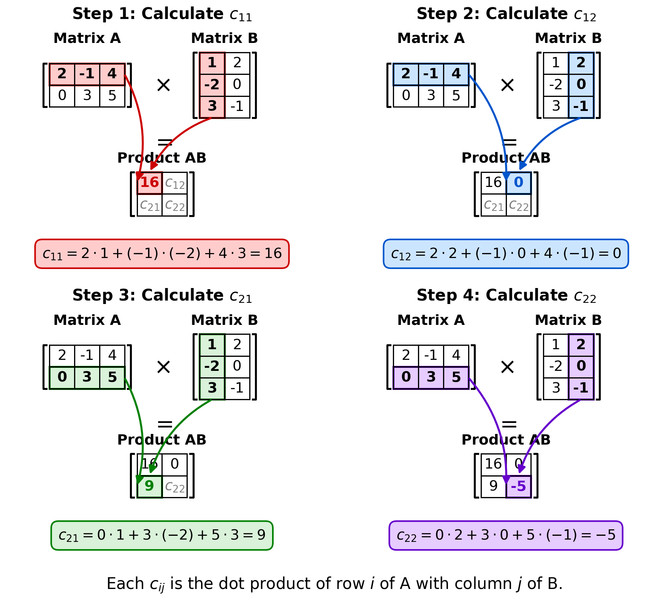
The rule is row by column. If C=ABC=AB, then entry cijc_{ij} comes from row ii of AA and column jj of BB.

cij=ai1b1j+ai2b2j+⋯+aimbmj c_{ij}=a_{i1}b_{1j}+a_{i2}b_{2j}+\cdots+a_{im}b_{mj}

That formula just says “take a dot product.”

Worked example

A=[2−14035],B=[12−203−1] A=\begin{bmatrix} 2 & -1 & 4\\ 0 & 3 & 5 \end{bmatrix}, \qquad B=\begin{bmatrix} 1 & 2\\ -2 & 0\\ 3 & -1 \end{bmatrix}

AA is 2×32\times 3, BB is 3×23\times 2, so ABAB is 2×22\times 2.

Here are the four dot products that fill the entries of ABAB.

c11=2(1)+(−1)(−2)+4(3)=16 c_{11}=2(1)+(-1)(-2)+4(3)=16 c12=2(2)+(−1)(0)+4(−1)=0 c_{12}=2(2)+(-1)(0)+4(-1)=0 c21=0(1)+3(−2)+5(3)=9 c_{21}=0(1)+3(-2)+5(3)=9 c22=0(2)+3(0)+5(−1)=−5 c_{22}=0(2)+3(0)+5(-1)=-5

So

AB=[1609−5] AB=\begin{bmatrix} 16 & 0\\ 9 & -5 \end{bmatrix}

The location matters. Row 2 with column 1 goes in entry (2,1)(2,1). This is not entry-by-entry multiplication.

Order Matters in Matrix Multiplication

With matrices AA and BB, three things can happen:

  • both ABAB and BABA exist
  • one exists and the other does not
  • both are undefined

In general,

AB≠BA AB\ne BA

Example with both defined:

A=[1201],B=[2031] A=\begin{bmatrix}1&2\\0&1\end{bmatrix},\quad B=\begin{bmatrix}2&0\\3&1\end{bmatrix}

Then AB=[8231]AB=\begin{bmatrix}8&2\\3&1\end{bmatrix} but BA=[2437]BA=\begin{bmatrix}2&4\\3&7\end{bmatrix}. Same sizes, different answers.

If AA is 2×32\times 3 and BB is 3×43\times 4, then ABAB is defined but BABA is undefined.

On a quiz or FRQ, keep the order exactly as written.

Interpreting Matrix Products and Avoiding Mistakes

A matrix product often means “combine categories into totals.”

If

Q=[12857109] Q=\begin{bmatrix} 12 & 8 & 5\\ 7 & 10 & 9 \end{bmatrix}

is quantities sold at two locations for three products, and

p=[324] p=\begin{bmatrix} 3\\ 2\\ 4 \end{bmatrix}

is the price column, then

Qp=[7277] Qp=\begin{bmatrix} 72\\ 77 \end{bmatrix}

That 2×12\times 1 result means one total revenue for each of the two locations.

Technology follows the same rules. A dimension error means the product is undefined.

Common mistakes:

  • writing dimensions backward
  • checking outer instead of inner dimensions
  • giving the wrong product size
  • multiplying entry by entry
  • putting a correct dot product in the wrong spot
  • assuming AB=BAAB=BA or that BABA must exist if ABAB does

Key Takeaways

A matrix with dimensions n×mn\times m has nn rows and mm columns, in that order.
The product (n×m)(m×p)(n\times m)(m\times p) is defined and has size n×pn\times p.
Each entry of a product matrix is a row-by-column dot product, not entry-by-entry multiplication.
In cijc_{ij}, the row number comes from the first matrix and the column number comes from the second.
Two matrices can have the same dimensions and still be impossible to multiply, like (2×3)(2×3)(2\times 3)(2\times 3).
Even when both products exist, ABAB and BABA usually give different answers.
In context, the dimensions of the result tell you what the outputs represent, such as 2×12\times 1 meaning one total for each of two locations.

AP® is a trademark registered by the College Board, which is not affiliated with, and does not endorse this website.

Notes

1 credit used · 5/5 remaining