Topic 4.3 Notes – Parametric Functions and Rates of Change
What Parametric Motion Tells You
A parametric planar motion has the form . As increases, the point moves through the plane.
The path in the -plane tells you where the particle can go. The parametrization tells you more than that:
- the order points are reached
- the direction of motion
- whether the particle repeats a point
- how the motion changes as increases
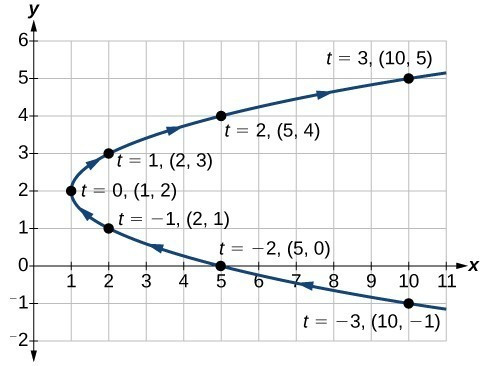
In the graph below, the labeled -values and arrows show that the same curve carries extra information about how the particle travels along it.
You read horizontal and vertical motion separately:
- If increases, the particle moves right.
- If decreases, it moves left.
- If increases, it moves up.
- If decreases, it moves down.
Put those together and you get overall motion such as right/up or left/down.
A few special cases show up a lot:
- Constant means no horizontal motion on that interval.
- Constant means no vertical motion on that interval.
- A turning value in one component means the motion reverses in that coordinate.
Reading Direction from Equations, Tables, and Graphs
From equations
You look for where and are increasing, decreasing, or constant. Turning values split the parameter interval into pieces.
Example: decreases then increases, and decreases then increases. That means the particle changes horizontal direction at one -value and vertical direction at another.
From tables
Read the rows in increasing order. That part gets missed a lot.
- Compare consecutive -values to decide left or right.
- Compare consecutive -values to decide up or down.
- If the successive differences change sign, the direction changes.
From graphs of vs. and vs.
- A rising graph means right.
- A falling graph means left.
- A rising graph means up.
- A falling graph means down.
From the path in the -plane
The curve alone does not tell direction unless arrows or parameter values are shown. A common test trap is treating the picture of the curve as if it tells you how the particle moved.
Same Point or Same Curve Does Not Mean Same Motion
A particle can pass through the same point at different -values and move differently each time. Direction depends on the parametrized motion, not just the coordinates.
Three quick examples belong together:
- Repeated point on one parametrization
A particle might hit at two different times, moving left/down once and right/up later. - Same curve, opposite directions
and trace the same parabola but in reverse directions. - Same direction, different rate
Replacing with can keep the same path and direction but change how fast the parameter moves through it.
Average Rates of Change and Secant Slope
Over to , average change is computed for each component separately:
These give net change per unit of parameter, not every twist and turn in between.
- Positive average -rate means net right.
- Negative average -rate means net left.
- Positive average -rate means net up.
- Negative average -rate means net down.
The slope between the two endpoint positions is
That is also the ratio of the two average component rates. If and use the same unit, the slope is unitless. The component rates still have units.
Reversing the order of the same two parameter values does not change the secant slope.
What Students Mix Up
- Average rate of change tells net change over an interval. It does not mean the component kept moving one way the whole time.
- A zero average horizontal rate can still happen when the particle moved right, then left, and came back.
- If , the secant line is vertical, so its slope is undefined.
- If both coordinate changes are zero, the particle returned to the same point, so there is no secant line between two distinct points.
- The unmarked Cartesian curve does not tell motion direction.
- The slope of the secant line between two points is not the same thing as the particle’s direction throughout the interval.
