4m left·0%
Reading Time: 4 min
Last Updated: September 10, 2026
Main Ideas: 4
Reading Time: 4 min
Last Updated: September 10, 2026
Main Ideas: 4

Topic 4.13 Notes – Matrices as Functions

Verified for 2027 AP® Precalculus Exam
Read aloud
Matrices in this topic are functions that take vectors in the plane and send them to new vectors. You’re connecting three views of the same idea: a matrix, a coordinate rule, and a geometric picture of what happens to points, vectors, and area.

What a Matrix Transformation Is

A 2×22\times2 matrix can act on a vector in R2\mathbb R^2. If

A=[a11a12a21a22]andv=[xy], A=\begin{bmatrix}a_{11}&a_{12}\\a_{21}&a_{22}\end{bmatrix} \quad\text{and}\quad \mathbf v=\begin{bmatrix}x\\y\end{bmatrix},

then the transformation is

L(v)=Av L(\mathbf v)=A\mathbf v

which means

(x,y)↦(a11x+a12y,  a21x+a22y). (x,y)\mapsto (a_{11}x+a_{12}y,\;a_{21}x+a_{22}y).

So these are all the same transformation:

  • the matrix AA
  • the rule (x,y)↦(…,… )(x,y)\mapsto(\dots,\dots)
  • a verbal description like “stretch, reflect, or rotate vectors”

A quick example:

  • L(x,y)=(2x−3y,  x+4y)L(x,y)=(2x-3y,\;x+4y)
  • matrix form is [2−314]\begin{bmatrix}2&-3\\1&4\end{bmatrix}

The input vector is the preimage. The output is the image.

A linear transformation has no constant term. That means the origin stays fixed:

  • linear: (x,y)↦(2x−y,  x+3y)(x,y)\mapsto(2x-y,\;x+3y)
  • not linear: (x,y)↦(2x−y+4,  x+3y)(x,y)\mapsto(2x-y+4,\;x+3y)

That +4+4 shifts points, so it is outside this AP topic.

Unit Vectors, Columns, and Key Geometric Meaning

The whole matrix is determined by what it does to the standard unit vectors

e1=[10],e2=[01]. \mathbf e_1=\begin{bmatrix}1\\0\end{bmatrix}, \qquad \mathbf e_2=\begin{bmatrix}0\\1\end{bmatrix}.

Every vector can be written as xe1+ye2x\mathbf e_1+y\mathbf e_2, so

L(x,y)=xL(e1)+yL(e2). L(x,y)=xL(\mathbf e_1)+yL(\mathbf e_2).

That is why:

  • first column =L(e1)=L(\mathbf e_1)
  • second column =L(e2)=L(\mathbf e_2)

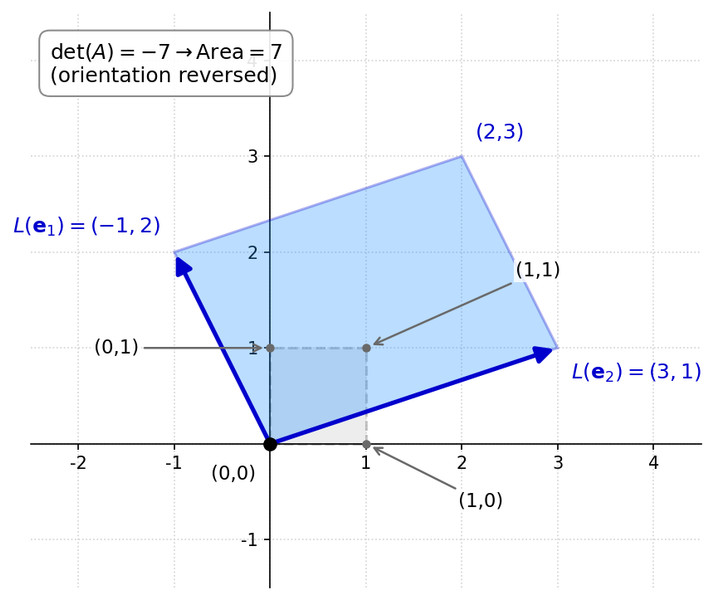
If L(e1)=[−12]L(\mathbf e_1)=\begin{bmatrix}-1\\2\end{bmatrix} and L(e2)=[31]L(\mathbf e_2)=\begin{bmatrix}3\\1\end{bmatrix}, then

A=[−1321]. A=\begin{bmatrix}-1&3\\2&1\end{bmatrix}.

Common mistake: putting those images in rows. They go in columns.

In the diagram, those two column vectors create the image of the unit square as a parallelogram.
That picture leads straight to rotations and determinants.

Rotation matrices

A counterclockwise rotation by angle θ\theta uses

[cos⁡θ−sin⁡θsin⁡θcos⁡θ]. \begin{bmatrix}\cos\theta&-\sin\theta\\ \sin\theta&\cos\theta\end{bmatrix}.

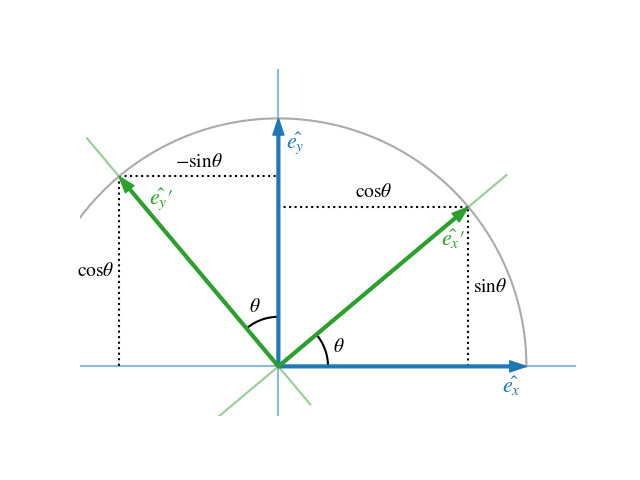
Its unit-vector images are

  • e1↦(cos⁡θ,sin⁡θ)\mathbf e_1\mapsto(\cos\theta,\sin\theta)
  • e2↦(−sin⁡θ,cos⁡θ)\mathbf e_2\mapsto(-\sin\theta,\cos\theta)

The rotation diagram tracks exactly those two images of the basis vectors.
Study guide illustration

So any vector follows the rule

(x,y)↦(xcos⁡θ−ysin⁡θ,  xsin⁡θ+ycos⁡θ). (x,y)\mapsto(x\cos\theta-y\sin\theta,\;x\sin\theta+y\cos\theta).

Clockwise by θ\theta is counterclockwise by −θ-\theta. On tests, students often miss the negative sign in the upper-right entry.

Determinant as Area Change and Invertibility

For A=[abcd]A=\begin{bmatrix}a&b\\c&d\end{bmatrix},

det⁡(A)=ad−bc. \det(A)=ad-bc.

The absolute value tells you the area scale factor:

  • ∣det⁡(A)∣>1|\det(A)|>1 area increases
  • 0<∣det⁡(A)∣<10<|\det(A)|<1 area decreases
  • ∣det⁡(A)∣=1|\det(A)|=1 area stays the same
  • det⁡(A)=0\det(A)=0 area collapses to 00
  • det⁡(A)<0\det(A)<0 orientation reverses

This connects to the unit-square picture because the image parallelogram has area ∣det⁡(A)∣|\det(A)|.

One trap here: area preserved does not mean length preserved. A matrix with determinant 11 is not automatically a rotation.

Composition and Inverse Transformations

If F(v)=AvF(\mathbf v)=A\mathbf v and G(v)=BvG(\mathbf v)=B\mathbf v, then

(G∘F)(v)=(BA)v. (G\circ F)(\mathbf v)=(BA)\mathbf v.

The matrix on the right happens first. That is the order issue students lose points on most often.

To build a composition from words:

  1. Identify which transformation happens first.
  2. Write each matrix.
  3. Multiply in composition order.
  4. Use the product on the vector if needed.

Since matrix multiplication is usually not commutative, AB≠BAAB\ne BA.

The identity transformation leaves every vector alone:

I=[1001]. I=\begin{bmatrix}1&0\\0&1\end{bmatrix}.

An inverse transformation undoes a matrix transformation. If L(v)=AvL(\mathbf v)=A\mathbf v, then

  • L−1(v)=A−1vL^{-1}(\mathbf v)=A^{-1}\mathbf v when AA is invertible
  • invertible exactly when det⁡(A)≠0\det(A)\ne 0

A rotation’s inverse is rotation by −θ-\theta. If det⁡(A)=0\det(A)=0, information is lost, so no inverse exists.

Key Takeaways

The columns of a matrix are the images of e1\mathbf e_1 and e2\mathbf e_2, in that order.
A linear transformation in this topic always keeps the origin fixed.
The rule for composition is (G∘F)(v)=(BA)v(G\circ F)(\mathbf v)=(BA)\mathbf v, so the first transformation is on the right.
The determinant gives area change through ∣det⁡(A)∣|\det(A)|, not length change.
A matrix has an inverse exactly when det⁡(A)≠0\det(A)\neq 0.
For rotations, remember [cos⁡θ−sin⁡θsin⁡θcos⁡θ]\begin{bmatrix}\cos\theta&-\sin\theta\\ \sin\theta&\cos\theta\end{bmatrix} and watch the sign in the upper-right entry.

AP® is a trademark registered by the College Board, which is not affiliated with, and does not endorse this website.

Notes

1 credit used · 5/5 remaining